
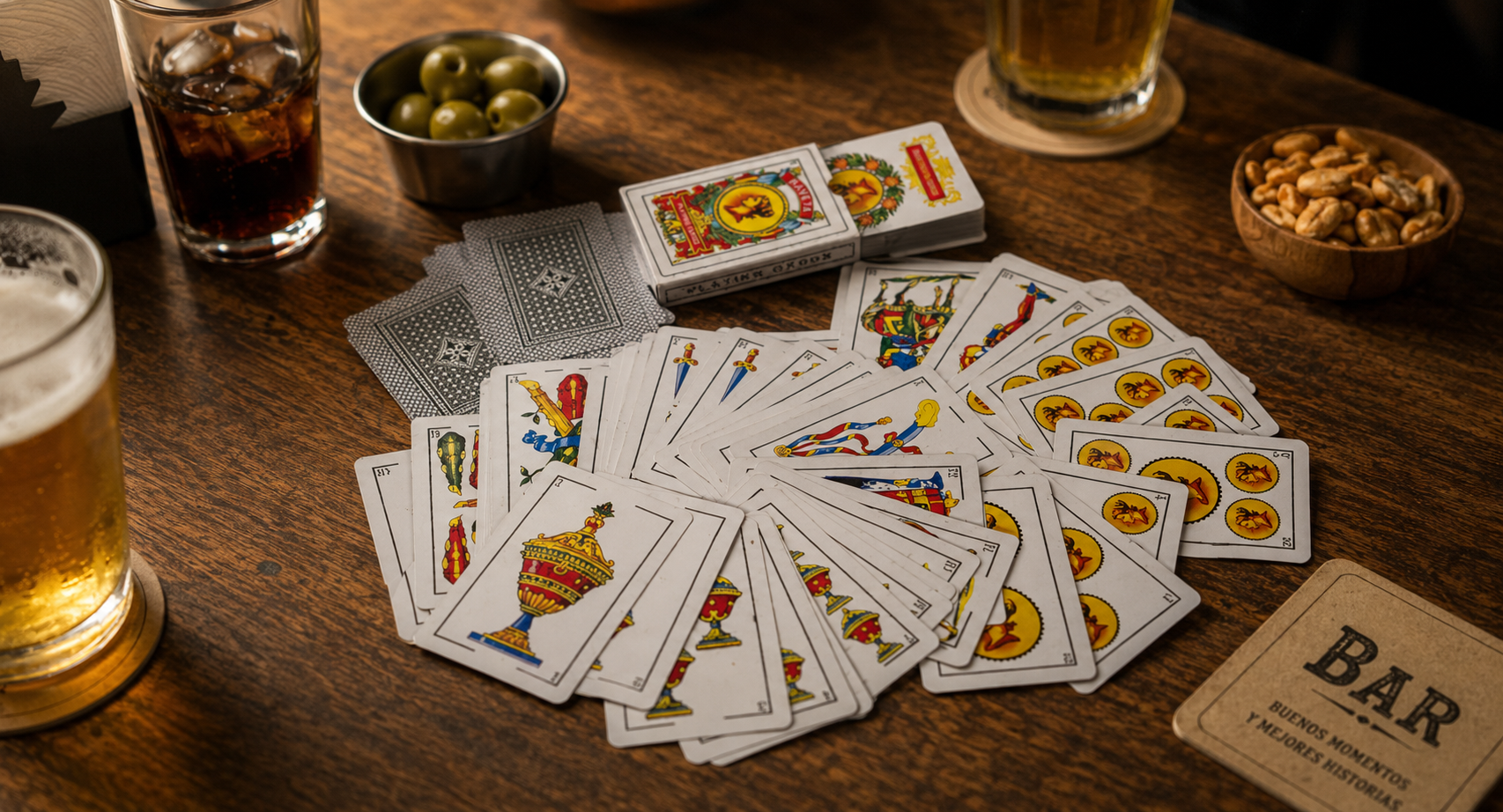
Spanish deck: complete guide | History, suits, games and patterns
Complete guide to the Spanish deck: documented origin, Latin suits, sota-caballo-rey (page-knight-king), 40/48 cards, Castilian and Catalan patterns, classic games.
Coins, cups, swords and clubs: the Spanish deck is a Latin-suit card system with over six centuries of history. Origin, suits, classic games and regional patterns.
The Spanish deck — the most widespread Latin-suit card system in the Spanish-speaking world — has 40 or 48 cards, four suits (coins/oros, cups/copas, swords/espadas and clubs/bastos) and three court cards per suit (sota, caballo, rey: page, knight, king). It has no Queen; it never had one in the classic pattern. It's the playing tool for mus, brisca, tute, guiñote and many other trick-taking games across the Iberian Peninsula and the Americas. This guide sums up what it is, where it comes from, how it's structured and which pattern fits each use.
In this guide
Documented origin
The Spanish deck was not invented in Spain: the "naipe" (playing card) arrived from Mamluk Egypt around the last quarter of the 14th century, and Mamluk decks themselves traced back to the Chinese sphere (no cheap paper, no playing cards). What was forged in the Iberian Peninsula was the design of the Latin suits and their iconography. The earliest documented mentions on Spanish soil are early and concrete:
- 1371 — The word naip appears in the rhyming dictionary of Valencian poet Jaume March.
- 1380 — The trade of naipero (card maker) is already established as a guild.
- 1382 — Barcelona's exchange bans card games.
- 1384 — Valencia's council bans «un novell joch apellat dels naips» ("a new game called of the cards").
The word "naipe" comes from the Arabic nā'ib, one of the court-card ranks in the Mamluk deck. The full history, with the Mamluk link and the consolidation of patterns, is in history of the Spanish deck.
The four Latin suits
| Suit | Origin | French equivalent |
|---|---|---|
| Coins (oros) | Gold coins, heirs of the Chinese-Islamic discs | Diamonds ♦ |
| Cups (copas) | Already in the Islamic suite before reaching Europe | Hearts ♥ |
| Swords (espadas) | Straight (not curved scimitars like the original) | Spades ♠ |
| Clubs (bastos) | Knotty cudgels, not ceremonial staves | Clubs ♣ |
The association with medieval social estates (clergy, nobility, commerce, peasantry) is a later cultural interpretation, not a fact documented by the designers. The only firm thing is the material genealogy. More detail in suits of the poker deck, where the correspondences with the French system are laid out.
40, 48 or 50 cards
There's no single canonical configuration. Each game carves its own:
- 48 cards — Nine number cards (1–9) plus three court cards per suit. The "complete" deck.
- 40 cards — The "trimmed" version: eights and nines removed. The most common today for mus, brisca or tute. This pruning became popular with ombre in the 17th and 18th centuries.
- 50 cards — The 48 plus two jokers. The joker is a modern, American addition, foreign to the original Latin design.
Page, knight and king
Three court cards per suit:
- Sota (page) — page or squire; functionally equivalent to the French jack/valet.
- Caballo (knight) — a mounted rider; the distinctive figure of Latin decks.
- Rey (king) — the crowned figure of highest rank.
The big absence vs the French deck is the queen. The Spanish deck kept the medieval knight exactly where the French one placed a queen. It's not that cards are missing: the hierarchy is simply different.
The "pinta": a Spanish design touch
Around the mid-17th century, the pinta appeared: cuts in the outer border of the card that let you identify the suit without opening the fan entirely. Zero cuts = coins, 1 = cups, 2 = swords, 3 = clubs. Hence the Spanish saying "lo conocí por la pinta" (I knew it by the pinta). It's the Spanish solution to the same problem the French would solve centuries later with corner indices.
Regional patterns
| Pattern | Features | Region |
|---|---|---|
| Castilian (Fournier, 1889) | Dagger-like straight swords, red cups, bearded kings, full-body figures | Dominant in Spain and export markets |
| National / old Catalan | Kings with long tunics reaching the pinta (17th c.) | Still present in North Africa and Ecuador |
| Modern Catalan | Egg-cup shaped cups, yellow and green | Second most widespread in Spain |
| Madrid / Seville | No pinta, no indices | Extinct by the 18th century |
The industrialisation of the Spanish deck was fixed by Heraclio Fournier in Vitoria between 1875 and 1877, with Emilio Soubrier and Ignacio Díaz Olano. The mature 1889 version won a bronze medal at the Paris Universal Exposition and became the de-facto standard in half the Hispanic world thanks to industrial and commercial reach.
Classic games
- Mus — a team game with signs and spoken bidding; emblem of Spanish sociability.
- Tute and brisca — classic family trick-taking games.
- Guiñote — popular Aragonese variant of tute.
- Chinchón — combinations, with run and three-of-a-kind as goal.
- Truco — a passion of the River Plate region in Argentina and Uruguay, with its folklore of permitted bluffing.
- Cuarenta — national game of Ecuador.
Which to choose and where
For home use (mus, brisca, tute), a Castilian 40-card deck, card stock with clear pinta is the most versatile option. If yours is collecting or gifting, reissues of historical patterns (old Catalan, national) carry added heritage value. To care for any deck, see how to care for playing cards.
Contact our team for any clarification about this document. Contact us


