

How to do a jigsaw puzzle: step-by-step technique
How to do a jigsaw puzzle of 500 to 5,000 pieces step by step: setting up, sorting pieces, building the frame, grouping by area and filling the hard parts.
Assembling a puzzle is not just fitting pieces: there is method. The step-by-step protocol for puzzles from 500 to 5000 pieces, with the logic behind each step.
Anyone who has been doing puzzles for years does not do it randomly. There is an order that multiplies speed and reduces frustration, especially in large pieces (1500+). This guide sums up the method used by experienced puzzlers, with the logic of why it works, not just the "what to do". If you have ever got stuck on a uniform sky or water zone, here is why and how to avoid it.
The method
1. Space setup
Before opening the box, prepare the environment. A bad setup ruins a good puzzle:
- Surface: stable table, big enough for the puzzle plus extra space to sort pieces. If you will assemble over several days, consider a dedicated puzzle board (rolling mat or rigid board) that lets you remove the puzzle without dismantling it.
- Lighting: overhead, white, no direct shadows. Good light cuts visual fatigue in half and speeds up detail recognition.
- Trays or boxes to sort: egg cartons, shoe lids, IKEA Trofast trays work. The important thing is having 6-8 containers to separate pieces by colour/zone.
- Reference image visible: the box standing nearby. If your sight is tired or the image small, print an A4 enlarged version.
2. Initial separation
Pour all the pieces on the table and flip them so they all face up. This takes 10-15 minutes in a 1000-piece, but it is invested time: if you skip this step, you will lose more time flipping pieces one by one while searching.
As you flip, make two piles:
- Borders (pieces with a straight side)
- Corners (two straight sides): only four
Leave the rest spread out on the table.
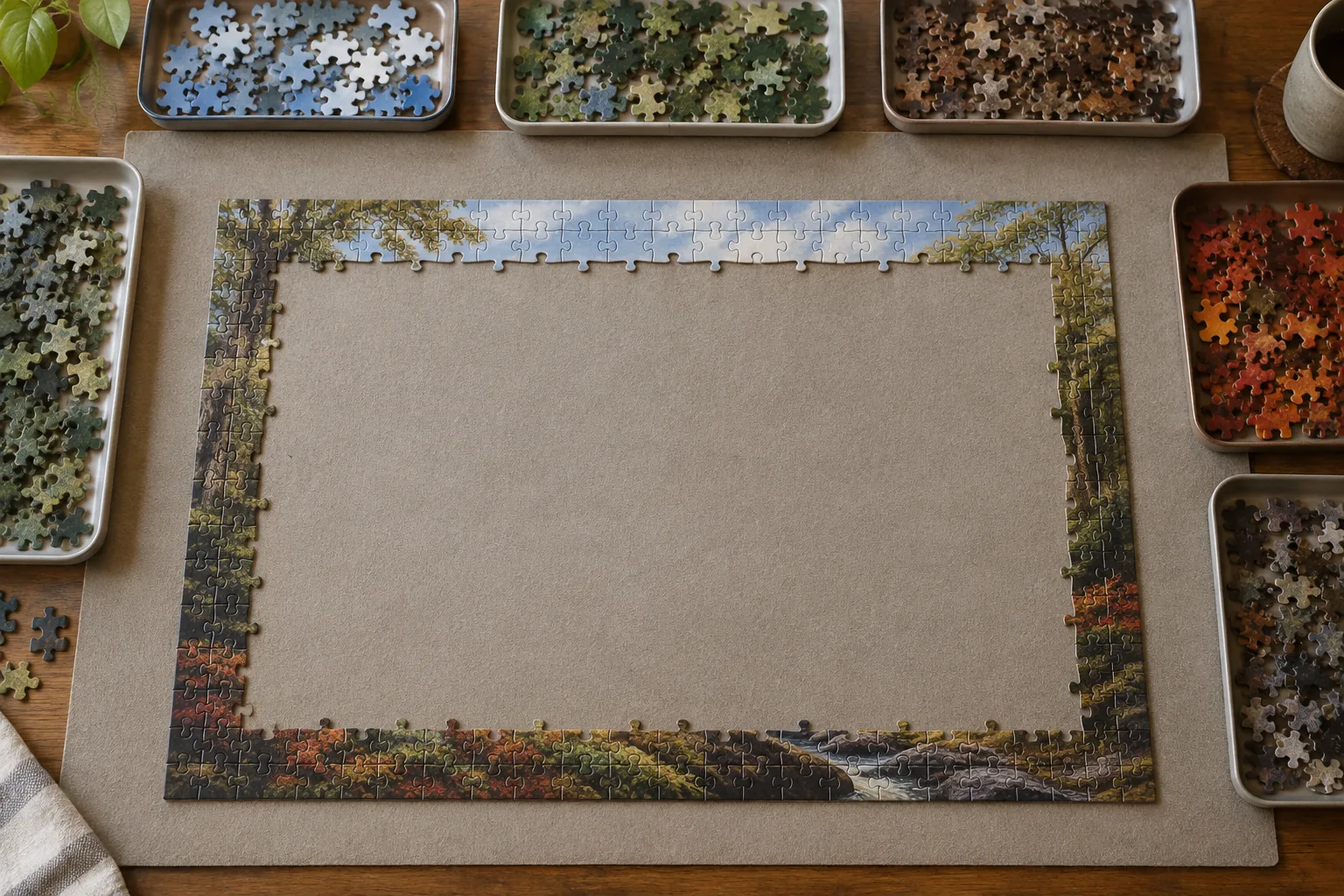
3. Frame first, always
Assemble the frame (borders + corners) before anything else. Reasons:
- Defines the real dimensions of the puzzle. From there you know where each zone goes.
- It is the fastest and most satisfying part. Borders are only ~120 pieces in a 1000, and they fit fast because there are fewer options.
- It gives visual references for the sky, ground, right, left corners.
Single exception: puzzles with "all sky" or "all water" frames where the border is uniform and very difficult to assemble by trial. There it is better to advance inwards first until you have recognisable zones touching the border.
4. Group by colour and zone
With the frame assembled, separate the remaining pieces by dominant colour or identifiable element. Examples:
- All pieces with blue sky → "sky" tray
- All with tree green → "vegetation" tray
- All with a recognisable detail (a face, a sign) → its own tray
The criterion is not perfectionist: it is enough order. If a piece has sky + roof, leave it in the tray where it is most useful. What matters is reducing the search space: when you are assembling the sky, you only look at 200 pieces instead of 800.
5. Assemble by "islands"
Identify in the image differentiated elements and assemble them as separate islands. Classic examples:
- A face or character
- A house, a building
- A sign with legible text
- A car, a unique object
Advantage: each island is a small puzzle with pieces of unique colours and patterns, much faster than advancing through the uniform sky. Once islands are assembled, you "float" them on the table and connect them with the fills.
Trick: if the puzzle has legible text, that is the first point to look for. Words divide the pieces into very few options.
6. Uniform fills at the end
Sky, water, white walls, single-colour floor: they are the fills. Always leave them for the end.
Reasons:
- When fills are all that is left, you have frame + islands as reference. Sky pieces fit in specific gaps, it is no longer "this blue piece could go in a thousand places".
- Starting with the sky of a 1500-piece puzzle is the fast route to giving up. An hour moving blue pieces without anything fitting is demoralising.
- When you get to the fills at the end, you are already in shape recognising die-cut shapes, not just colours. That helps a lot in uniform zones.
Trick for large fills: group the pieces not only by colour but by die-cut shape (pieces with 4 ins, 4 outs, 2+2, 3+1...). In a pure blue sky, the die-cut is what differentiates one piece from another.
Brain teasers for all ages
Metal, wood and plastic puzzles, from those solved in minutes to those that take weeks.
 QiYi Kong Ming Lock Tic Tac Toe Rompecabezas
 Puzzle Hanayama Huzzle Cast: Amour
 Professor Puzzle: Metal and Wood - Franklin's
 Professor Puzzle: Set of 3 ( Halley,Galileo and Kepler)
When you are stuck
There will come a moment in every puzzle (especially 1500+) when you spend 20 minutes without fitting anything. It is normal. Strategies:
- Change zone. If you have been on the sky for a while, jump to assembling the floor or a detail.
- Rest 15 minutes. Visual fatigue makes you stop seeing differences between similar pieces. A pause "resets" the eye.
- Look at the puzzle from another angle. Standing up and seeing it from the side sometimes reveals a gap you did not see from the front.
- Re-sort. If trays are messy, you spend more time searching.
- Accept that tomorrow you advance more. Frustration makes the brain clumsy; a puzzle assembles better relaxed than fighting it.
Specific tips by size
| Size | Typical time | Key tips |
|---|---|---|
| 500 | 4-8h | No board; normal table. One or two sessions. |
| 1000 | 8-20h | Trays to sort. Board useful if you want to put aside. |
| 1500 | 15-30h | Board recommended. Daily 1h sessions. |
| 2000-3000 | 30-80h | Board needed. 2-4 weeks at casual pace. |
| 5000+ | 100h+ | Table dedicated only to this. Good lighting needed. |
| 10,000+ | 250h+ | Over 5 m long; multi-month project. Only for very keen. |
Typical mistakes that can be avoided
- Forcing pieces. If it does not fit with soft pressure, it is not the piece. Forcing damages the die-cut and the correct one will not fit later.
- Mixing the floor with the sky in the same tray. Sorting is half the work well done.
- Starting from the centre instead of the frame. You are left without references.
- Working with little light. Visual fatigue slows you down doubly.
- Comparing your progress with a YouTube timelapse. Timelapses are 10h of work in 2 minutes. Your real speed is perfectly normal.
Frequently asked questions
How long does a 1000-piece puzzle take?
Between 8 and 20 hours for someone with average experience. Depends a lot on the image (a landscape with lots of sky takes longer than a collage of differentiated objects) and on available time.
Better to start with the frame or the centre?
Frame first, unless the border is uniform (all sky). The frame gives the dimensions and references for everything else.
How do I preserve a finished puzzle?
Puzzle glue (Ravensburger Conserver, Educa Fix Puzzle) applied with spatula or sponge on the finished surface. Let dry 24h on the board. Then it can be moved or framed.
Is a puzzle board worth it?
For 1500+ pieces or if you will assemble several throughout the year, yes. It lets you remove the puzzle without dismantling it and protects pieces during long sessions.
Why can't I find the correct piece?
Almost always visual fatigue. Rest 15 minutes and come back. If it still doesn't appear after resting, check the sorting: the piece may be in the wrong tray.
Brain Teaser Puzzles
QiYi Blossom Lock Kong Ming Plastic Puzzle

QiYi Kong Ming Lock Ball

Ball in the Cage - Caged ball Kong Ming puzzle
QiYi Kong Ming Lock Three Connection Big Triple

QiYi Luban Sphere Kong Ming Lock 65mm ABS

QiYi Kong Ming Lock Twenty-four Locks
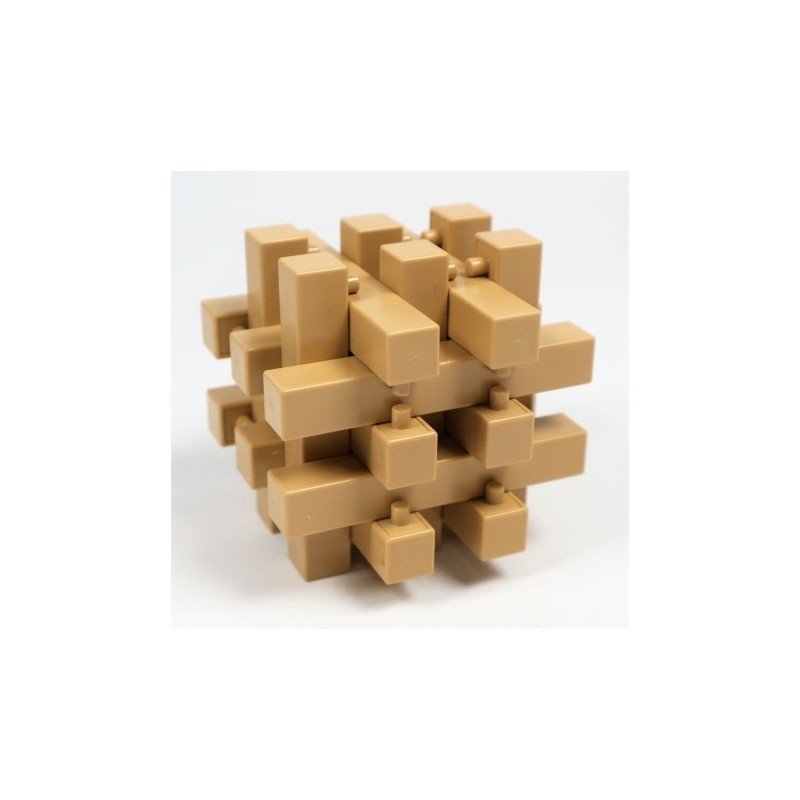
QiYi Kong Ming The 18 Arhats 8003 71mm ABS
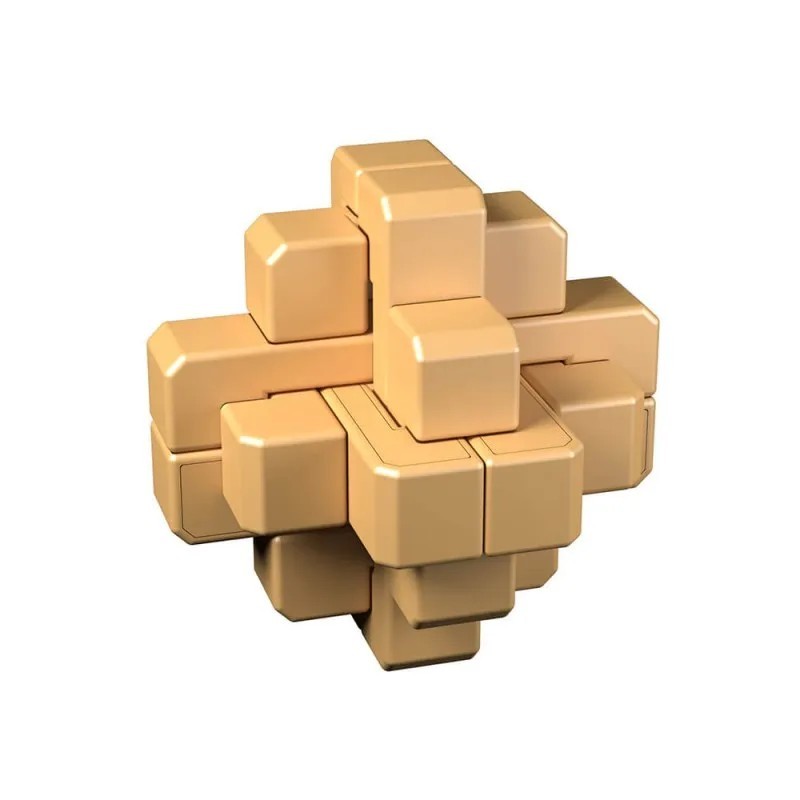
QiYi Kong Ming Lock Blockade
Contact our team for any clarification about this document. Contact us


