
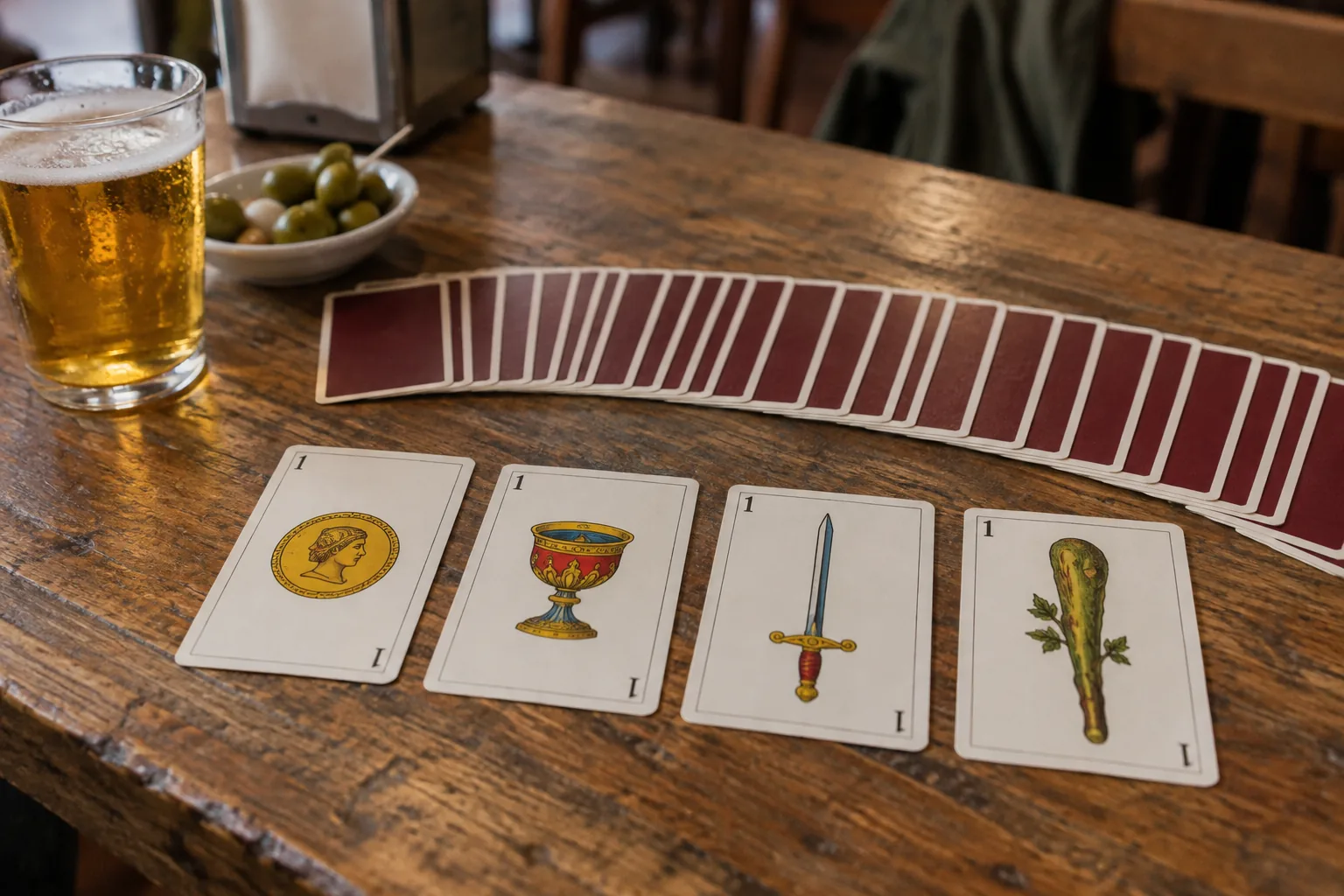
Spanish deck games: mus, tute, brisca, guiñote and more
The classic Spanish deck games: mus, tute, brisca, guiñote, chinchón, truco and cuarenta. Rules, number of players, difficulty and advice on which to learn first.
The Spanish deck is the playing tool for games like mus, tute, brisca or guiñote. Basic rules, number of players, difficulty and where to start.
The Spanish deck sustains an entire family of games, some centuries old, with well-established rules and big followings. This guide summarises the main ones: what they are, how they are played in essence, how many people are needed, what difficulty they have, and where to start if you have never played. It does not replace a rules manual (each game deserves its deep explanation), but it gives you the map to decide what to learn first.
Mus
Probably the most characteristic game of the Spanish deck and definitely the most social. Played in pairs (four players), with 40 cards and a system of spoken bidding that gives rise to bluffs, signals between partners and lots of verbal exchange.
- Players: 4 (two pairs).
- Cards: 40 (without 8 or 9).
- Difficulty: medium-high to master; basic rules are learned in one game, but strategy and signals require practice.
- Duration: 30-90 min per game.
Structure: four phases (Grande, Chica, Pares, Juego), in each one points are bid until a pair "sees" or "throws". Cards are dealt 4 per player; you can "mus" (discard and draw) until someone says "no hay mus" and bidding starts.
Signals between partners: agreed beforehand (e.g. biting the lip = I have two kings, wink = duples), they are part of the game. It's not cheating: it's the mechanic.
Variants: "mus a la una" counts plays at score, "mus puro" or "vasco" has slightly different rules. Each region has its nuance.
Tute
Trick-taking game with trumps. Can be played by 2 to 4 people, in individual or pairs version.
- Players: 2-4.
- Cards: 40 (without 8 or 9).
- Difficulty: medium. Rules learned in 1-2 games; strategy requires a bit more.
- Duration: 20-45 min.
8 cards are dealt per player and the card defining the trump suit is uncovered. Each player throws a card per trick; whoever throws the highest of the opening suit or a higher trump wins. There are points for cards (Ace=11, Three=10, King=4, Knight=3, Page=2) and for "tute" (announcing King and Knight of the same suit) or "cuarenta" (King and Knight of trump).
Variants: tute habanero, tute cabrón, tute subastado (with prior bidding). Each one with its particularities.
Brisca
The "starting game" par excellence. Simple, fast, ideal to teach children and to play while chatting.
- Players: 2-4 (better with 2 or 4 in pairs).
- Cards: 40.
- Difficulty: low.
- Duration: 10-20 min.
3 cards are dealt per player and the trump is uncovered. Each turn you throw a card and draw another from the deck (while there are some). Whoever wins each trick takes the cards to score points at the end. Strategy consists of not "burning" your best cards (Ace and Three) on lost tricks and reserving trumps for final points.
Did you know decks like these exist?
At heart, every deck has the same cards. What changes is everything else: the design, the finish, metallic inks or gilded edges. Take a look at our catalogue and bring your own style to the card table.
Browse our playing cards →




Guiñote
Regional variant of tute, very popular in Aragón. Has its own nuances that make it recognisable.
- Players: 4 (two pairs).
- Cards: 40.
- Difficulty: medium.
- Duration: 30-60 min.
Similar structure to tute in pairs, but with specific rules: mandatory drag in some situations, "cantes" with different value and the possibility of "renuncia" (when you don't have the requested suit). It's a game with strong cultural component in Aragón.
Chinchón
Combination game, not trick-taking. It's about making runs and triples of the same suit or number to discard all cards and win.
- Players: 2-8.
- Cards: 48 (with 8 and 9).
- Difficulty: low-medium.
- Duration: 20-40 min per hand; a game can go to 100 points.
7 cards are dealt per player. On your turn you draw a card (from the deck or discard pile) and discard another. Goal: combine the 7 into runs (3+ consecutive cards of same suit) or triples (3 of same number of different suit). The "chinchón" is the maximum play: run of 7 cards of same suit, wins automatically.
Escoba (or escoba de 15)
Trick-taking game with sums. Focuses on making "escobas" by summing exactly 15 with cards from the table.
- Players: 2-4.
- Cards: 40.
- Difficulty: low.
- Duration: 15-30 min.
3 cards are dealt to each player and 4 on the table. On each turn, you throw a card from your hand and, if the sum with some card(s) on the table equals exactly 15 (Page=8, Knight=9, King=10), you collect them. If you clear the whole table, it's "escoba" (1 extra point). At the end cards and "sevens of coins" (the two of coins is especially valuable) are counted for points. Very good to play with children because it practises sums.
Truco
River Plate version of trick-taking game with Spanish deck, very popular in Argentina, Uruguay and parts of Brazil. Has a unique theatrical component: lying is allowed and each bid is "sung".
- Players: 2, 4 or 6 (pairs).
- Cards: 40 (without 8, 9 or jokers in the classic version).
- Difficulty: medium-high. Rules learned quickly, but the "psychological game" requires experience.
- Duration: 30-60 min.
Each player receives 3 cards. There's own hierarchy (Ace of swords is the highest card, then Ace of clubs, 7 of swords, 7 of coins, and then the rest in order). Three rounds: wins whoever takes two. During rounds you can "envidar" (truco, retruco, vale cuatro) or "envido" (al tanto). Distinctive: you can make signals with partners and, when bidding, drop "I believe and go" or "I don't believe, I don't see".
Cuarenta
National game of Ecuador. Played with Spanish deck but with its own rules.
- Players: 2 or 4 (pairs).
- Cards: 40 (without 8, 9 or jokers).
- Difficulty: medium.
- Duration: 30-60 min.
5 cards are dealt per player. There are "caídas" (playing a card of the same number as the last one on the table to collect it), "rondas" (playing a card of the same number as the previous one of your own caída), and "limpia" (emptying the table). First to reach 40 points wins. Important in Ecuadorian culture and still played a lot in families and gatherings.
Where to start
| If... | Start with |
|---|---|
| You want the simplest | Brisca |
| You're going to play with children | Escoba or Brisca |
| You want the most social | Mus (need a partner) |
| You want combination game | Chinchón |
| You're looking for strategic challenge | Tute or Truco |
| You're Aragonese or want to be | Guiñote |
| You live in River Plate | Truco |
| You live in Ecuador | Cuarenta |
Universal rules many share
- Follow the opening suit: in trick games, you must throw a card of the suit played first if you have it; if not, you can trump or discard.
- The Ace is 1 but usually has the highest hierarchy: in mus, tute, brisca, worth more than the King.
- The Three is the second highest card in many games, an important peculiarity of the Spanish deck.
- Face cards score little in games like brisca and tute (King=4, Knight=3, Page=2 points only).
How much does a deck of cards cost?
From €5 to over €100. The 52 cards and the rules stay the same; this is what changes.
 To play€5.95 To play€5.95 |  Designer€12.95 Designer€12.95 |  Premium€17.99 Premium€17.99 |  Collectible€34.94 Collectible€34.94 | |
|---|---|---|---|---|
| Typical price | €5-9 | €9-15 | €15-30 | €30 or more |
| What sets it apart | Classic casino design | Artist illustration on back and faces | Special inks, embossing and foil on the box | Limited print runs and gilded edges |
| Who it is for | Games at home | Playing with something beautiful | Gifts or cardistry | Collecting and display |
| Example | Tally-Ho Fan Azul | theory11 Medallion | The Sandwich Series (Luncheon Meat) | Kings Wild LOTR Two Towers Gilded |
| See decks | See decks | See decks | See decks |
Frequently asked questions
How many cards does the Spanish deck have for mus?
40 cards: 1 to 7 plus Page, Knight and King of each suit. 8, 9 and jokers removed.
Can mus be played with 3 people?
No: mus is essentially a pairs game, requires 4.
What's the easiest game to start with?
Brisca, without a doubt. Simple rules, short games, intuitive mechanics. Ideal for children and to teach someone who has never touched Spanish cards.
Is making signals in mus cheating?
It's not cheating, it's part of the game. Partners agree their signals beforehand.
What deck do I need for these games?
A standard 40-card Spanish deck (Castilian Fournier pattern is most common). For chinchón you need 48 cards. Brands: Fournier, Cartamundi, Naipes Comas.
Playing Cards

Gemini Casino Phthalo Green – Playing Cards

Premier Edition Restricted Red – Playing Cards

Premier Edition Jet Black Private Reserve – Playing Cards

Card Mafia One Piece Robin – Playing Cards

Lounge Edition Terminal Turquoise – Playing Cards

Lounge Edition Taxiway Yellow – Playing Cards

Cardistry Fanning Yellow Edition – Playing Cards

Tally-Ho Gaff – Playing Cards
Contact our team for any clarification about this document. Contact us


