
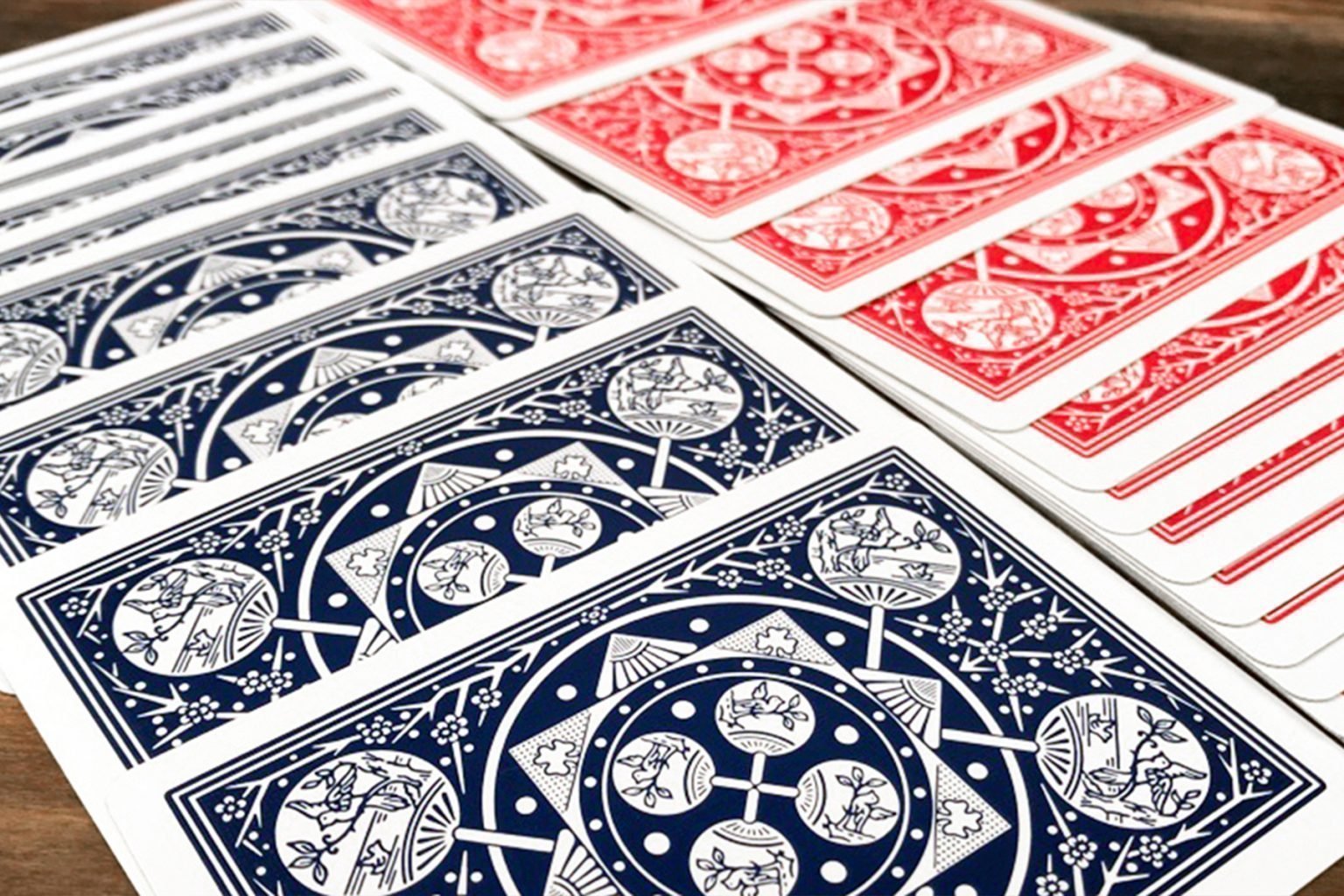
Bicycle vs Theory11 vs Tally-Ho: the truth, no myths
They come out of the same factory. We compare Bicycle, Theory11 and Tally-Ho by stock, crushed, finish, cut, durability and price so you choose with criteria.
All three are printed at USPCC. The real difference is not in the brand: it is in the stock, the crushed, the finish and the cut. We explain it without marketing.
I'll start by breaking the debate in half: if you think Theory11 is "from another, much better factory" than Bicycle, you are buying a myth. Bicycle, Tally-Ho and Theory11 come out of the same industrial plant —the United States Playing Card Company—, with the same paper, the same machines and, often, even the same person adjusting the rollers. What changes between them is not a factory secret: it is a short and very concrete list of technical decisions (which stock, whether it is pressed or not, which cut, which finish) that anyone can learn to read. And when you read them well, you choose better and stop overpaying.
I have cross-referenced what the forums that really call the shots say —theory11.com/forums, UnitedCardists— with the technical analyses of PlayingCardDecks and Bicycle's official documentation. The conclusion bothers the purists of both brands. If you still doubt even the format, pass through which deck of cards to buy first; if you want the full family map, look at types of playing card decks.
The fact almost nobody tells you well: the factory is the same
Bicycle and Tally-Ho are brands owned by USPCC. Theory11 is an independent company that commissions its printing from USPCC. All three share the same industrial supplier. This doesn't make them identical —the ordered stock, the finish and each client's quality control vary— but it does explain a phrase repeated to exhaustion in the forums: "they're much more alike than people think". A veteran UnitedCardists user sums it up mercilessly: two USPCC decks of the same model can handle differently from each other, because USPCC does not guarantee consistency between runs. Keep that idea: it comes back further down and it changes everything.
A brief history of each brand (no legends)
- USPCC: founded in Cincinnati in 1867 as Russell, Morgan & Co. (they started printing circus posters, not playing cards). Card production starts around 1881; in 1885 the Bicycle brand is born. The business is reorganized in 1894 as The United States Playing Card Company. Since 2019 it is a subsidiary of the Belgian Cartamundi; it produces in Erlanger (Kentucky) and at the Fournier plant in Vitoria (Spain).
- Bicycle (1885): the most recognizable paper deck on the planet and the only early USPCC brand in continuous use. The famous "808" that appears next to the cyclists is just a catalogue reference —like Bee's 92 or the 606—, with no Masonic or esoteric meaning. It is one of the most stubborn myths in the hobby.
- Tally-Ho (1885): born the same year as Bicycle but from the hand of Andrew Dougherty, another historic maker. USPCC absorbs Dougherty in 1907 and integrates Tally-Ho. Its two cult backs are the Fan Back and the Circle Back (concentric circles).
- Theory11 (2007): founded by Jonathan "JB" Bayme with a group of magicians and artists. It started as an online magic collective and shifted into a designer-deck brand: embossed boxes, foiling, numbered editions and big licenses (Star Wars, James Bond, Marvel). Its hallmark is the premium presentation —and a quality control that the forums consistently rate highly—.
Here is 80% of the difference: stock, crushed, finish and cut
Forget the brand for a moment. A USPCC deck is defined by four technical decisions. Master them and you'll read any deck like a technician, not like a blind buyer.
1. The stock (the paper): four options, not two
The usual myth says "there is Bicycle stock and Bee stock". Half false. USPCC actually offers four combinations, because either of the two base papers can additionally go through the Thin-Crush process:
- Retail / Classic (standard Bicycle): the classic paper. Balanced, cheap, ubiquitous. From the factory it tends to be a bit slippery and appreciates breaking in.
- Premium / Bee Casino (no. 92): casino grade. The forums describe it as somewhat thicker, stiffer and more durable than standard Bicycle; it needs more break-in but withstands brutal dealing. On UnitedCardists there is consensus that "Bee is perceptibly stiffer".
- Crushed Retail: the pressed Classic. Thinner, softer and faster in response.
- Crushed Premium: the pressed Bee. The hallmark of the Bicycle Elite Edition; many magic professionals switched to it precisely because of this.
Classic Tally-Ho is usually printed on crushed stock: that's why that soft feel that cardists and fingertip magic love so much. It is not black magic: it is pressed paper.
2. The crushed: what it really is (you'll be amazed how simple it is)
Here comes the fact almost nobody explains well and that shows how much marketing there is in this. The Thin-Crush process is not a special paper or a secret recipe: USPCC simply squeezes the rollers a bit tighter that emboss the linen texture into the card. That's all. Same card, tighter rollers, more compressed and thinner paper.
How much does it thin? PlayingCardDecks measures it in a very trade-specific unit —"cards of thickness"—: a deck of pressed Premium is about 3-4 cards thinner than unpressed Premium; pressed Retail, another 3-4 cards thinner still; and pressed Classic is the thinnest of all, about 3-4 cards below its normal version. Practical result: crushed feels "broken in" straight out of the box —soft, flexible, no click— in exchange for being more slippery and wearing out sooner. A deal that delights cardists and some magicians, and that table-game people don't need at all.
3. The finish: Air-Cushion, Linoid and Cambric are the SAME finish
Repeat it with me: Air-Cushion (Bicycle), Linoid (Tally-Ho) and Cambric (Bee) are today the same micro-relief process with three commercial names inherited from when they were different brands. There is no superior "Tally-Ho" texturing. What cardists perceive as "the Tally-Ho glides better" doesn't come from the name of the finish: it comes from that deck usually being on crushed stock. Confusing the finish with the stock is the number-one technical mistake in the hobby.
4. The cut: traditional vs modern (and why it matters for the faro)
When USPCC cuts the sheet into cards, the angle of the edge falls to one side. There are two cuts:
- Traditional cut (face-to-back): allows you to do a face-down faro with a freshly opened deck. Quite a few magicians prefer it for this.
- Modern cut (back-to-face): the USPCC standard since the 1980s. The clean faro comes out first in the other direction.
With use, the edges round off and the deck ends up faroing both ways —part of what break-in "fixes" is exactly this—. You have it step by step in how to care for playing card decks.
The hidden factor: the coating
There is a fifth nuance few look at: the coating. USPCC handles a Magic Finish (more slippery, developed around 2011) and a standard finish that is somewhat less slippery —the latter, according to PlayingCardDecks, only for large runs (from about 15,000 units)—. That is why a short-run designer edition and a mass-production Rider Back can feel different even though they "share stock": the coating is not the same and it wears off with use.
Comparison table
| Criterion | Bicycle (Rider Back) | Theory11 | Tally-Ho |
|---|---|---|---|
| Factory | USPCC (own) | USPCC (commissioned) | USPCC (own) |
| Origin | 1885 | 2007 | 1885 (Dougherty; to USPCC in 1907) |
| Typical stock | Retail / Bee casino (Premium) | Premium or crushed, high QC | Crushed (pressed Classic) |
| Finish | Air-Cushion | Air-Cushion (same process) | Linoid (same process) |
| Feel | Balanced, somewhat slippery from the factory | Good snap, "tuned" handling, high QC | Soft and fast from the box |
| Durability | Good; very high in casino stock | Good, varies by edition | Medium: crushed wears out sooner |
| Indicative price | 3-5 € (Rider Back) | 8-15 € (premium presentation) | 5-8 € |
| Ideal for | Magic, practice, daily play | Collecting, gifting, stage | Cardistry, fingertip work |
Honest note: prices swing by edition, import and print run; take them as an order of magnitude, not a price list. And remember the between-batch consistency: the table describes tendencies, not physical laws.
Suitability by use (with criteria, not by trend)
Close-up card magic
The Bicycle Rider Back is the de facto standard of the teaching material for card magic: cheap, available and with a back most effects take for granted. That reduces surprises: a trick described "for Rider Back" works with your Rider Back. Theory11 comes in when you perform in front of an audience and want an impeccable presentation —the perceived quality of the object influences how the effect is received; it's not vanity, it's performance psychology—. Tally-Ho appeals to those who do a lot of double turnovers and fine threading because of its soft crushed-stock feel.
Cardistry
For flourishes, the historical pattern is the Tally-Ho Circle Back and geometric backs like the Theory11 Monarchs, for two real technical reasons: crushed stock (soft, responds quickly in springs and dribbles) and a symmetrical back (it doesn't break the illusion in cuts and fans on camera). Bicycle works perfectly well if you choose a symmetrical back from its catalogue and break it in; what it lacks from the factory is the crushed feel, which arrives with the break-in. If you're starting out, prioritize a symmetrical back and snap, not the brand: we develop this in cardistry for beginners.
Table play (poker, home game)
For a home poker game, durability and price rule. Here the Bee casino stock is the silent king: stiffer, more durable, designed to deal thousands of hands. A standard Bicycle also does the job more than well. Theory11 is playable, but you pay for presentation a weekly game doesn't take advantage of —and crushed, which wears out sooner, is exactly what you don't want for intensive play—.
Collecting
Theory11 territory: numbered runs, foiling, embossed boxes, movie licenses. Bicycle and Tally-Ho have cult editions, but the "collectible designer deck" ecosystem is where Theory11 stands out. Look at our collector decks and the premium ones; if foil or gilded editions come your way, their conservation is another sport: we explain it in how to care for playing card decks.
Video cardistry and competition
If you film or compete, three nuances that are not marketing come in: back symmetry (a directional back breaks the reading in cuts on camera), face contrast (large indices and saturated color "read" better in compressed video) and stock response (that stiff-soft middle ground that holds aerials and displays). The Tally-Ho Circle Back and several geometric Theory11 decks come up repeatedly for these three concrete reasons, not by reputation.
Stage magic vs close-up
In close-up, a recognizable back and fine glide rule: the Rider Back is the pattern the material assumes. In stage and parlor mentalism, where the audience doesn't touch the deck, presentation weighs: a Theory11 with a careful box raises the "perceived value" of the game. The technical difference between the two decks may be minimal; the difference in stage impact is not.
The elephant in the room: what about "custom" designer decks?
Many people who arrive at this debate believe the next step after Bicycle is a hideously expensive "custom" deck that will handle better. Bad news for your wallet, good for your judgement: most designer decks are printed at USPCC on the same stock as a Rider Back and, with equal stock and finish, they handle practically the same. What you pay extra for is artwork, a luxury box, foiling and a limited run —not performance—. PlayingCardDecks says it bluntly: a custom "performs and handles the same" as a standard Bicycle when the stock matches.
This has a brutal practical implication: if your goal is pure handling (training cardistry, practice magic), the extra money for a custom is aesthetics, not technique. The custom makes sense if you perform and the deck is part of the show, if you collect, or if a specific back solves a visual problem for you on camera. For everything else, a broken-in Rider Back is the worst-kept secret in the hobby.
And a note on scale that gives perspective: USPCC is the largest playing-card maker in the US. If you lined up the Bicycle cards produced in a single year, they would go 7.5 times around the Earth. That industrial scale is exactly the reason for the (in)consistency between batches —and for the Rider Back being available in any corner of the planet, something that matters more than it seems for a magician—.
Why the Rider Back is the magic standard (it's no coincidence)
There is a technical reason and a psychological one, and it's worth separating them. The psychological: the Rider Back "looks like a perfectly ordinary deck", and that sends the spectator the message that "there's nothing weird here". An exotic or designer deck draws attention exactly where you don't want it —the spectator becomes suspicious of the object instead of enjoying the effect—. The technical/logistical: there is a gigantic ecosystem of gaff cards, marked decks and props with a Rider Back, because USPCC puts two courtesy extra cards in each deck and the pattern is universal. If your teaching material, your gaffs and your street deck share a back, everything fits without surprises. It's hard to overstate how convenient that is for anyone doing serious card magic.
How to evaluate a deck yourself (in 5 minutes, no forums)
You've read a thousand contradictory opinions. Normal: everyone judges their batch, their climate and their hand. Better than believing anyone —including me—, learn to test a deck with a short, repeatable protocol:
- Table spread: spread the deck in a long fan. Does it come out even or in jumps? It measures glide and coating consistency.
- Pressure fan: a good pressure fan reveals the stiffness of the stock and the state of the finish.
- Spring: listen and look. A clean "snap" and a regular arc indicate stock with good response; if it jams, it's slippery or dried out.
- Test faro: try to faro face down and face up. It tells you the cut (traditional vs modern) without looking at the box.
- C-flex and release: does it come back flat or stay warped? Warped from the start = bad batch or bad storage by the seller.
Do this with two decks of the same brand and model. If they feel different —and they often will—, you've just verified with your own hands the central lesson of this article: the batch matters almost as much as the brand.
Iconic editions
- Bicycle Rider Back / Standard 808: the best-selling deck in the world; the universal trade reference.
- Bicycle Elite Edition: the crushed Premium success story; mass conversion of magic professionals.
- Tally-Ho Circle Back / Fan Back: two absolute classics of cardistry and fingertip magic.
- Theory11 Monarchs: the most cited "accessible premium"; handling widely praised in forums.
- Licensed Theory11 (Star Wars, James Bond, Marvel): the engine of modern collecting.
Myths worth throwing in the bin
- "Bicycle's 808 has a hidden meaning". No: a catalogue number, just like Bee's 92 or the 606.
- "Air-Cushion, Linoid and Cambric are different finishes". Today they are the same process with inherited names.
- "Theory11 prints in a secret, better factory". It prints at USPCC; the difference is in stock, crushed, coating and quality control.
- "Crushed is a special premium paper". It is the same paper with the embossing rollers squeezed tighter. Full stop.
- "Tally-Ho always lasts longer than Bicycle". The opposite, tending to false: crushed wears out sooner; whoever wants durability goes to Bee casino.
Price and value for money
Price does not measure handling linearly. A Rider Back is one of the cheapest decks on the market and, broken in, performs for magic, play and practice almost like alternatives three times more expensive. What you pay extra on a Theory11 is design, embossed boxes, foiling, numbering and licenses: real value if you collect or perform, zero value if you just practice on the sofa. Tally-Ho sits in a middle range: a different crushed feel and a reputation among cardists for a moderate premium over Bicycle.
Practical tip: if you're serious, buy by the brick (a box of 12). The cost per deck plummets and you always have a replacement to rotate —key to not destroying your best deck—. We develop this in how to care for playing card decks.
Variability between runs: the factor that invalidates half the internet
I insist because the specialist forums never tire of repeating it: USPCC does not guarantee consistency between print runs. A Bicycle from one batch can come out stiffer or more slippery than another of the same model from another batch. Three practical consequences:
- Judging an entire brand by one deck is a statistical error. Test several before laying down the law.
- Break-in levels out a good part of those differences: a deck "bad from the factory" usually improves a lot after breaking it in.
- For professional use, many people buy a brick and "select" the ones that feel best, saving the rest for destructive practice.
That's why you should distrust categorical comparisons —including this one— that don't qualify the batch factor. The honest thing is to talk about tendencies, not dogmas.
Quick verdict
There is no universal "best": there is a best for you.
- You're starting and want a single one: Bicycle Rider Back. Cheap, available, valid for everything.
- Intensive play at home: Bicycle in Bee casino stock (durability).
- Cardistry and fingertip work: Tally-Ho Circle Back (crushed stock).
- Stage, gift or collecting: Theory11.
Whichever you buy, it performs as much from the break-in and the care as from the brand: don't skip how to care for your deck.
Buying mistakes I see over and over
- Buying Theory11 to "learn magic": you spend on presentation what you should spend on volume. To learn you want many cheap, identical decks you can destroy without guilt, not a pretty box you cherish too much to use.
- Buying crushed Tally-Ho for intensive play: crushed is what you do not want if you're going to deal thousands of hands; there you ask for Bee casino.
- Judging a brand by one deck: we've said it, but it's the king mistake. A bad experience with one batch doesn't condemn an entire brand.
- Paying the "premium" surcharge to practice at home: the handling of a broken-in Rider Back is 90% of that of almost any custom of the same stock. The other 10% is aesthetics you don't see on the sofa.
- Buying one at a time: if you're serious, a single deck is expensive per unit and leaves you with no spare. The brick is the play.
Quick decision table
| If your priority is... | Buy | Why |
|---|---|---|
| Learn magic cheap | Bicycle Rider Back brick | Teaching standard, compatible gaffs, spares |
| Durability in play | Bicycle Bee casino stock | Thicker, stiffer stock |
| Cardistry and springs | Tally-Ho Circle Back | Crushed stock + symmetrical back |
| Video / competition | Geometric Theory11 or Tally-Ho | Back symmetry and face contrast |
| Gift / stage | Theory11 | Presentation that raises perceived value |
| Collect / invest | Numbered or foil Theory11 | The most mature designer ecosystem |
What I know, what depends and what is marketing
What I know: all three are printed at USPCC; crushed is the paper with the embossing rollers squeezed tighter; Bee casino is the most durable stock; Air-Cushion/Linoid/Cambric are today the same process; with equal stock, a custom handles like a Rider Back.
What depends: which deck "feels better" depends on the batch, the climate, the break-in and your handling. Your hand is one more variable.
What is marketing: the finish names, part of the "premium" aura of designer editions and the idea that the brand matters more than the stock.
Low-commitment recommendation: buy a brick of Bicycle Rider Back and a single Tally-Ho Circle Back. For less than the cost of a premium box you'll have material to compare standard stock against crushed with your own hands —which is the only comparison that really counts—.
Frequently asked questions
Are Bicycle and Tally-Ho the same deck with a different back?
They share a factory (USPCC) and an equivalent finish, but the stock differs: classic Tally-Ho usually goes on crushed stock (pressed Classic, softer and thinner) and standard Bicycle goes unpressed. The difference shows, especially in springs and dribbles, though less than the folklore says.
What exactly is "crushed stock"?
It is not a special paper. USPCC squeezes the rollers that emboss the linen texture harder and compresses the card: a pressed deck ends up about 3-4 cards thinner than the normal one. Softer and "broken in from the factory", but more slippery and somewhat faster wearing.
Does Theory11 deserve its price versus Bicycle?
If you value presentation, boxes, foiling and designer editions, yes. If you just practice or play, a Bicycle performs almost the same in handling for a fraction of the price. What you pay extra for is design and quality control, not a better factory.
Which lasts longer in intensive use?
Bee casino stock (no. 92): thicker and stiffer. Crushed (classic Tally-Ho, Elite) wears out sooner by design. Even so, the variability between USPCC runs means two decks of the same model don't always behave the same.
Which do I choose to start in cardistry?
Tally-Ho Circle Back or a symmetrical-backed Theory11: soft stock and a symmetrical back is what matters when starting, not the exact brand. A broken-in Bicycle also works.
Why does my new Bicycle slip and "click"?
It's normal: humidity different from the ambient, an un-broken-in coating and un-rounded edges. It needs acclimatization and break-in. We explain it step by step in the care guide.
Next step: learn to get years of life out of any of the three in how to care for playing card decks, or go back to the playing card decks catalogue.
Playing Cards

Gemini Casino Phthalo Green – Playing Cards

Icon Black – Playing Cards

Premier Edition Restricted Red – Playing Cards

Premier Edition Jet Black Private Reserve – Playing Cards

One Piece – Robin – Playing Cards

Lounge Edition Terminal Turquoise – Playing Cards

Lounge Edition Taxiway Yellow – Playing Cards

Cardistry Fanning Yellow Edition – Playing Cards
Contact our team for any clarification about this document. Contact us


