
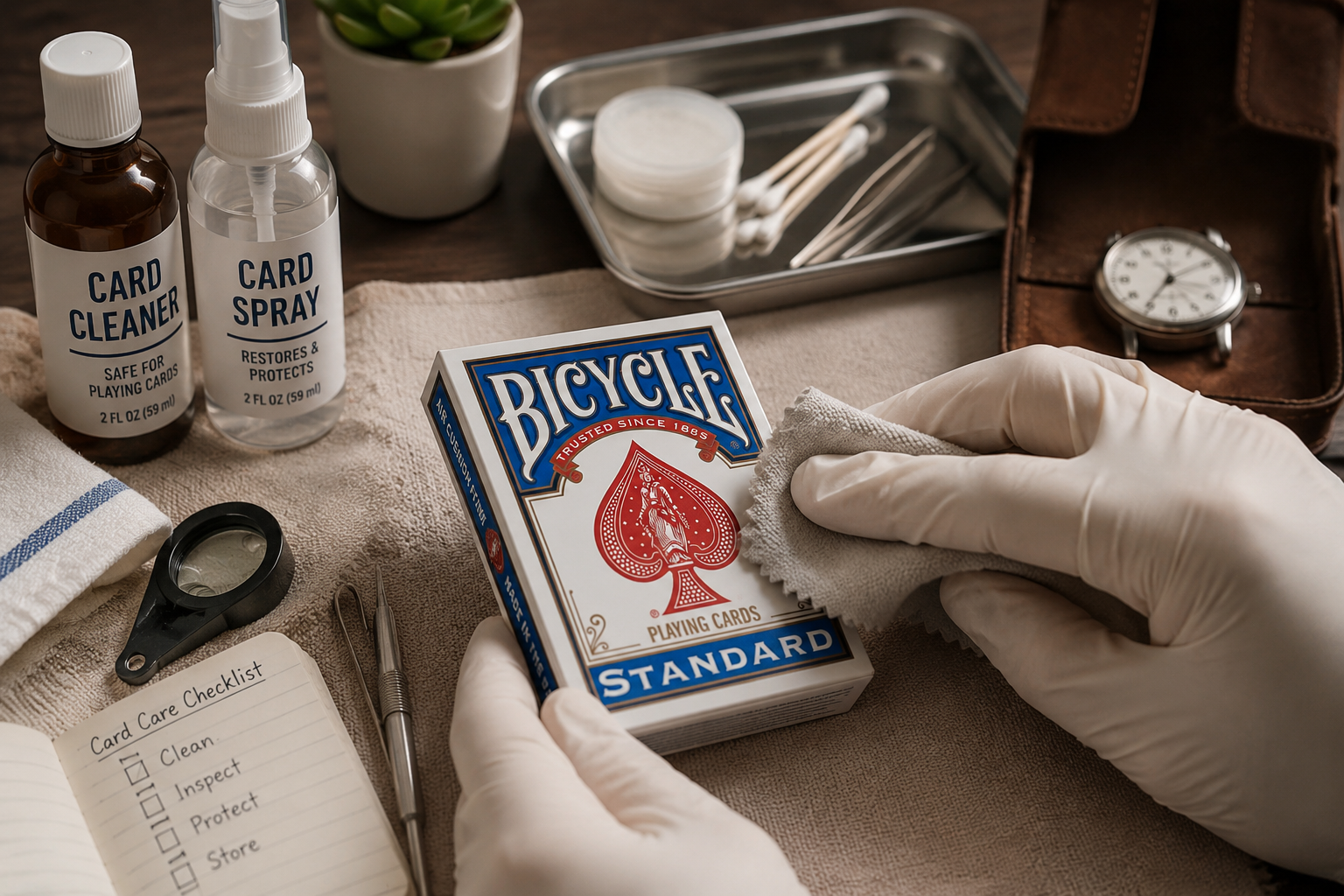
How to care for playing cards: the physics that saves them
How to care for playing cards with criteria: real break-in, handling, storage at 20C and 30-40% RH, the freezer myth and care of foil and gilded.
Playing-card paper is more resilient than you think, if you respect the physics. Real break-in, handling, storage and the myths that kill your cards.
Most decks don't die of old age: they are murdered in one afternoon by moisture, sweat and a back pocket. And almost all those deaths are avoidable with four rules of physics —not of superstition—. Knowing how to care for playing cards is not pampering a fragile object: it is understanding what happens to the paper and stopping doing the three or four things that destroy it without you realizing.
I have synthesized the sources the trade respects —PlayingCardDecks, Lee Asher, magician and cardist threads on theory11.com and UnitedCardists— into an actionable, folklore-free protocol. Spoiler: the freezer trick is almost always a bad idea, and I'll explain why.
1. Physics first: why a deck deteriorates
A card is paper with a layer of micro-textured finish that reduces friction and a coating that makes it glide. Anything that attacks that system shortens its life:
- Moisture: enemy no. 1. Paper is hygroscopic: it absorbs water from the air, swells, warps and "sticks"; when it dries it can crack.
- Moisture swings: even worse than stable high moisture. The repeated expansion-contraction warps the paper permanently.
- Heat: deforms, dries out the finish and, under pressure (a pocket), curves the deck in a matter of hours.
- Sun and UV: discolor backs and boxes; degrade inks and coating.
- Grease and sweat: skin oils adhere to the finish, dirty the edges and accelerate the "sticking".
- Dust: acts as an abrasive between card and card every time you shuffle.
The ideal storage condition, according to the consulted sources, is 20 °C (68 °F) and a relative humidity of 30–40%, in darkness and —this is the important part— with those values stable. Stability matters more than the exact number.
2. The break-in: "breaking in" a new deck (and what it really fixes)
A freshly opened deck is stiff, slippery and sometimes "clicks". The break-in is not a mystical ritual: it corrects three concrete physical things —the uneven humidity relative to the ambient, the unsettled coating and the un-rounded edges of the factory cut—. About 10 minutes is usually enough.
- Acclimatization: leave the deck for a day or two in the room where you'll use it. It equalizes its humidity with the ambient and the "click" disappears on its own. It is the step most people skip and the one that pays off most.
- Soften the edges: rub each edge of the deck with your fingers or against your trousers. It accelerates the rounding that use would do in weeks and improves the faro immediately.
- Aeration: hold the deck as if for a spring, squeeze it into a C shape and let air get between the cards. This unsticks the coating/oil that holds them together from the factory. This is the key technique of the break-in.
- Shuffles and figures: a series of riffle shuffles (with a bridge at the end so as not to warp), pressure fans, spreads and springs —always in both directions—.
- Faro in both directions: the factory cut favors one direction; as the edges round off, the faro ends up working both ways.
3. Handling: habits that multiply useful life
- Washed and dry hands, always. It is the single measure with the most impact: skin grease and moisture are what most dirty the edges and "stick" the cards.
- Practice on a soft surface (rug, mat): in cardistry drops are inevitable and a hard floor destroys corners.
- Springs in both directions: alternate the direction so the deck doesn't take on a permanent warp.
- Give it rest: a heavily worked deck recovers if it rests and "breathes" for a while.
- No tight rubber bands: with heat they melt and mark the edges forever.
4. Storage
| Situation | Recommendation |
|---|---|
| Daily use | Always inside its tuck box: a barrier against dust and moisture. |
| Position | Store the deck flat: gravity keeps it pressed and reduces warping. |
| Place | Dark, cool, dry, with no direct sun or sharp temperature changes. |
| Climate | Target: 20 °C and 30–40% RH stable. |
| Avoid it: body heat + pressure + sweat = guaranteed warp. Use a card clip or a rigid case. | |
| High humidity | Airtight box with silica gel (the "DO NOT EAT" sachets) to stabilize the RH. |
| Collecting | Chemically stable plastic or archival paper free of acids, peroxides and sulphur. |
For collections of sealed collector decks, the enemy is not a specific humidity, but the swing of humidity and temperature. A stable interior cupboard beats a pretty display cabinet next to a window.
Recovering a warped deck: the card clip overnight
One of the few real "repairs" that exist. If a deck has curved —from a pocket, heat or springs in a single direction— it isn't necessarily dead: lay it flat, squeeze it with a metal card clip (or between two flat surfaces with some weight) and leave it like that all night. Paper has memory, but it also yields to sustained pressure. It doesn't bring a deck back from the dead, but a mild-to-moderate warp corrects surprisingly well. Severe warp or dog-eared corners: that is irreversible, off to destructive practice.
5. Deck rotation and when to retire it
If you practice a lot, rotate several decks: you spread the wear instead of killing a single one. Save the premium decks or collector ones for performing or displaying; use cheap decks for raw training. If you buy by the brick, this comes almost free.
Retire a deck when:
- The cards stick and the fan comes out lumpy even though you aerate it.
- The corners are dog-eared —irreversible mechanical damage—.
- The faro and the spreads no longer come out clean no matter how much you break it in.
- In magic: a marked back that "gives it away". Here there is no forgiveness.
A deck retired from play still serves for destructive flourishes with no regret: ideal while you learn cardistry from scratch.
6. Cleaning: what you can do and what is a myth
Let's be honest: a paper card does not get washed. The realistic options:
- Clean and dry hands (prevent > cure; 90% of the care is this).
- Gently rub the edges of the deck to drag off surface dirt.
- Only on 100% plastic decks: a barely damp cloth and immediate drying. Paper does not allow this under any circumstance.
Fanning powder: the shortcut half the trade uses and won't confess
Let's be honest where most guides look the other way. Fanning powder (zinc-stearate based) does return glide to a worn deck and is what many professionals use for perfect fans. It is not a myth that it works. The honest nuance: it is a patch, not maintenance. Applied in excess it dirties the finish, stains and, in the medium term, attracts more dirt. My stance: use it if you perform and need an impeccable fan now; don't turn it into a routine to cover up a deck that actually needs a break-in or retirement. A pinch, not a cloud. And never on decks you intend to keep.
The detail almost nobody controls: the playing surface
Your table matters more than you think. Working on bare wood or glass sands the edges every time you pick the deck up and punishes the corners on every drop. A neoprene mat or close-up pad does two things at once: it cushions drops (cardistry) and improves handling (the cards "lift" better off a soft surface for spreads and turns). It is one of the lowest-cost, highest-return investments in useful life —below silica gel and clean hands, but above almost everything else—.
Subtle trick: avoid black-bordered decks for training
A detail only those who have worn out many decks tell you: wear shows much more on black-bordered backs than on white-bordered ones. Every micro-rub of the edge whitens the black and the deck "looks" finished before it is —and in magic, a back that looks worn gives it away—. For raw training and street magic, white border. Save the beautiful black-bordered ones for the display cabinet or rare performances.
7. Myths about care
- "Put the deck in the freezer to fix it": it circulates as a remedy for clumped decks. Cold may help very occasionally with the finish, but it is not maintenance: the condensation when you take it out usually makes the problem worse (you're putting water into the paper). Better to control the source humidity with silica gel.
- "Add talc so they glide": a patch that dirties the finish and attracts more dirt in the medium term. A correct break-in does the same with no side effects.
- "A good deck lasts years with intensive use": in casual use, months; in daily cardistry practice, its useful life is measured in hours or days before it gets marked.
- "Storing on edge is the same": flat is better; the weight counteracts the warp. A small gesture, a big difference in the long run.
8. Premium, foil and gilded decks: another sport
Editions with foiling, gilded (gold/silver) edges or reliefs are the most delicate: the decoration is an added layer that scratches and peels off, and it doesn't come back.
- Don't use them for practice: the gilding flakes off with aggressive springs and faros.
- Minimal handling: perfectly dry hands; sweat degrades the gilded edge the first time.
- No rubber bands or pressure: they mark the foil and the embossed box.
- Sealed if you collect: many are worth more sealed; document the numbering before deciding to open.
- Zero sun: UV fades foils and metallic inks faster than a normal back.
If you doubt which deck deserves this treatment, review the brand comparison in Bicycle vs Theory11 vs Tally-Ho and choose according to whether you use it to play, practice or collect; before buying, which deck of cards to buy saves you expensive mistakes.
9. Adapt to your climate
The common enemy —moisture— behaves differently depending on where you live:
- Humid (coast, tropics): high RH clumps decks in days. Airtight box with silica gel, frequent rotation, always in the tuck box. Away from kitchens and bathrooms.
- Dry (interior, intensive heating): the paper dries out, the edges become brittle and the finish "creaks". Avoid direct sun, which accelerates the brittleness.
- Sharp changes (between seasons, air conditioning): the worst scenario. The repeated expansion-contraction warps the paper. Here stability matters more than the exact RH number.
10. Transport: where most decks die
A deck that's perfect at home gets ruined in a backpack. Rules:
- Never in the back trouser pocket: heat + pressure + sweat + body curvature. It is the most common death sentence.
- Use a card clip (rigid clamp) or hard case: they keep the deck pressed and flat.
- Don't leave it in the car: the cabin reaches temperatures that deform the paper and melt rubber bands.
- For several decks, a rigid box with separation: it prevents them marking each other.
11. Archival materials for collectors
If you preserve decks with value, the storage material matters as much as the environment. Look for chemically stable plastic or archival cardboard/paper free of acids, peroxides and sulphur. Cheap plastics migrate plasticizers and "sweat" the box over the years; acidic cardboard yellows and degrades inks. For valuable sealed pieces, rigid "deck protector" sleeves and, where appropriate, encapsulation. Document numbering and condition: a sealed deck is usually worth more than an opened one, so the decision to open is irreversible and worth money. More on selecting pieces in collector decks.
12. Diagnosis: what's wrong with your deck
Before throwing it away, identify the problem; many have a fix or, at least, prevention for the next time:
| Symptom | Probable cause | Action |
|---|---|---|
| "Clicks" and slips (new) | Lack of acclimatization and break-in | Acclimatize 1-2 days + break-in |
| Sticky and lumpy | Moisture or hand grease | Aerate, dry the environment, clean hands; if it doesn't improve, retire |
| C-warped or domed | Heat/pocket/springs in a single direction | Store flat with weight on top; alternating springs |
| Black/dirty edges | Unwashed hands, dust | Rub the edges; prevent by always washing |
| Dog-eared corners | Normal mechanical wear | Irreversible: retire to a practice deck |
| Discolored back | Sun/UV | Irreversible: never store in the light |
Golden rule: most problems are about prevention, not repair. Paper barely "heals"; it is cared for before it deteriorates.
13. Paper vs 100% plastic: different care, different expectations
Not all care applies equally depending on the material, and it's worth being clear because many people treat a plastic deck as if it were paper and vice versa:
| Aspect | Paper (USPCC and similar) | 100% plastic |
|---|---|---|
| Moisture | Critical: it swells and warps | Almost indifferent |
| Cleaning | Only edges, dry | Barely damp cloth, immediate drying |
| Break-in | Necessary and effective | Barely applies |
| Useful life | Weeks/months (use); hours (intensive cardistry) | Years in table play |
| Feel for magic | The trade reference | Too stiff for many effects |
| Price | Low | High |
Practical translation: for home poker with children, drinks and a yard, 100% plastic is unbeatable for maintenance —you wash it and it lasts years—. For magic and cardistry, paper is not up for debate even though it lasts less: handling rules and the deck is a consumable. Knowing what you expect from each material avoids the frustration of demanding from one what only the other delivers.
The mental error that kills more decks than moisture
There is a bias I see constantly: treating a paper deck as a durable object. It is not. A practice deck is a consumable, like guitar strings or bike tyres. "Failure" is not a deck wearing out after weeks of daily cardistry —that is normal functioning—; failure is destroying your only good deck because you used it for everything. Internalize this and you'll stop suffering over worn decks: the worn ones did their job. What you really care for —a stable environment, clean hands, rotation— protects the set, not a single unit. Changing your mindset here saves more decks (and more disappointments) than any specific technique in this guide.
13b. Maintenance by use
- Close-up magic: an intact back and fine glide are sacred; retire as soon as a back gets marked, because it gives it away. Rotate identical decks.
- Cardistry: prioritize flexibility over aesthetics; a "beaten" but flexible deck still serves for practice. A soft surface and a "sacrifice" deck always at hand. More in cardistry for beginners.
- Play: durability and clean edges; here casino stock or 100% plastic minimizes maintenance.
- Collecting: don't handle, stable environment, archival materials and, where appropriate, keep the seal.
14. The first 24 hours: the protocol that defines the deck's life
What you do the first day weighs more than almost everything you do afterwards. A concrete script:
- Hour 0: don't open it right after buying it if it came from a shipment (thermal change). Leave it closed, acclimatizing in the room where you'll use it.
- 1-2 days: still closed or freshly opened inside its tuck box, flat, away from a window and radiator. The humidity of the cardboard equalizes with the air and the "click" goes on its own.
- First use: washed and dry hands. Remove the cellophane and the warranty card, keep the tuck box.
- Break-in: 10 minutes. Edges first, then aeration (the most important), then shuffles and springs in both directions, faro at the end.
- End of day: back into the tuck box, flat. Don't leave it loose on the table all night collecting dust and moisture.
If you can only remember one thing from this whole guide, make it this: acclimatize and aerate. Those two gestures, which cost zero euros and almost zero time, resolve most of the "my new deck is bad" complaints.
15. Care inventory by budget
| Level | What you get | Cost |
|---|---|---|
| Free | Clean hands, acclimatize, flat in its tuck box, alternating springs | 0 € (80% of the result) |
| Basic | + Silica gel sachets, airtight box | Low |
| Recommended | + Neoprene mat, metal card clip | Medium |
| Collector | + Acid-free archival sleeves/encapsulation | Varies by collection |
Notice where the bulk of the result is: in the 0 € column. Everything else is marginal optimization. Anyone who sells you that you need an expensive kit for a deck to last is selling you the wrong column.
Quick checklist
- Washed and dry hands, always.
- A 10-min break-in —especially aeration— before demanding anything of it.
- In its tuck box, flat, cool, dry, no sun; 20 °C and 30–40% RH stable.
- Rotate several decks; save the premium ones.
- Silica gel if you live in a humid climate.
- Foil/gilded: look, don't beat.
Frequently asked questions
Why does my new deck "click" and slip?
It's normal: its humidity doesn't match the ambient, the coating isn't broken in and the edges are still rough from the cut. Acclimatize it for a day or two and give it a break-in with aeration; the click disappears and the glide settles.
Is the freezer thing for humid decks true?
It's a debatable emergency fix, not maintenance. Cold may help very occasionally, but the condensation when you take it out usually puts more water into the paper and makes things worse. What's effective: controlling humidity with silica gel and stable storage.
How long does a well-cared-for deck last?
In casual use, weeks or months. In intensive daily cardistry practice, much less —hours or days before it gets marked—. Rotating decks and saving the premium ones is what lengthens the set of your collection, not squeezing a single one.
Can I wash the cards?
Not the paper ones: they get destroyed. Only surface cleaning of edges and prevention with clean hands. The 100% plastic ones allow a barely damp cloth and immediate drying; nothing more.
Do I store the deck upright or flat?
Flat. The weight helps keep the cards pressed and reduces warping in the long run. It's free and makes a difference over the months.
What humidity and temperature are ideal?
Around 20 °C and 30–40% relative humidity, in darkness. But more important than the exact number is that those values are stable: the swing is what really warps the paper.
The ideal life cycle of a deck
Internalize this flow and you avoid 90% of premature deaths: purchase (stock and finish by use) → acclimatization (1-2 days in its final environment) → break-in (10 min: edges, aeration, shuffles, faro) → active use (clean hands, soft surface, alternating springs, rest) → storage between sessions (tuck box, flat, cool and dry) → rotation (several decks spreading the wear) → retirement (to destructive practice when it sticks, dog-ears or no longer performs). A premium or collector deck skips the cycle: it goes straight to conservation, with no use.
What I know, what depends and what is marketing
What I know: moisture and its swing are enemy number one; aeration is the break-in step with the most impact; flat preserves better than on edge; paper is prevented, not cured.
What depends: how long your deck lasts depends on your climate, your sweat, your practice intensity and the brand. There is no universal "days of life" figure.
What is marketing: "reviver" sprays, miracle talcs and expensive accessories that promise what a silica-gel sachet and clean hands already do.
Low-commitment recommendation: put your decks in an airtight box with a couple of silica-gel sachets and wash your hands before each session for a month. Without spending more, you'll see the difference and know whether your problem was the environment or the handling.
And remember: no care technique compensates for a bad initial choice. If you buy a deck unsuitable for your use, it will wear out badly no matter how much you pamper it. That is why this is complemented by the Bicycle vs Theory11 vs Tally-Ho comparison and by the prior buying guide.
Next step: if you're going to push your decks hard with flourishes, combine this guide with cardistry for beginners, or go back to the playing card decks catalogue.
Playing Cards

Gemini Casino Phthalo Green – Playing Cards

Icon Black – Playing Cards

Premier Edition Restricted Red – Playing Cards

Premier Edition Jet Black Private Reserve – Playing Cards

One Piece – Robin – Playing Cards

Lounge Edition Terminal Turquoise – Playing Cards

Lounge Edition Taxiway Yellow – Playing Cards

Cardistry Fanning Yellow Edition – Playing Cards
Contact our team for any clarification about this document. Contact us


