
Ludo dice roller
A six-sided die for Ludo when the die or the shaker has gone missing: press Roll, or drag the die and let go over the tray. It keeps track of whose colour is up and tells you when you roll a six and when three sixes come in a row.
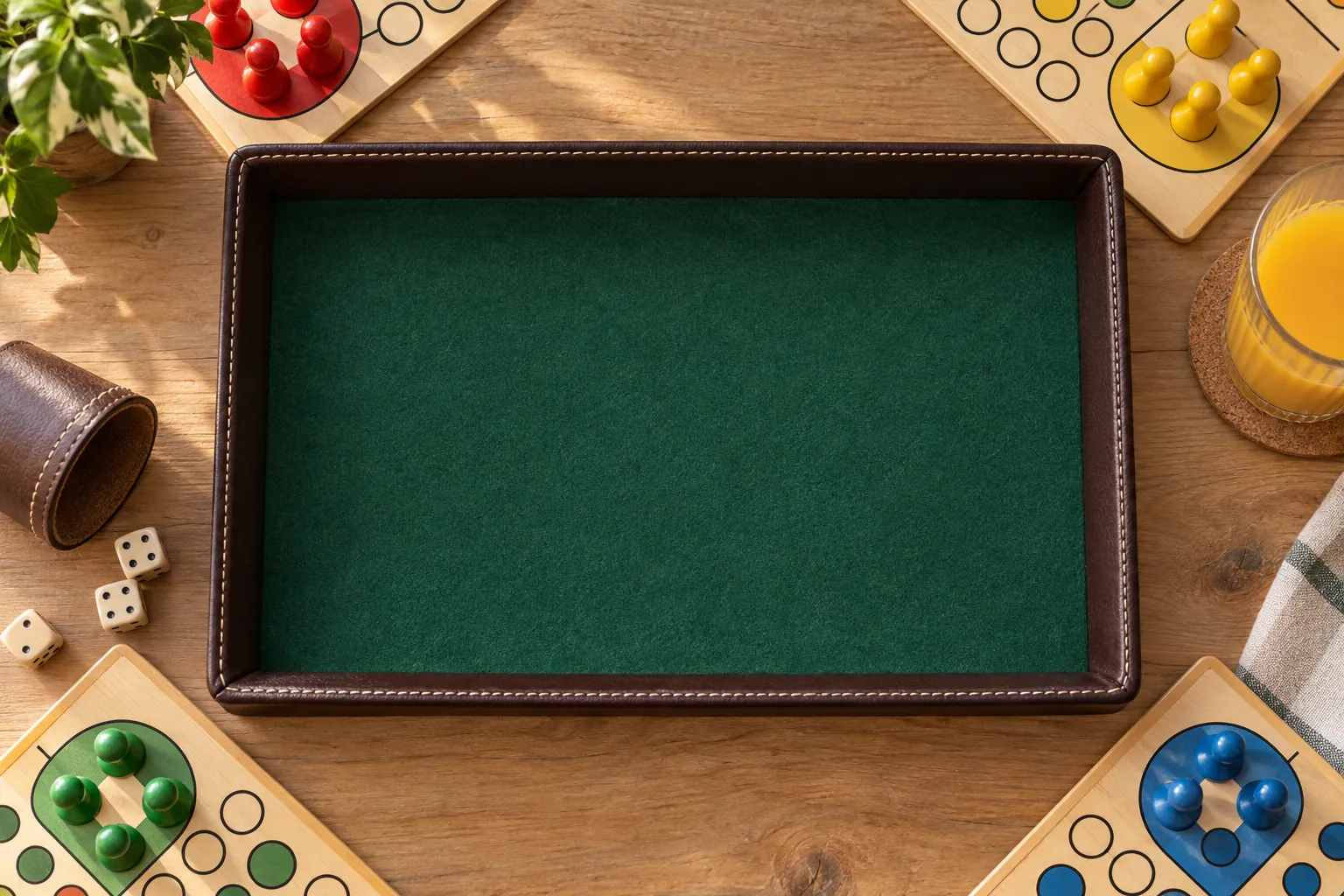
Press the tray, drag and let go to throw
How to use this Ludo dice roller
In short
Do you need a 6 to start in Ludo? Yes. In standard Ludo a token can only leave the yard on a 6, and you roll again afterwards. Some local rules, especially with two dice, also let a token come out on a 1. In Spanish parchís you come out on a 5.
The roller is set up for a four-colour game. Each roll goes to the colour whose turn it is and, once it is done, the turn moves on by itself in this order: red, yellow, green and blue. If you roll a six, the turn stays with you and the page tells you to roll again. If you roll three sixes in a row, an alert appears so the table can apply the penalty.
- Choose one die (standard Ludo) or two dice (for the versions that use a pair, common in South Asia).
- Press Roll, or drag the die with your finger or mouse and release it over the tray. The die tumbles with real physics, so the result comes from the throw, not from a pre-set animation.
- Check which colour is active before moving a token. If someone has skipped a go on the board, change the active colour before rolling.
The board and tokens are still your own. The page only replaces the die and the shaker, and it counts the turns and the sixes so nobody has to remember.
Ludo dice rules
Ludo has fewer dice rules than its Spanish and German cousins, but the ones it has decide most games. These are the rules found in standard British sets, with the most common house variations.
Rolling a six to start
All four tokens begin in the yard. A token can only enter the track, on its starting square, when you roll a 6. Until you do, your turn is a single roll and then play passes on. A token that is captured goes back to the yard and needs another 6 to come out again.
A six gives another roll
After a 6 you move (or bring a token out) and then roll again. A second 6 earns a further roll as well.
Three sixes in a row
The usual rule is that a third consecutive 6 is not played: you do not move with it and the turn passes straight to the next player. Some families play a harsher version in which the token moved with the earlier sixes is also sent back to the yard. Agree which one you use before you start, because it changes how risky a run of sixes is.
Exact roll to finish
Tokens go round the board and then up their own home column. Most rule sheets require the exact number to reach the centre; if the roll is too high, that token cannot use it and you have to move another one or lose the go.
One die or two
The British game uses a single die. In India and Pakistan, Ludo is often played with two dice, and some local rules let a token come out on a 1 as well as a 6. With two dice the chances change a lot, as the tables further down show.
Ludo and its relatives: Parchís, Mensch, Petits Chevaux
Ludo belongs to a family of race games played on a cross-shaped board. Each country fixed its own dice rules, which changes the pace of the game considerably.
| Game | Country | Roll needed to come out | On a 6 | Three 6s in a row |
|---|---|---|---|---|
| Ludo | UK and many others | 6 | Roll again | The roll is lost and the turn passes |
| Parchís | Spain | 5 | Roll again; counts as 7 when no tokens are left at home (common rule) | The last token moved goes home |
| Mensch ärgere dich nicht | Germany | 6 (three tries when you have no tokens in play) | Roll again | No penalty in the basic rules; played as a house rule |
| Petits chevaux | France | 6 | Roll again | Some rule sets make you lose a horse |
The Spanish game adds rules that do not exist in Ludo: a token that captures another moves on 20 squares, a token that reaches home lets you move 10 squares with another, and two tokens of the same colour on one square form a blockade that nobody can pass. Spanish parchís also has a two-dice version in which doubles take the place of the 6.
Where Ludo comes from: from Pachisi to the English nursery
Ludo is a simplified form of Pachisi, a game from India closely related to Chaupar. Both use a cross-shaped board, usually embroidered cloth, with four arms of squares. The main difference was the source of chance: Pachisi was played with cowrie shells thrown by hand and scored by how many landed mouth up, while Chaupar, the courtly version, used long dice.
The name Pachisi comes from the Hindi word for twenty-five, the highest throw that the shells could give. The American trade name Parcheesi and the Spanish Parchís come from the same word.
The firmest evidence that the game existed in the 16th century comes from the court of the Mughal emperor Akbar. At Fatehpur Sikri a courtyard is laid out as a giant board, and tradition says Akbar played there with members of his court as the pieces. His chronicler Abul Fazl described the game with sixteen pieces, three dice and the cross-shaped board, and noted that it had long been played in Hindustan. Older carvings are sometimes said to show Chaupar, but they only show dice, so they cannot date the board.
From Patchesi to Ludo
The game reached England in the late 19th century. The games maker John Jaques registered the name Patchesi in 1887, and soon afterwards the game spread as Ludo, Latin for I play, with a British patent in the name of Alfred Collier that most histories of the game date to 1896. Collier also sold it as Royal Ludo. The decisive change was replacing the shells with a cubic die and a shaker, which the whole family still uses. The Royal Navy developed its own version, known as Uckers.
Germany, France and Spain
Josef Friedrich Schmidt designed Mensch ärgere dich nicht in Munich in 1907 and 1908 as a stripped-down Ludo. It went into series production in 1914 and became popular during the First World War, when Schmidt sent around 3,000 copies to military hospitals for wounded soldiers. In France the game took the shape of a horse race, the petits chevaux, which appear in department store catalogues in the late 1930s. In Spain it became parchís, with its own rules about coming out on a 5 and counting 20 after a capture.
Ludo dice odds
All figures are calculated for a fair six-sided die, where each number has a probability of 1/6. In Ludo the number you wait for at the start is the 6, so this table gives your chances of getting a token out within a given number of rolls.
| Rolls | Chance of at least one 6 | Exact fraction |
|---|---|---|
| 1 | 16.67% | 1/6 |
| 2 | 30.56% | 11/36 |
| 3 | 42.13% | 91/216 |
| 4 | 51.77% | 671/1296 |
| 5 | 59.81% | 4651/7776 |
| 6 | 66.51% | 31031/46656 |
| 8 | 76.74% | 1288991/1679616 |
| 10 | 83.85% | 50700551/60466176 |
Average number of rolls to get a 6
6. You only pass a 50% chance on the fourth roll.
Long waits are normal
The chance of still having no 6 after 10 rolls is 16.15%, and after 20 rolls it is 2.61%. In a four-player game, someone stuck in the yard for ten turns is not evidence of a loaded die.
Three sixes in a row
1/216, or 0.46%. On average that happens once every 216 turns for any one player.
Rolls per turn
With a six giving another roll (up to three), the average turn has 43/36 rolls, about 1.19.
With two dice
| Event with two dice | Combinations out of 36 | Chance |
|---|---|---|
| At least one 6 | 11 | 30.56% |
| At least one 6 or one 1 (where a 1 also lets you out) | 20 | 55.56% |
| A double | 6 | 16.67% |
| Double six | 1 | 2.78% |
| Total of 7, the most frequent | 6 | 16.67% |
Playing with two dice nearly doubles the chance of getting out in a single turn compared with one die (30.56% against 16.67%), and if a 1 also counts it rises above one in two.
Practical tips
Settle the house rules first
The usual arguments are about the third six, whether you must take the exact number to finish, and whether a 1 can bring a token out.
Get a second token out early
With only one token on the track, a bad roll can leave you with no useful move. A 6 is your only way out of the yard, so using it to bring out a new token usually gives you more options later.
Count the squares behind you
A rival token one to six squares behind can land on you next turn. The closer it is, the more combinations hit you, especially if sixes give it extra rolls.
Do not wait for a number to be due
Each roll is independent: ten turns without a 6 does not make one more likely next time.
Keep the die where everyone can see it
With a phone or tablet in the middle of the table, everyone sees the roll and the active colour, which ends most arguments about whose go it was.
Frequently asked questions
Do you need a 6 to start in Ludo?
Yes. In standard Ludo a token can only leave the yard on a 6, and you roll again afterwards. Some local rules, especially with two dice, also let a token come out on a 1. In Spanish parchís you come out on a 5.
What happens if you roll three sixes in Ludo?
Under the usual rule you do not move with the third 6 and the turn passes to the next player. Some families also send the token moved with the earlier sixes back to the yard. The chance of three sixes in a row is 1/216, or 0.46%.
Is Ludo played with one die or two?
British Ludo uses one die. In India and Pakistan two dice are common. This roller lets you choose either.
How many rolls does it take on average to get a 6?
Six rolls on average. The chance of having rolled a 6 is 42.13% after three rolls and passes 50% on the fourth (51.77%).
Do you have to roll the exact number to finish in Ludo?
In most rule sets, yes. If the roll is higher than the squares left to the centre, that token cannot use it and you move another token or lose the go.
What is the difference between Ludo and Pachisi?
Pachisi is the Indian original, played on a cloth board with cowrie shells instead of a die. Ludo is the English version patented in the 1890s, with a cubic die and a shaker and simpler rules.
Is this online die really random?
Yes. The die is moved by a physics engine and the number depends on how it lands, as with a real die on the table. Long waits for a 6 or several sixes in a row are within normal odds, as the tables on this page show.
Can I use it for a six-player Ludo board?
Yes, the die and the rolling rules are the same. The automatic turns on the page cover the four colours of the classic board (red, yellow, green and blue); with six players, keep track of the two extra colours yourselves.
More dice to play with
 Online dice roller: roll 1 to 12 virtual dice from d4 to d20
 Roll a d20: online 20-sided dice roller
 D&D and RPG dice roller online
 Roll 2 dice: an online two dice roller
 D100 roller: percentile dice online
 Yahtzee dice roller with score sheet
 Poker dice online
 Liar's dice (Perudo): your hidden dice and the odds of every bid
 Catan dice roller
 Risk dice roller and battle calculator
 Monopoly dice roller
 Dice probability calculator
 Yes or no dice