

Rubik's Cube Notation: R, U, F, R', M, Rw and x y z
Rubik's cube notation explained with diagrams: what R, R' and R2 mean, slice moves M E S, wide moves Rw, x y z rotations and 4x4 notation.
In short
In Rubik's cube notation, each letter is a face: R right, L left, U up, D down, F front and B back. A letter on its own means a quarter turn clockwise, as if you were looking straight at that face; with an apostrophe, read as "prime" (R'), the turn goes the other way, and with a 2 (R2) it is a half turn.
- M, E and S turn the middle slices; x, y, z rotate the whole cube
- A lowercase letter or a w (r or Rw) moves two layers at once
- On big cubes a number is added: 2R is the second layer and 3Rw is three layers together
- It is called Singmaster notation after David Singmaster, who devised it in late 1978
Every tutorial for solving the cube, from the beginner's method to the algorithms used by champions, is written in the same letter code. If you can't read it, a sequence like R U R' U' looks like a password; once you can, it is as clear as a recipe. The good news is that the basic system fits into six letters and two symbols, and everything else (slice moves, wide moves, rotations, big cubes) is built on the same logic.
In this guide we go through every move with colour diagrams of a cube in the standard orientation: white on top and green in front, which is the one the World Cube Association (WCA) uses to scramble cubes in competition. That way you can pick up your cube, hold it the same way and check each turn as you read.
Where Singmaster notation comes from
When the Rubik's Cube reached Western mathematicians in the late 1970s, each of them described the turns in their own way. David Singmaster, an American mathematician based in London and a lecturer at what is now London South Bank University, first saw the cube at the 1978 International Congress of Mathematicians in Helsinki, solved it within a few weeks and, by the end of that same year, had devised a system of letters to write down his solutions.
He published it in his Notes on Rubik's "Magic Cube", a booklet he began distributing himself in 1979, expanded in later editions and which Penguin reissued in 1981. Besides the notation, those notes contained one of the first published layer-by-layer methods and the first serious mathematical analysis of the puzzle. The notation was so successful that it now carries his name, Singmaster notation, and it is the basis of the notation the WCA uses in its official regulations. Singmaster died in February 2023, aged 84.
The six faces: R, L, U, D, F and B
The key idea is that the letters refer to positions, not colours. The face in front of you is always F, whatever its colour. If you turn the whole cube in your hands, the face that used to be R may become F, and from that moment on it is called F. Thanks to this, an algorithm works the same with any colour scheme and no matter which colour you start from.
| Letter | Stands for | Face | Colour (white top, green front) | What the turn does, seen from the front |
|---|---|---|---|---|
| R | Right | Right | Red | The right column moves up |
| L | Left | Left | Orange | The left column moves down |
| U | Up | Top | White | The top row moves to the left |
| D | Down | Bottom | Yellow | The bottom row moves to the right |
| F | Front | Front | Green | The face you are looking at turns clockwise |
| B | Back | Back | Blue | The back face turns; from the front it looks anticlockwise |
What does R mean on a Rubik's cube? Understanding "clockwise"
The rule says that a letter on its own is a quarter turn (90 degrees) clockwise. The detail that trips almost everyone up is where you look from: always as if that face were right in front of your eyes. For F it is easy, because you are already looking at it. For R, imagine leaning over to look at the cube from the right: the clock turns and, seen from your normal position, the right column of the front face moves up.
The opposite face does the reverse. If you lean over to the left to do L clockwise, from the front you will see the left column move down. That is why R and L, although both are "clockwise", move the front pieces in opposite directions. The same happens with U and D, and with F and B.
R prime (') and R2: direction and half turns
Two modifiers can be added to any letter:
- Apostrophe or prime ('): a quarter turn anticlockwise. R' is read "R prime" and exactly undoes what R does.
- The number 2: a half turn (180 degrees). R2 is the same as doing R twice in a row. Since a half turn one way leaves the layer the same as a half turn the other way, the result does not depend on the direction.
There is a variant you will see in speedcubing tutorials: U2'. The result is the same as U2, but it tells you to do the half turn the other way round because it suits your fingers better. It is a hint about execution, not a different move.
Slice moves: M, E and S
On the 3x3 there are three layers that are not faces: the middle ones. To turn them on their own, three more letters are used: M (for middle, the vertical middle slice), E (for equator, the horizontal one) and S, the middle slice parallel to the front. Each one is tied to an outer face that sets its direction:
| Letter | Layer that turns | Follows the direction of | Seen from the front |
|---|---|---|---|
| M | Between L and R (vertical) | L | The middle column moves down |
| E | Between U and D (horizontal) | D | The middle row moves to the right |
| S | Between F and B (facing the front) | F | Turns like the front, clockwise |
The directions of M, E and S look arbitrary and are the most common source of mistakes in algorithms that use them. Just remember three pairs: M goes with L, E with D and S with F. They take the same modifiers as the faces: M', M2, E', S2…
Two important details. First, turning a slice moves the centres, so the colour you thought was "in front" changes place. Second, M, E and S are not part of the official WCA notation: the regulations only cover face turns, outer block turns (the ones with w) and rotations. Even so, M is common in methods such as Roux and in many last-layer algorithms.
Cubes for every level
From a first magnetic 3x3 to competition cubes and less common shapes such as the Megaminx or the Pyraminx. Take a look at our catalogue.
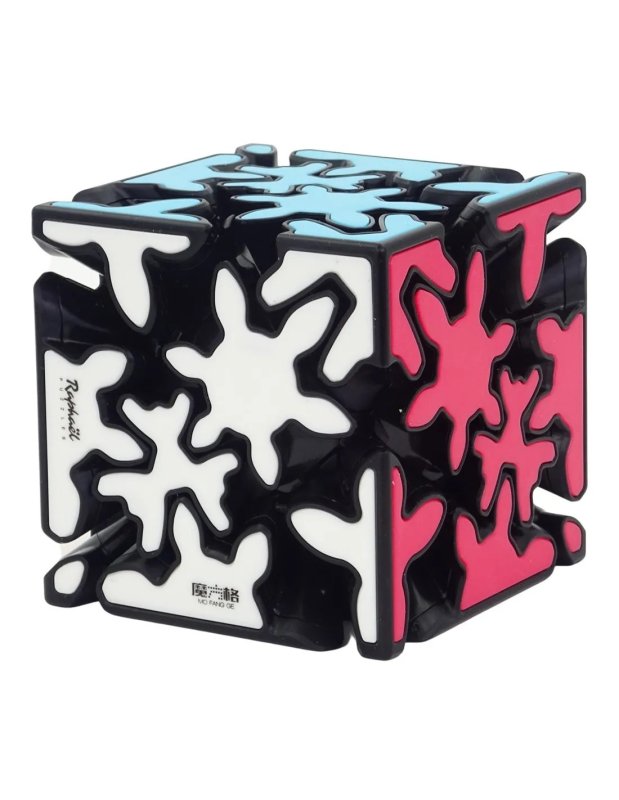
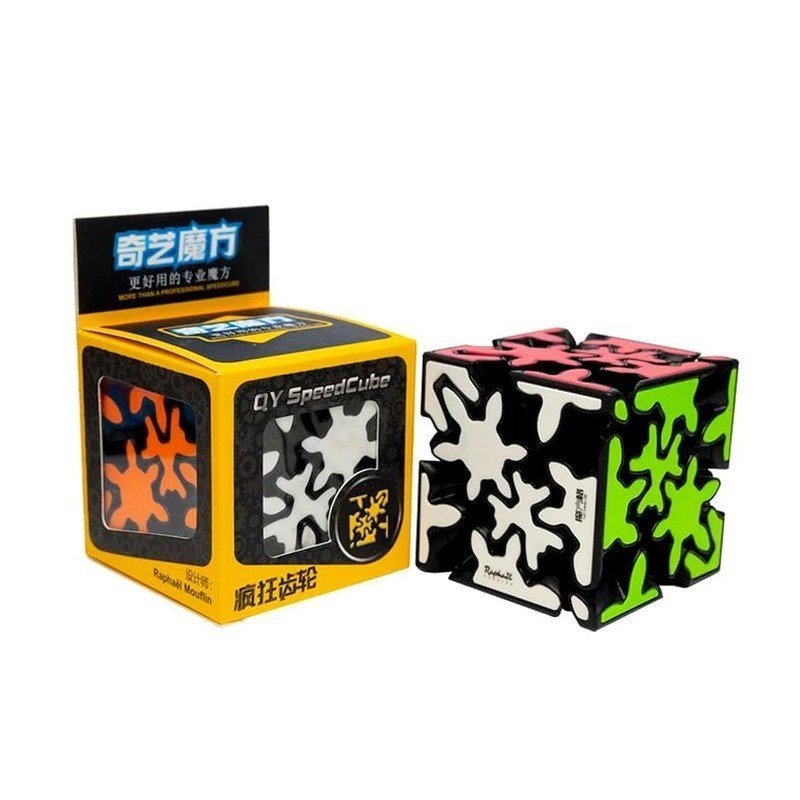 QiYi Crazy Gear Cube 3x3 - Puzzle con Engranajes
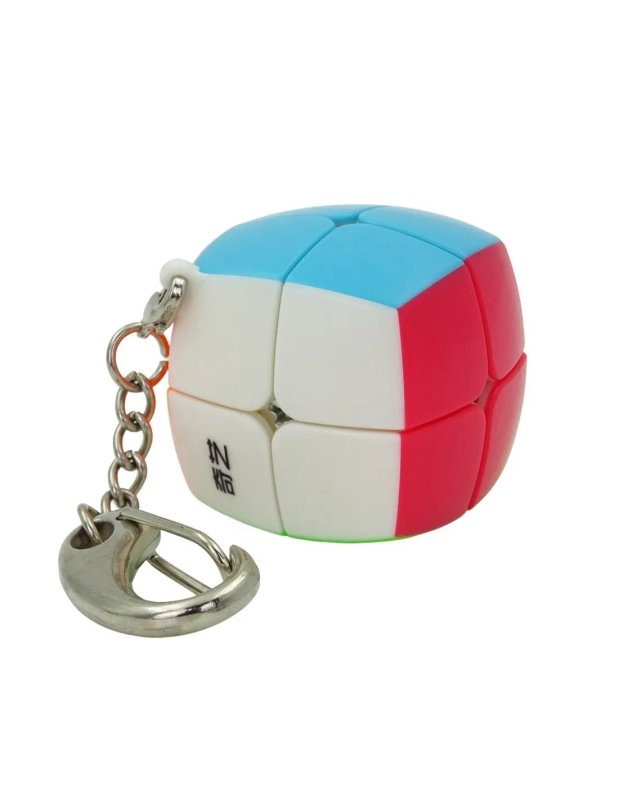
 QiYi 2x2 Mini Pillowed Llavero Stickerless Removible
 QiYi QiHeng S2 Megaminx Stickerless Dodecaedro
 QiYi Void 3x3 Magnético UV Coated Stickerless
Wide moves: r vs Rw
A wide move turns an outer face and the adjacent middle slice at the same time, as if they were a single piece. It is written in two ways that, on the 3x3, mean exactly the same:
- Lowercase: r, l, u, d, f, b. This is the traditional form and the one you will see in many algorithms.
- With a w (for wide): Rw, Lw, Uw, Dw, Fw, Bw. This is the form used in the WCA regulations.
The link with the other moves is simple: r = R + M', because the middle slice goes along with R and M' is exactly the middle slice turning upwards. In the same way, l = L + M, u = U + E' and f = F + S. Primes and doubles work the same: r', Rw2 and so on.
The w exists because on big cubes lowercase becomes ambiguous: depending on the source, "r" on a 4x4 can mean the two outer layers or only the second layer. We explain this in the big cube section.
Cube rotations: x, y and z
Sometimes an algorithm asks you to turn the whole cube in your hands without moving any layer relative to the others. That is what rotations are for. They are written in lowercase and follow the direction of a face:
- x: the whole cube turns like R. The front face becomes the top.
- y: the whole cube turns like U. The right face comes to the front.
- z: the whole cube turns like F. The top face goes to the right.
A trick to keep them apart: in the alphabet, x is closer to R than to L, y closer to U than to D, and z closer to F than to B; each rotation turns like the face it is closest to. With prime and 2 they work like everything else: y' turns the cube like U', and x2 turns it upside down.
Since a rotation does not change the state of the puzzle (only how you hold it), the WCA does not count it as a move. After a rotation, remember that the letters are renamed: after a y, what used to be the R face is now F, and the next F turn is done on it.
Big cube notation: 4x4, 5x5 and beyond
On a 4x4 or a 5x5 there are several inner layers between each pair of faces, so you need to say how many layers turn, or which one. The system used by the WCA adds a number in front of the letter:
| Notation | What it moves | Where it is used |
|---|---|---|
| R | Only the outer right layer | All cubes |
| Rw or 2Rw | The two right layers together | Official WCA From the 3x3 up |
| 3Rw | The three right layers together | Official WCA From the 4x4 up; common in 6x6 and 7x7 scrambles |
| 2R | Only the second layer from the right | 4x4 and 5x5 algorithms (SiGN notation, very widespread) |
| r | Depends on the source: the two outer layers, or only the inner layer | Older tutorials; check the key |
The WCA regulations (article 12a) define block turns as nRw, where n is the total number of layers that move and must be between 2 and the number of layers of the cube minus one. If it is left out, it is taken to be 2, which is why Rw and 2Rw are the same. Under that rule, 3Rw is valid on a 4x4 or a 5x5 but not on a 3x3, where moving three layers would mean turning the whole cube.
To turn only an inner layer, the WCA has no symbol of its own, but the community almost always uses what is called SiGN notation: 2R is the second layer counting from the right, 3R the third, and so on. This is how 4x4 parity algorithms are usually written. So in the 2R vs Rw question, 2R is one inner layer and Rw is two layers together. If you see a big cube algorithm in lowercase, look for the author's key: some use "r" for the inner layer and others for two layers.
If you are just starting with big cubes, our guide to types of Rubik's cubes covers the differences between the 2x2, 4x4, 5x5 and non-cubic puzzles.
How to read cube algorithms and practise them
An algorithm is a sequence of turns read from left to right, one after another, separated by spaces. Before you start, hold the cube in the orientation the tutorial asks for (usually with a particular layer on top) and do not let go of it or turn it unless an x, y or z rotation appears.
The classic example: R U R' U'
The sequence R U R' U' is probably the most repeated one on the cube. The community knows it by a nickname, the sexy move, and it shows up inside a huge number of algorithms, starting with the beginner's method. It reads like this: R (the right column goes up), U (the top row to the left), R' (the right column goes down) and U' (the top row to the right).
It has a property that makes it a good exercise: if you repeat it six times in a row on a solved cube, the cube ends up solved again. It is the best way to practise notation without worrying about scrambling it: if it is not solved after the sixth time, you know you have done a turn the wrong way. The same happens with another very common sequence, R' F R F', which also returns to the starting state after six repetitions.
Brackets, inverses and other conventions
- Brackets: they change nothing; they just group turns that are done as one block. For example, F (R U R' U') F' is thought of as "F, a sexy move and F'".
- Inverse of an algorithm: to undo a sequence, read it backwards and invert each turn. The inverse of R U R' U' is U R U' R'.
- Exponents: some authors write (R U R' U')3 to show that the block is repeated three times.
- Capital rotations: sometimes you will see X, Y, Z; they mean the same as x, y, z.
How moves are counted
When you read that an algorithm has "11 moves" or that any cube can be solved in 20 at most, it helps to know what is being counted. There are two classic metrics: in the half turn metric (HTM), R2 counts as one move; in the quarter turn metric (QTM), R2 counts as two. With the first, it was proved in 2010 that every 3x3 can be solved in 20 moves or fewer; with the second, the maximum is 26.
The WCA also defines two metrics of its own in article 12: the outer block turn metric, which counts any face turn or w block turn as one and does not count rotations, and the execution metric, which counts every turn and every rotation as one.
Notation is easier to learn on a cube that turns smoothly
A cube that locks up halfway through a turn makes you lose count of your moves. Magnetic cubes help each layer settle into line at the end of the turn.
See speedcubing cubesNotation for other puzzles: Pyraminx, Megaminx, Skewb and more
Each competition puzzle has its own notation in article 12 of the WCA regulations. They share the logic of the cube (a letter for the layer, an apostrophe for the opposite direction), adapted to their shape. These are the basics for each one:
2x2, 4x4, 5x5, 6x6 and 7x7
They use the same letters as the 3x3. The 2x2 has no middle slices, so there are only face turns and rotations; on the big cubes, block turns with a number and w are added.
- R, U, F…
- Rw, 3Rw
- 2R (SiGN)
Pyraminx notation
It is held with one face horizontal at the bottom and another facing you. U, L, R and B turn the two layers of each vertex 120 degrees: the top one, the left one, the right one and the back one.
- U, L, R, B
- u, l, r, b: tip only
- 120° turn
More detail
Lowercase letters move only the tip of each vertex, which does not affect the rest of the puzzle; that is why they appear in scrambles but not in algorithms. Since each turn is a third of a full turn, two U turns equal one U', and the 2 is not used. Clockwise is judged looking straight at the corresponding tip.
Megaminx notation
It has twelve pentagonal faces, and each face turn is 72 degrees (a fifth of a turn). Official scrambles use a special notation with only six moves.
- U, U'
- R++, R--
- D++, D--
More detail
In scrambles, R++ and D++ turn almost the whole puzzle 144 degrees (two fifths of a turn) while keeping a few pieces fixed; the -- signs turn the other way. This system, proposed by Stefan Pochmann, entered the WCA regulations in 2008. For solving algorithms, a notation similar to the 3x3 one is used instead, on the faces around the one being worked on.
Skewb notation
Its cuts are diagonal, so each turn moves half the puzzle around a corner, by a third of a turn (120 degrees).
- R, U, L, B
- 120° turn
- One corner stays fixed
More detail
It is held showing three faces with the top one facing up. According to the regulations, R turns around the bottom right vertex, L around the bottom left one, U around the top one and B around the back vertex that you cannot see. The corner pointing towards you does not move during the scramble.
Square-1
It is written with pairs of numbers in brackets, such as (1, 0), which show how far the top and bottom layers turn in steps of 30 degrees, and a slash / that turns the right half by a half turn.
- (top, bottom)
- / half turn
- 30° steps
Clock
It has no layers, only clocks and pins. The notation shows which pins are raised (UR, DL, ALL…) and how many hours the wheel is turned, with + for clockwise and - for anticlockwise.
- UR3+, ALL2-
- y2: flip it over
If any of these puzzles catches your eye, our shop has a section of brain teaser puzzles and, for cubes and competition puzzles, one for Rubik's cubes and speedcubing.
Rubik's cube notation chart: all the moves
| Notation | What it means | Example |
|---|---|---|
| R L U D F B | Clockwise quarter turn of the face (looking straight at it) | R: the right column moves up |
| ' (prime) | Anticlockwise quarter turn | U': the top row moves to the right |
| 2 | Half turn, either direction | F2 |
| 2' | Half turn towards the anticlockwise side (a hint for your fingers) | U2' |
| M | Vertical middle slice, like L | M: the middle column moves down |
| E | Horizontal middle slice, like D | E: the middle row moves to the right |
| S | Front middle slice, like F | S' |
| r l u d f b | Outer face plus the middle slice (on the 3x3) | r = R + M' |
| Rw Lw Uw… | Two layers together (official WCA form) | Rw = r on the 3x3 |
| 3Rw | Three outer layers together (from the 4x4 up) | 3Uw' |
| 2R | Only the second layer (SiGN notation, big cubes) | 2R2 |
| x | Whole cube rotation like R | x: the front goes to the top |
| y | Whole cube rotation like U | y: the right face comes to the front |
| z | Whole cube rotation like F | z: the top face goes to the right |
| ( ) | Group turns; they do not change the algorithm | F (R U R' U') F' |
Common beginner mistakes
- Doing L in the same direction as R: R moves the right column up, but L moves the left one down. If an algorithm "doesn't work", check the L, D and B turns first, since those are the faces you view from the opposite side to usual.
- Turning the cube by accident: when going from one turn to the next it is easy to rotate the cube in your hands. If your front face changes, all the following letters are applied to different faces.
- Mixing up r and R: in small print the lowercase letter is easy to miss. On top of that, a lowercase l looks like a capital I, which is not a move at all; that is why many authors prefer to write Lw.
- Thinking the letters are colours: F is not "green", it is the face in front of you. An algorithm works the same with any colour in front.
If you are looking for a first cube to practise on or a gift for someone who is starting out, in which Rubik's cube to give as a gift we sort them by level, and in best speedcubing cubes we compare the competition models.
Frequently asked questions
What does R mean on a Rubik's cube?
R stands for right, the right face. Doing R means turning it a quarter turn clockwise, as if you were looking at it from the right; from the front, the right column moves up.
What does the apostrophe mean, as in R'?
The apostrophe, read as "prime", means the turn is done anticlockwise. R' undoes what R does: from the front, the right column moves down.
What is the difference between R, r and Rw?
R moves only the right layer. r and Rw mean the same on the 3x3: the right layer and the middle one together. The WCA uses the form with w because on big cubes the lowercase letter is ambiguous.
What is M on a Rubik's cube?
M (middle) is the vertical middle slice, the one between L and R. It turns in the same direction as L, so from the front the middle column moves down. E and S are the other two slice moves.
What do x, y and z mean?
They are rotations of the whole cube in your hands. x turns like R, y turns like U and z turns like F. They do not change the state of the cube, only which face is in front.
Is U2 turned to the left or to the right?
It doesn't matter: a half turn one way leaves the cube the same as a half turn the other way. Some tutorials write U2' to suggest the more comfortable direction for your fingers, but the result is the same.
What is the "sexy move"?
It is the nickname of the sequence R U R' U', the most repeated one in cube algorithms. Repeated six times on a solved cube, it brings it back to its starting state, which makes it a good exercise for practising notation.
Is the notation the same for the 2x2 and the 4x4?
The basics are: the same six letters, prime and 2. The 2x2 has no middle slices; on the 4x4 and bigger, multi-layer turns such as Rw and 3Rw are added and, in algorithms, inner layer turns such as 2R.
With these letters you can follow any tutorial, from the beginner's method to advanced algorithms. If you want a cube to practise with, our Rubik's cubes and speedcubing section has everything from starter models to competition cubes.
Want more guides like this one? Sign up for the newsletter.
Keep exploring
- Rubik's cube: the complete guide
- How to solve the Rubik's cube step by step
- Types of Rubik's cubes
- Best Rubik's cubes for speedcubing
- Brain teaser gift ideas
Rubik's Cubes and Speedcubing

YuXin 2x2 Baseball Shape Mod

YuXin 2x2 Basketball Shape Mod
YuXin 2x2 Ball Shape Mod Purple

Skewb Mirror DianSheng (Pink)
QiYi Magic Snake 60 Blocks Multicolour
QiYi Sail W 3x3 reinforced mechanism 56 mm

QiYi Sail 6x6 black classic beginner 60.5 mm
QiYi Sail 2x2 black compact for beginners
Contact our team for any clarification about this document. Contact us


