

Home poker night: full guide with kit, blinds and prizes
How to run a poker game with friends: how many chips, blinds step by step, the best deck, prize splits and house rules that stop arguments before they start.
A poker night that runs itself
A well-organised poker night is one of the best things you can do with friends on a Friday. No screens on, conversation around the table, a game that mixes luck and thinking, and the promise that whoever is last man standing will have something to talk about the next day. But like almost everything that looks simple from the outside, there are three or four details that separate an evening which runs itself from one that grinds to a halt after twenty minutes because nobody is quite sure what the blue chip is worth, or because the corner-shop deck has already started marking itself by hand thirty.
In this guide I'll walk you through everything worth settling before the first guest rings the doorbell: how many people to invite, which kit to buy, which blinds to use, how to structure the game (cash game or tournament) and the small details that round the whole thing off. If you have never played, start with how to play Texas Hold'em; here we assume that at least one or two of the people sitting down know the rules inside out. And if you need a reminder of the terminology as you read, the glossary of poker terms is right there.
How many guests and how long it will last
The ideal number of players is between 6 and 8. With fewer than four the game loses its interest (too many hands are won by simply stealing from the button, there is little variety in the decisions), and with more than nine the table slows right down: hands drag on, people get bored between actions and each orbit ends up taking twice as long.
On a sensible running time:
- Standard evening (home tournament): 3-4 hours. You need to leave time for everyone to settle in, play a good few orbits and reach a final table with some tension in it. This is the most common format.
- Long evening (serious tournament): 4-6 hours. It needs a properly designed blind structure with scheduled breaks. For groups who have played before and want "something a bit more serious".
- Quick evening (light cash game): 2-3 hours. Everyone sits down when they like and leaves when they like. Good for flexible afternoons, or for trying out the kit without committing to a whole night.
Tell your guests a couple of days in advance and spell out the exact format: "a 10 € tournament at 9 pm with a light supper included" is far clearer than "let's have a game of poker". If people know what to expect (how much the buy-in is, roughly what time it finishes, whether there is food or they should eat first), they turn up in the right frame of mind and everything starts better.
Cash game or tournament: which to pick for a night with friends
This is the first big decision and it shapes everything else. Both options work, but they play out very differently.
Cash game
Every chip is worth real money. You buy chips for a given amount (say 20 €) and play with them. If you run out, you "top up" by buying more. When you want to leave, you cash in the chips you have for their value. The blind structure never changes: you play the same way all night, hand after hand, with the same minimum bets.
The upsides: you come and go as you please, the bets are always "real" money for everyone involved, and there is no elimination pressure: if you bust, you reload and carry on. The downsides: someone can be priced out of the night before it is over, and one player can end up hugely relieved while another is cleaned out. It takes mutual trust and a clear idea of the maximum each person is willing to put in.
Tournament
Each player pays a fixed buy-in (10 €, for example) and receives a fixed number of chips (5,000, for example). The chips are not worth money directly: they are "points" that keep you alive. Players are knocked out as they run out of chips, and at the end the top 1, 2 or 3 finishers take a prize from the total pot.
Upsides: everyone pays the same, losses are capped at the buy-in, and there is a "story" with a beginning (everyone equal) and an ending (one winner). It is more predictable and more of a narrative. Downsides: once you are knocked out you are left watching or doing something else, which can break the evening if you go early. That is exactly what rebuys are for, and we'll get to those.
What we recommend for a first time
For a first poker night with friends, a tournament is almost always the better option: the financial ceiling is clear, everyone gets the same shot, and the mechanics tell a better story. A cash game works better when everyone is a regular and knows exactly how far they want to go, or when there are people who want to drop in and out without committing to the whole night.
How many chips you need, and in which denominations
A standard starter set has 300 chips split across four or five colours. That is just right for 6-8 players. If there are going to be more than eight of you, a set of 500 gives you more room, especially in a tournament, because stacks end up large in the later rounds and you need high-value chips so you are not handling impossible towers.
For a 6-8 player tournament, a typical breakdown of a 300-chip set works like this:
| Colour | Chip value | Quantity per player | Total for 8 players |
|---|---|---|---|
| White | 25 | 20 | 160 |
| Red | 100 | 15 | 120 |
| Blue | 500 | 5 | 40 |
| Green | 1,000 | 2 | 16 |
That gives a starting stack of 20×25 + 15×100 + 5×500 + 2×1,000 = 6,500 chips per player. For 8 players that is 52,000 chips in total, comfortably covered by a 300-piece set if you divide it up like this (160 + 120 + 40 + 16 = 336, well within the margin). There are chips left over for the final rounds, when you'll need to swap small piles for high-value chips so nobody is stacking mountains.
If you don't want to get bogged down in distributions, there is a rule of thumb that works: the starting stack should be between 100 and 150 times the opening big blind. If you are going to start at 25/50, give everyone 5,000-7,500 chips. That guarantees the early levels of the tournament have "real play" in them before the blinds start to bite and force the action.
Plastic, ceramic or composite chips
Quickly, so nobody sells you a dud:
- Lightweight plastic (~3-4 g): the ones in cheap supermarket kits. They blow away at the slightest breeze, the colour smudges, and they feel like nothing. Fine for a trial run, not for a serious night.
- Composite (~11.5 g): the usual middle option. A metal core inside resin. Good feel when you stack them, decent weight, reasonable price. This is what 80% of people buy for home use.
- Ceramic (10-12 g): like professional casino chips. Matt texture, that distinctive sound when you toss them, very hard-wearing. Considerably more expensive. Only worth it if you are going to play regularly for years.
Blind structure: the backbone of the tournament
Blinds are forced bets that go up at set intervals to push the tournament forward. If the blinds never rose, a game could literally last for days because careful players would never run out of chips. Raising the blinds is what forces the action, makes people play their hands and brings the tournament to an end within a sensible time.
A blind structure for a home tournament of around 3-4 hours with 6-8 players might look like this:
| Level | Small blind | Big blind | Duration |
|---|---|---|---|
| 1 | 25 | 50 | 20 min |
| 2 | 50 | 100 | 20 min |
| 3 | 75 | 150 | 20 min |
| 4 | 100 | 200 | 20 min |
| 10-minute break | |||
| 5 | 150 | 300 | 15 min |
| 6 | 200 | 400 | 15 min |
| 7 | 300 | 600 | 15 min |
| 8 | 500 | 1,000 | 15 min |
| 9 | 800 | 1,600 | 10 min |
| 10 | 1,200 | 2,500 | 10 min |
| 11+ | 2,000 | 4,000 | 10 min |
As the end approaches (a final table with 2-3 players and reasonable stacks), you can speed things up further by cutting levels to 5 minutes to force a finish. If the night is dragging on, you can also skip a level: there is nothing wrong with doing it, but announce it out loud beforehand.
The easiest way to keep track of the time is a blind timer app on your phone: Poker Blind Timer, Blind Valet and similar apps are free, sound an alarm when the level goes up, warn you a minute before and save you having to watch the clock. The alternative is an ordinary timer and somebody keeping an eye on it, but that somebody ends up distracted about two hands in.
When to bring in the ante
The ante is a forced bet paid by every player in each hand, unlike the blinds, which only two players post per orbit. It exists to inflate the pot before the cards are dealt and to force action once stacks start getting short. In professional tournaments it usually kicks in from the fourth or fifth level. In a home game it is optional: if you want a livelier night in the later rounds, bring it in from level 6 at a value of around 10-12% of the big blind.
Did you know decks like these exist?
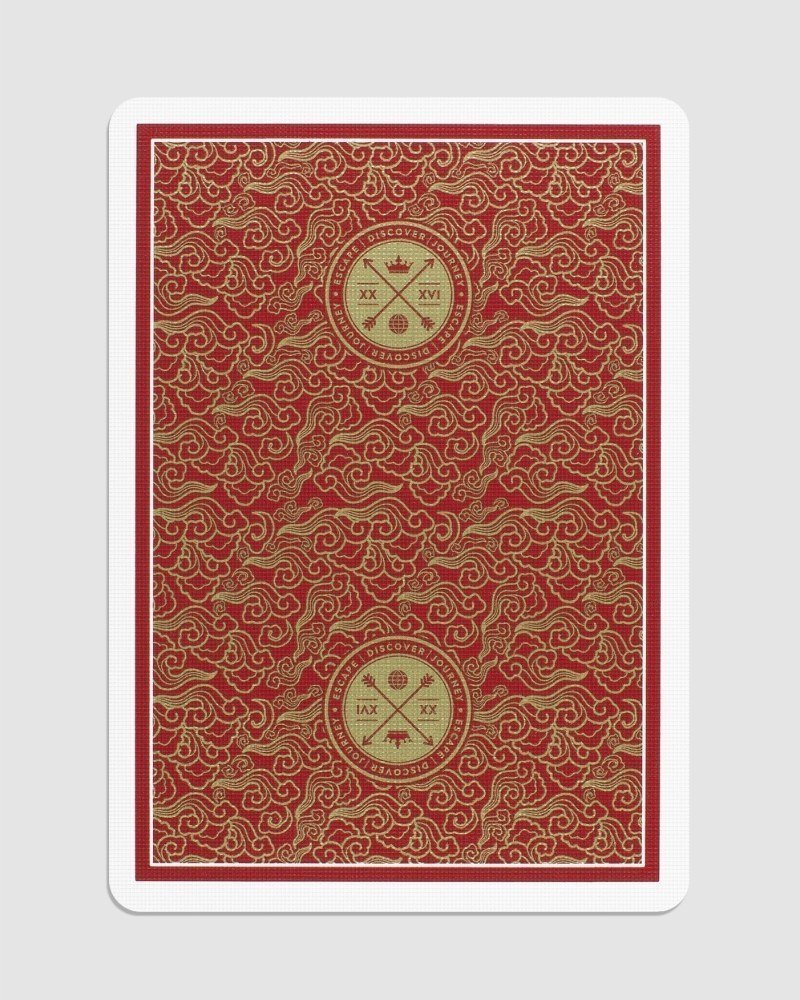
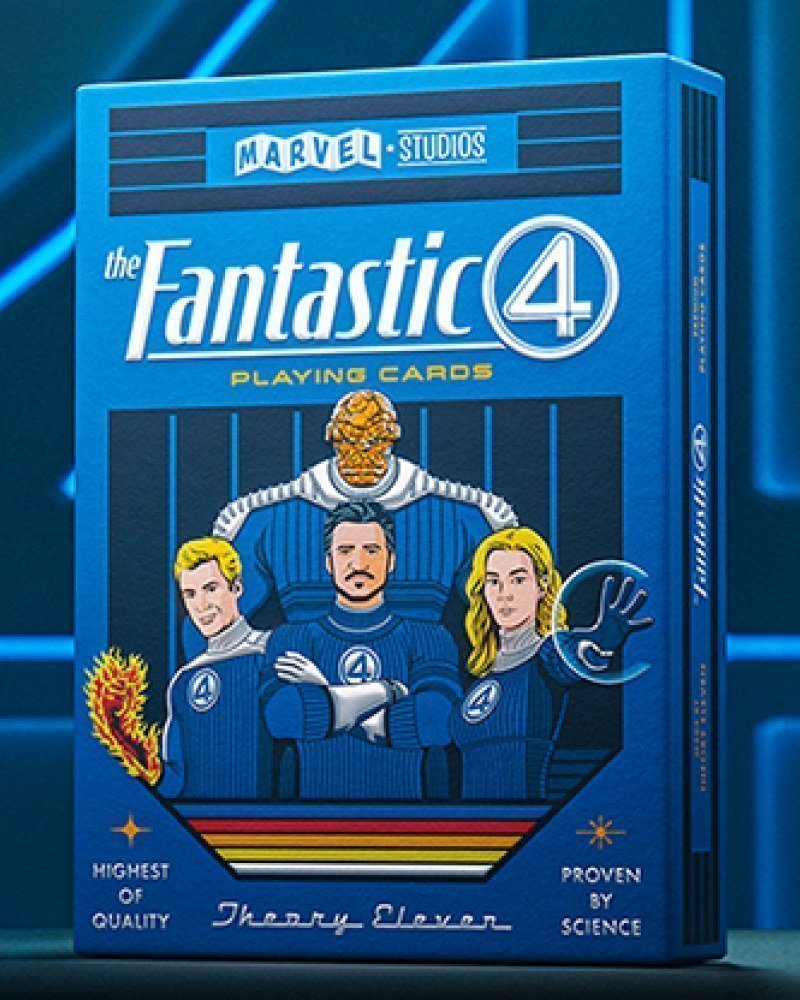
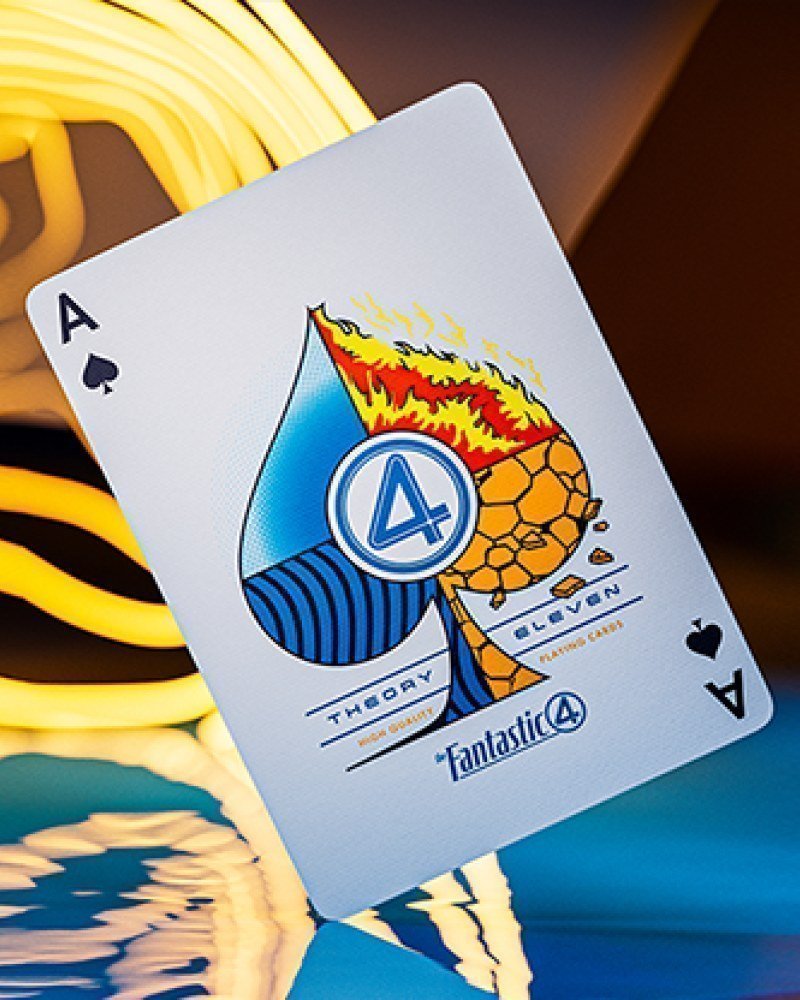
At heart, every deck has the same cards. What changes is everything else: the design, the finish, metallic inks or gilded edges. Take a look at our catalogue and bring your own style to the card table.
Browse our playing cards →




The complete kit: what you need on the table
The bare minimum for a proper poker night:
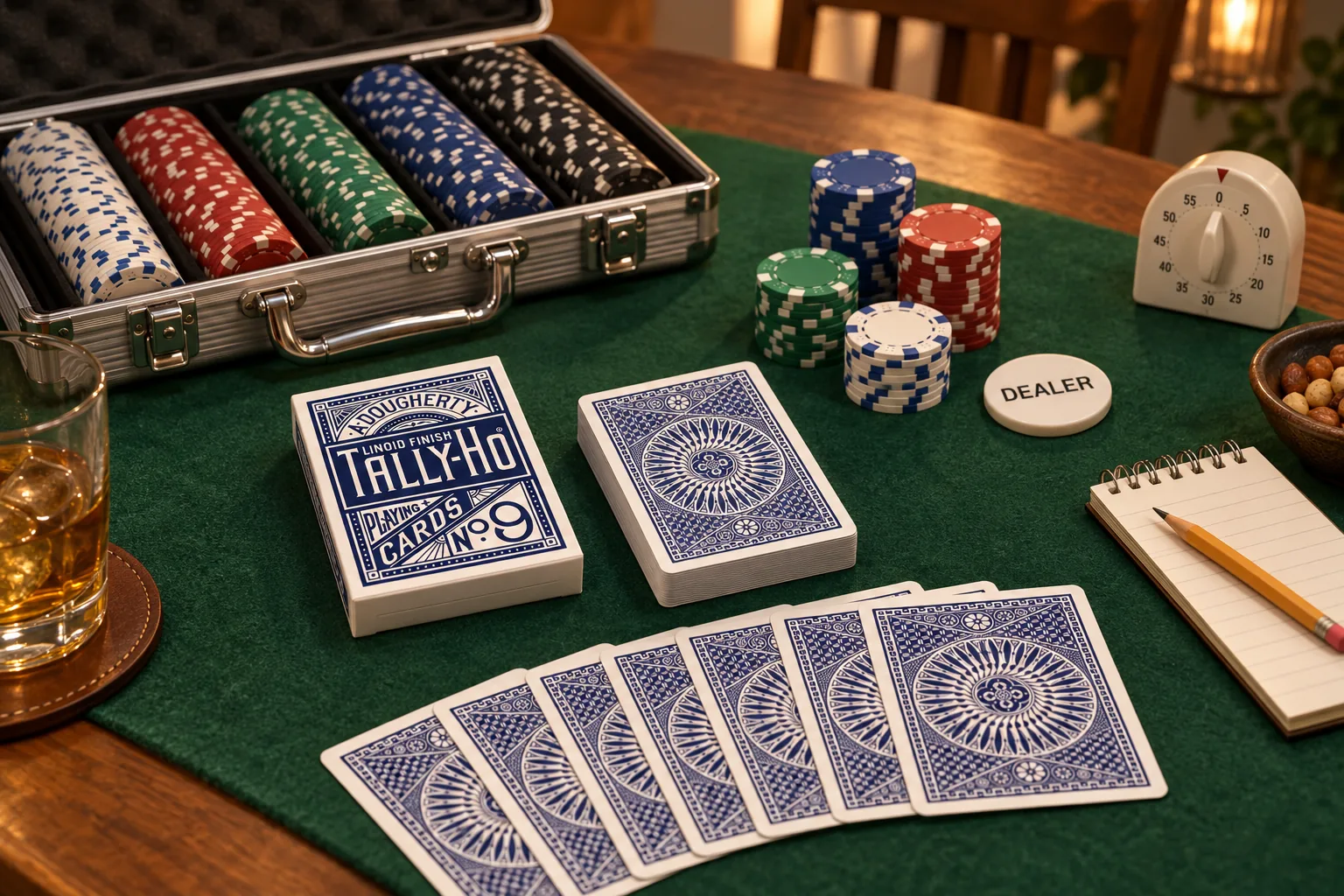
- One or two poker decks. Two is better than one: while one is in play, the other is being shuffled for the next hand, which saves time between orbits. Go for quality: a Bicycle Standard, a Bee Stinger or a Tally-Ho are the classic table decks. Corner-shop decks give up over a long night: they lose their snap, they fan badly and they start to mark.
- Chips: 300 for 6-8 players; 500 for 8-10. "Casino weight" chips (11.5 g or more) feel right when you stack them; cheap thin plastic ones weigh next to nothing and scatter at the slightest knock.
- Dealer button: it comes with the chip set almost every time. If not, a coin or any small agreed object will do, as long as it clearly marks who is dealing this hand.
- Blind buttons: two extra discs marking where the SB and BB are. Useful rather than essential, above all at big tables where it is easy to lose track when someone asks "hang on, who was the big blind?".
- A suitable table: any large table will do as long as the cards slide properly. If you fancy going further, a felt mat (the sort you lay over a dining table) makes a clear difference: the cards glide instead of catching, and the chips stay put.
- Comfortable chairs: a long session on hard stools turns into torture. Make sure you have seats with a decent back for everyone who will be sitting down.
- A timer or blind app.
- A printed sheet with the blind structure and the prize list. Print a copy and leave it on the table: it heads off arguments halfway through the night.
If you want to go further, the details that really raise the quality of the evening are: a pendant light over the table (no vertical strip lighting, no harsh bulbs), a dedicated case for storing the chips between hands, a card holder for new players who can't quite fan a hand yet, and a cut card for lowering the deck if you are going to play with a rotating dealer.
Which deck to choose, and why it isn't all the same
Plenty of people setting up a home game for the first time buy any old deck from the corner shop "because it's only one night". And on the first hand, it really is all the same. By the time you have dealt 80 hands and you all start noticing that the edges are giving way, the cards are marking and two from the middle have stuck together, it matters rather more. And halfway through the second night, that deck is ready for the bin.
The three decks you'll see on any serious table anywhere in the world:
- Bicycle Standard: the lifelong classic. Made by USPCC (the United States Playing Card Company), Air Cushion finish, perfectly balanced for play. When in doubt, this one never lets you down. Priced between 4 and 6 €.
- Bee Stinger: the casino favourite thanks to its diamond back, which makes it harder to mark cards for cheating. A smoother finish, very hard-wearing. Also USPCC.
- Tally-Ho: two back options (Fan Back and Circle Back), also with an Air Cushion finish. The choice of many serious players because of the snap when you shuffle, that little click a well-pressed deck makes. Priced much like the Bicycle.
All three sit around 4-6 € in our selection of poker decks. If you are going to get through 80 hands a night and hold regular sessions, pick up two or three and rotate them so they don't all wear out at once. If you want to know more about what really separates the brands, it is all in our Bicycle vs Theory11 vs Tally-Ho comparison. And if you want to understand where playing cards came from in the first place, the history of the poker deck is full of interesting facts that lie behind today's design.
Plastic decks: the "forever" option
Another detail people overlook: the decks you see in televised casino tournaments and big card rooms are plastic (brands like KEM, Copag and Modiano), not paper. Plastic takes far more hands and is washable (a glass of wine won't kill it), but it feels strange at first if you have come from paper, and it costs more: between 20 and 40 € a deck. For home use, a quality paper deck is more than enough. The only people who move to plastic are groups playing several nights a week or running semi-professional clubs.
Prizes: how to split the pot
In a 6-8 player tournament with a small buy-in, the fairest and most common split is:
- 1st: 60% of the total pot.
- 2nd: 30% of the total pot.
- 3rd: 10% of the total pot.
If only the winner gets paid (winner-takes-all), the evening becomes more exciting but also riskier for anyone who doesn't reach the final table. If there are 4 or 5 of you, a single prize for first place is the simplest option and it works. If there are 8 or more, go for 60-30-10 so that three players get paid and nobody is left too frustrated at busting in fourth.
The "bounty": prizes for knockouts
One alternative that works very well in games among friends: every time you knock a player out, you take a small fixed slice of their buy-in (1 € out of the 10 €, for example). The main prize shrinks by the same amount, but there is an incentive to play aggressively all night: eliminating someone pays. It hugely increases both the fun and the interaction between players. A mixed format would look like this:
- Buy-in: 10 € per player.
- Of that 10 €: 3 € go into the bounty pool (you collect 3 € for each player you knock out).
- The remaining 7 € go into the main pot, split 60-30-10 between the top three.
"Shootout" and "SnG" tournaments for awkward group sizes
If there are a lot of you (10-16 players) and a single table becomes unmanageable, the shootout format splits you across two tables, with the winner of each going through to the final. Sit & Go (SnG) events are quick variants: everyone starts with a smaller stack, the blinds rise faster and the whole thing takes 60-90 minutes. Handy if you want to fit two short games into one night instead of a single long one.
House rules: the small decisions that prevent arguments
Before you start, it is worth getting everyone to agree on these basics. The rule is: whatever is decided is law, even if someone later wants to change it mid-hand because it suits them. Arguing in the middle of a hand about a rule nobody discussed is the quickest way to ruin the night.
- Dealing: the deal rotates with the button. Each player shuffles and deals when it is their turn, or you appoint a "permanent dealer" (usually the host) who always deals so there are fewer mistakes. Both formulas work; decide beforehand.
- Accidentally exposed cards: if a card is seen by accident during the deal, most official rules call for a reshuffle and a fresh deal. Agree in advance: do you apply that rule, or carry on with the "tainted" hand? At home the first accident is usually forgiven and the rule applied from the second one onwards.
- String betting: in formal poker you cannot "drip chips in" to see your opponent's reaction and then decide whether to raise. The bet is whatever you push forward in one continuous motion. In a friendly game it is usually forgiven the first few times, but it is worth announcing your action verbally: "I call 100" before you put the chips out.
- Verbal declaration vs chips: if you say "raise to 200" without putting chips out, that is your official bet. You can't take it back. This heads off the classic "I'll bet 100... no, make it 50" when you see someone flinch.
- Dealing errors (misdeals): if the dealer gets it wrong (too few cards, wrong order, one turned over when it shouldn't be), the hand is void and the deck is reshuffled. This applies before the flop is complete; after that, the hand stands.
- Showdown with no action: if two players reach the river with nobody having bet (everyone checked), both have to show their hand to see who wins. "You first" and "show yours and I'll decide whether to show" don't count.
- Talking about live hands: a universal rule, and probably the most important one for keeping the game fair: if you're not in the hand, you don't talk. No commenting on what others might have, no advice, no reacting to the community cards, no showing the hand you folded. Players who have folded stay out of it.
- Time per decision: in a home game you don't need a strict clock. But if somebody takes two minutes over every decision in every hand, the night becomes endless. A reasonable limit is 30-60 seconds per decision in a normal hand, and 2-3 minutes for big decisions with a whole stack on the line.
Put these rules on a sheet next to the blind list. If a question comes up mid-hand, you go to the sheet and nobody argues. That sheet saves a lot of discussion.
Snacks and drinks: planning the food
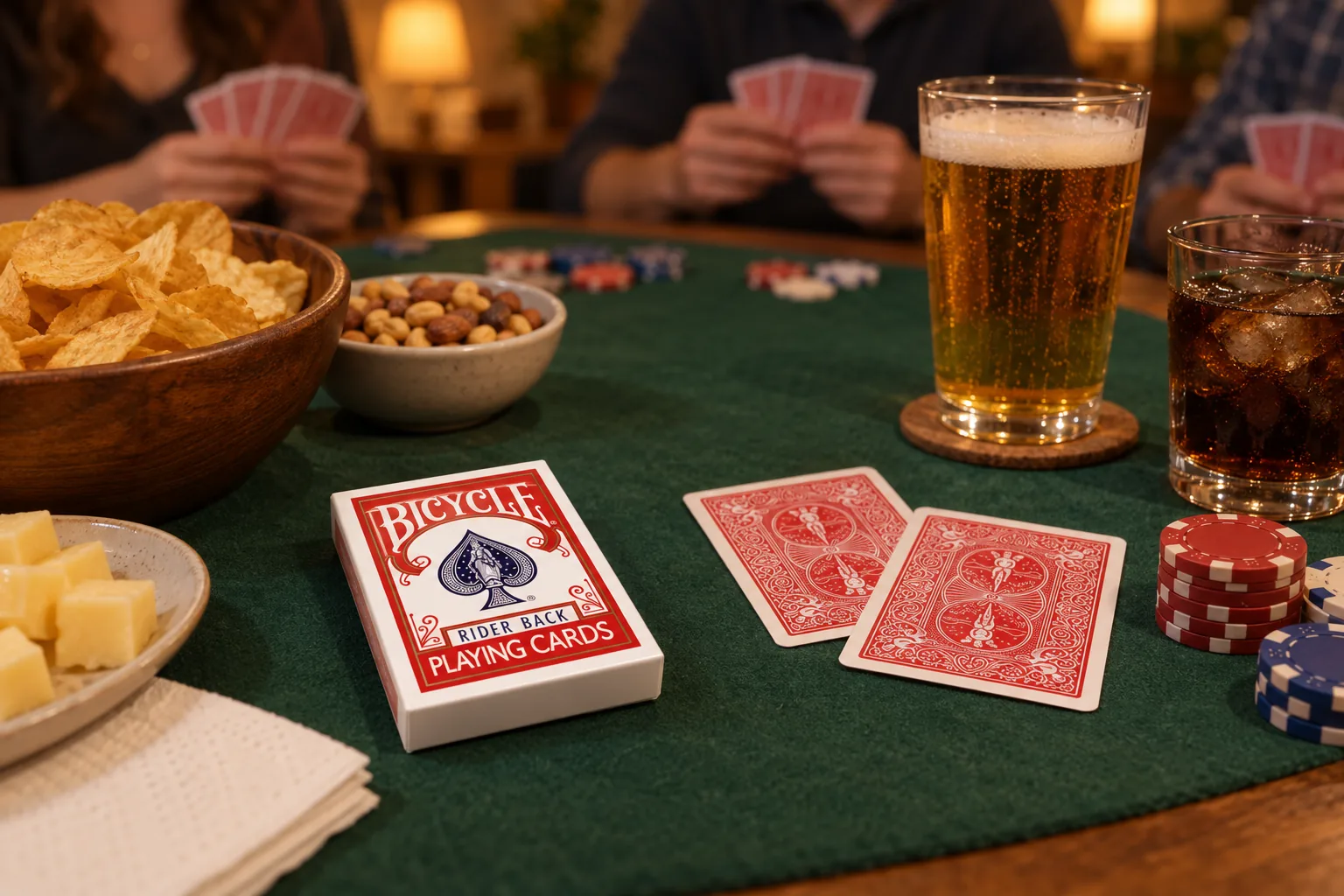
The thing that most affects how long the evening actually lasts, and which almost nobody factors in when planning it, is the food. If everyone arrives hungry, the first hour goes on dinner and the whole thing falls apart. If nobody eats, after two hours the table starts looking for excuses to stop. The balance matters just as much as getting the blinds right.
What works best, in this running order:
- Something to nibble on at a separate table while people arrive. Crisps, olives, cubes of mature cheese. 20-30 minutes, without sitting down at the playing table yet.
- A light supper before the first hand. Pizza, sandwiches, a charcuterie board, a quiche, sausage rolls. Something that doesn't call for a deep bowl and proper cutlery at the card table.
- Individual snacks on the playing table during the game: nuts, popcorn, some small fruit. Things you pick up with your fingers without smearing the cards.
- Soft drinks available throughout: water, fizzy drinks, a big jug of something. A poker night with alcohol flows nicely until the third round; from the fourth onwards come the mistakes and the silly arguments. Beer in moderation, yes; shots, no.
- Coffee for the long breaks. It keeps the evening awake right to the end, especially if you are going to play for five or six hours.
What you have to avoid: any sauce hot or cold, melted cheese, chicken wings, greasy food that goes straight onto the cards. Greasy cards become unpresentable within a few hands and the game turns into something unpleasant to follow. Damp napkins within reach and hand wipes are the sort of detail that seems not to matter until it very much does.
Classic first-timer mistakes
1. Too many players
Inviting 10-12 people because "the more the merrier". The table becomes very slow (too many folds, every hand takes a long time), people get bored, and the game ends up as either two badly organised tables or one unmanageable one. Better 6-8 committed players than 12 half-hearted ones. If there are a lot of you, plan a second table from the outset or use a shootout format.
2. Blinds that go up too slowly
Levels of 30-40 minutes in a home game: you reach the fifth level without having had to make a single difficult decision. The evening drags and people lose interest before the interesting phase even begins. Better 15-20 minutes per level for a total of 3-4 hours.
3. Starting stacks that are too small
Handing out 1,500 chips with opening blinds of 25/50 means that after a couple of raises people are already in trouble. The starting stack should be at least 100 times the opening big blind so the early levels are playable. If you are short of chips, adjust the blinds upwards, not the stacks downwards.
4. Changing the rules halfway through
"Let's add an ante now" or "let's push the blinds up, we're going slowly". Any rule changed halfway through will favour some and hurt others, and that breeds resentment even if nobody says so. The big decisions (blinds, ante, format, prizes) all belong before the first hand.
5. Having no change for rebuys (in a cash game)
If someone wants to top up and nobody can break their 50 € note, the game stops. Getting change ready (fives, tens and coins) avoids the problem and keeps everything flowing.
6. Ignoring the social factor
Poker is a game, but the evening is among friends. If somebody is losing everything and taking it in good humour, don't squeeze them too hard with shark moves. If somebody is far too serious and spoiling it for the rest, remind them it is meant to be fun. The balance matters. The game that is technically perfect but socially uncomfortable doesn't come back next Friday.
7. Not setting the room up in advance
Starting to lay the table at 9 pm when the game is at 9 pm is a guarantee that at 9.30 nobody is sitting down. Set out the chips in ready-made stacks, print the blind and rules sheet, have the decks to hand, and when the first guest arrives you can nibble on something while you wait for the rest.
How much does a deck of cards cost?
From €5 to over €100. The 52 cards and the rules stay the same; this is what changes.
 To play€5.95 To play€5.95 |  Designer€12.95 Designer€12.95 |  Premium€17.99 Premium€17.99 |  Collectible€34.94 Collectible€34.94 | |
|---|---|---|---|---|
| Typical price | €5-9 | €9-15 | €15-30 | €30 or more |
| What sets it apart | Classic casino design | Artist illustration on back and faces | Special inks, embossing and foil on the box | Limited print runs and gilded edges |
| Who it is for | Games at home | Playing with something beautiful | Gifts or cardistry | Collecting and display |
| Example | Tally-Ho Fan Azul | theory11 Medallion | The Sandwich Series (Luncheon Meat) | Kings Wild LOTR Two Towers Gilded |
| See decks | See decks | See decks | See decks |
Frequently asked questions about hosting a poker night
How many chips do I need to buy for an 8-player game?
A 300-chip set in 4-5 colours is just right for 6-8 players. If the idea is to hold regular nights with more people or with longer structures, a 500-chip set gives you more room for the late-stage stacks, when each player might hold 30,000-50,000 chips and the low-value ones become dead weight.
Tournament or cash game for a first night with friends?
Tournament. The financial ceiling is clear from the start (a fixed buy-in), everyone pays the same, and the evening has a "story": you all start equal, someone is going to win. A cash game works better when all the players are already regulars and know exactly how much they are willing to put on the table.
How long should the blind levels be in a home tournament?
Between 15 and 25 minutes per level for a 3-4 hour tournament. If it is too fast, the blinds speed up the eliminations and there is no time to play hands properly; if it is too slow, you reach the fifth level without having faced a single tough decision. 20 minutes per level is the sweet spot for a first time.
Which deck do you recommend for a poker night?
For a regular game with friends, a Bicycle Standard or a Tally-Ho are the two classic choices. Air Cushion finish, proven durability, priced between 4 and 6 €. If you are going to play a lot of hands in one night, keep two in rotation: while one is being dealt, the other is being shuffled for the next orbit and you save time between hands.
How are the prizes split in a home tournament?
The most common arrangement with 6-8 players: 60% to first, 30% to second, 10% to third. If there are 4-5 of you, a single prize for first place. A fun alternative is the bounty: part of the buy-in goes to whoever knocks you out, which encourages more aggressive play all night long.
How do I handle someone wanting to buy more chips after losing?
In a cash game, they can reload freely at the same amount or more. In a freezeout tournament there is no reload: if you are knocked out, you're out. There are rebuy tournaments where, during the first 60 minutes, you can pay another buy-in and return with a starting stack, which adds to the prize pool. Decide before you start and make it clear. A common mixed format: "unlimited rebuys during the first 4 levels, then freezeout".
Is it legal to host home poker games for money?
In most of Europe, private games between friends with no third party profiting from them are legal: what is prohibited is the house taking a commission (the rake) or the whole thing being run as a business. If you as the host take no percentage of the pot and everything staked is shared out among the players, there is no legal issue. As with everything, it pays to be sensible about the amounts and not to run sessions open to the public.
Can I use variants other than Hold'em on a home night?
Of course. Plenty of home games rotate variants every so many hands: eight orbits of Hold'em and one of Draw or Omaha for a change, for instance. I go through the main ones and which suits each purpose in poker variants. Formats like HORSE are far too complex for beginners, but slipping in a couple of orbits of Five-Card Draw or Crazy Pineapple works very well.
What if the players turn up with wildly different skill levels?
That's normal. A couple of tricks: lower the buy-in so the maximum loss doesn't sting the beginners, spend five minutes at the start recapping the hand rankings and the basic rules so everyone starts from the same place, and ask the more experienced players to go easy on the elaborate bluffs in the early rounds. The game isn't a professional tournament: it's a night with friends. If the good players don't let the others play, the others don't come back.
Quick summary: the kit and the night in five points
- 6-8 players, 3-4 hours, a tournament with a fixed buy-in (10-25 € is a good range to start with).
- Kit: two Bicycle or Tally-Ho decks, a 300-chip set, a dealer button, a mat if you have one, a printed sheet with the blinds and the rules.
- Starting stack: 5,000-7,500 chips. Opening blinds of 25/50, 20-minute levels, rising sensibly until the end is forced.
- Prizes: 60-30-10 for 6-8 players. Bounty optional for extra fun.
- A light supper beforehand, clean snacks during, drinks in moderation, coffee for the long breaks.
With that you already have a night that will run itself. The rest (who wins, who pulls off the worst bluff, who spends half an hour on tilt) is part of any game and has nothing to do with the host.
Where to start if you have never hosted one
If you have never put on a proper poker night, the most practical approach is to start with a basic kit: two quality poker decks and a starter chip set. The brands that have been showing up on serious tables for decades are Bicycle and Tally-Ho, and they are the safe bet. Our whole selection is in poker decks, and to understand what really sets the brands apart there is the Bicycle vs Theory11 vs Tally-Ho comparison. If you fancy digging deeper into playing cards in general (why there are 52 of them, why those suits), have a look at the suits of the poker deck and our general playing card selection.
For any players turning up without knowing the rules, send them how to play Texas Hold'em and poker hands and their ranking in advance. Thirty minutes of reading and they can sit down at a table without embarrassing themselves. And if you'd like them to pick up a little strategy while they play, the introduction to table positions and working out pot odds are the next logical steps.
And if you catch the bug and want to know what lies beyond Hold'em, poker variants offer plenty of ways to alternate formats within the same evening. Five orbits of Hold'em, one of Five-Card Draw for a change, another of PLO if everyone can play it... far more fun than always playing the same thing. With that, the next home poker night won't be an improvisation any more, but something people will be looking forward to repeating.
Poker
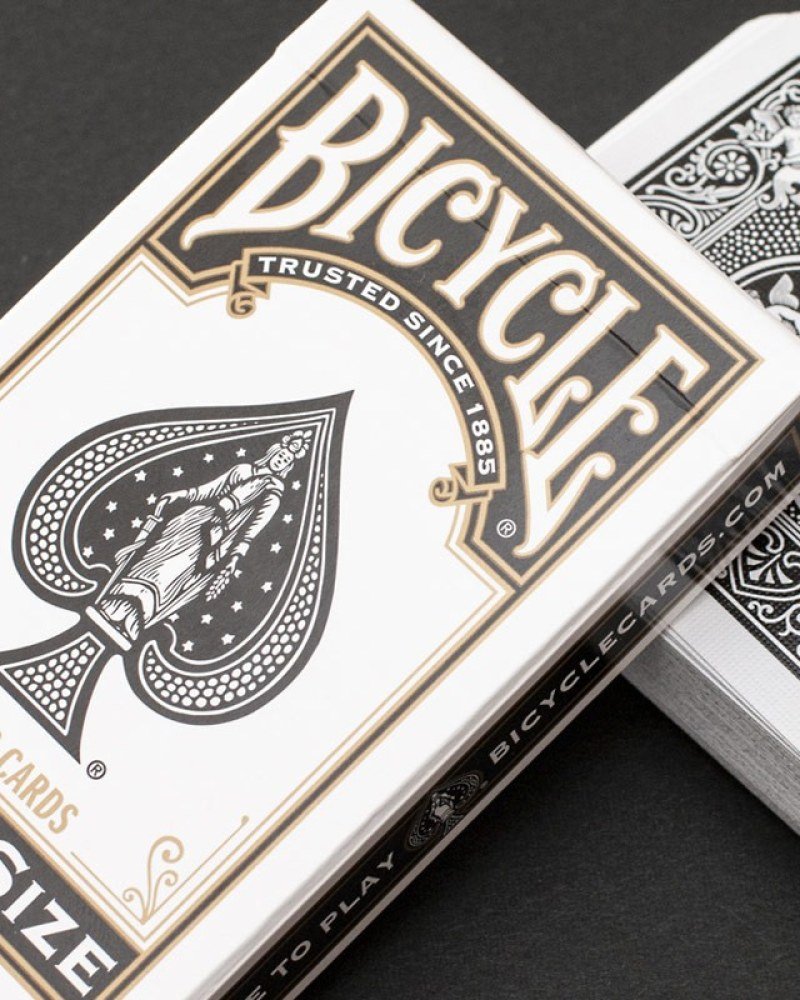
Bicycle Bridge Black – Playing Cards

Tally-Ho Circle Expert Touch Blue – Playing Cards

Tally-Ho Circle Expert Touch Red – Playing Cards
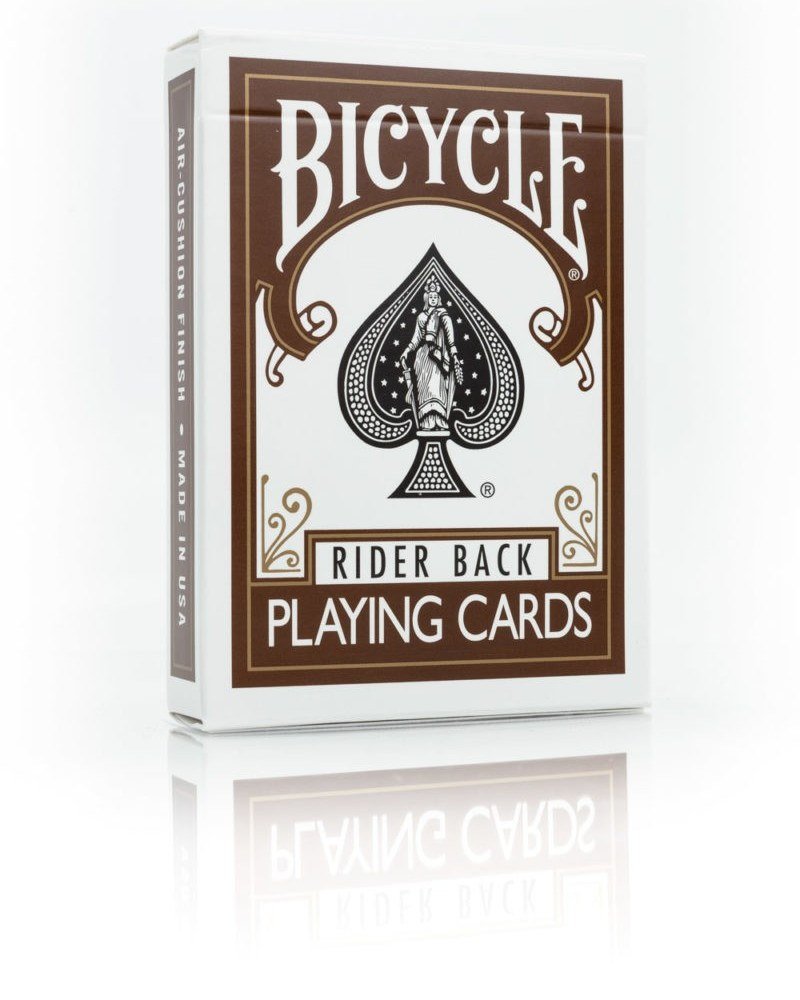
Bicycle Brown Back – Playing Cards
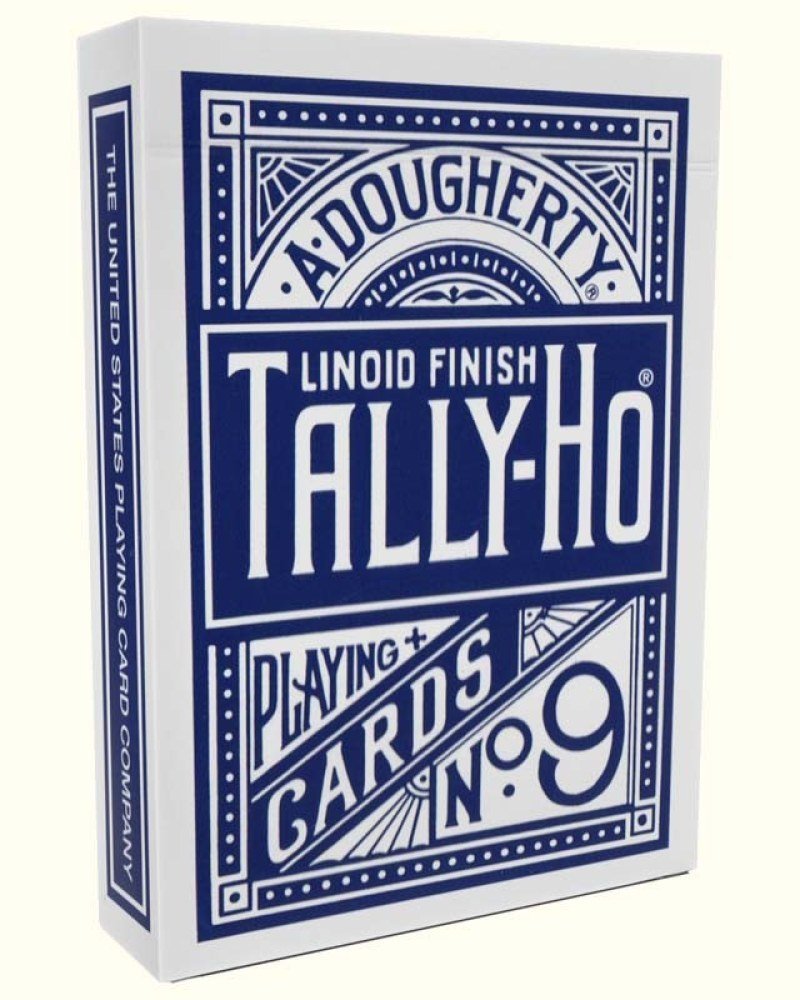
Tally-Ho Fan Blue – Playing Cards
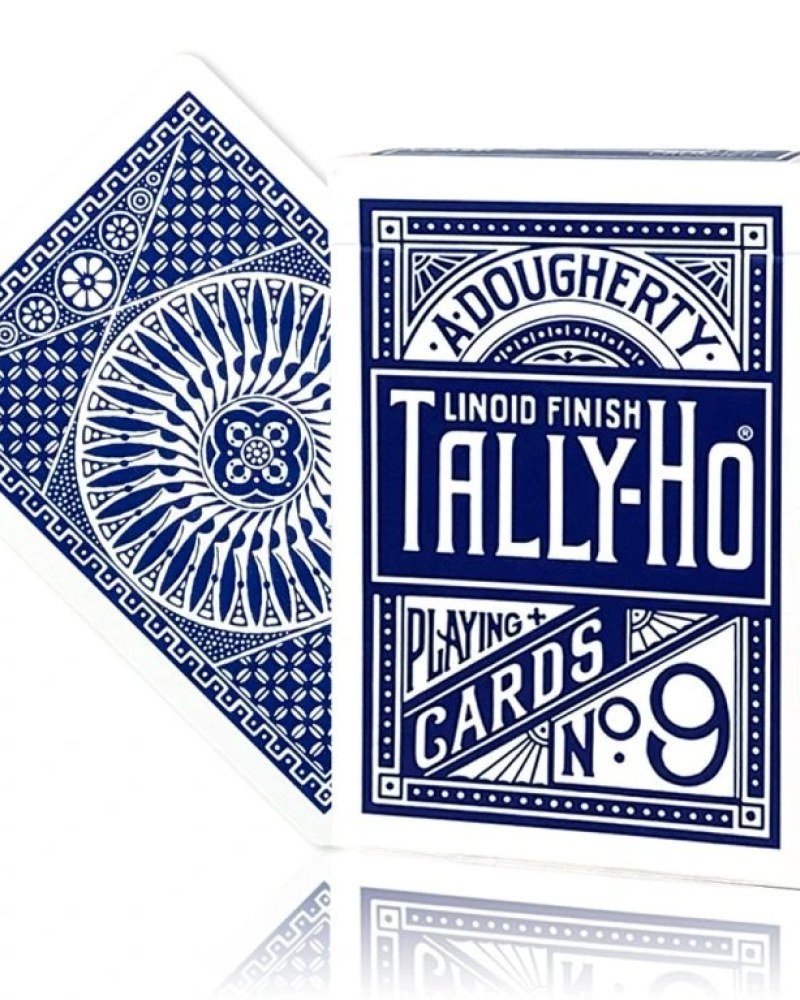
Tally-Ho Circle Blue – Playing Cards

Tally-Ho Circle Red – Playing Cards

Bee Jumbo Index Blue – Playing Cards
Contact our team for any clarification about this document. Contact us


