

How to Solve a 2x2 Rubik's Cube: Beginner Method
Solve the 2x2 Rubik's Cube in three steps: white layer, yellow face with the Sune, then corners with the T-perm and Y-perm. Notation and common mistakes.
In short
To solve a 2x2 Rubik's Cube with the beginner method, you work in layers and three steps: first you complete the whole white layer (face and sides), then you make every top sticker yellow by repeating an algorithm called the Sune, and finally you put the four top corners in their places with one of two algorithms. Three move sequences are all this method needs.
- Step 1, white layer:
R U R' U'repeated until each corner drops into its slot. - Step 2, yellow face: the Sune,
R U R' U R U2 R', three times at most. - Step 3, corners in place: T-perm (two adjacent corners) or Y-perm (two diagonal corners).
The 2x2 looks like the easy sibling of the classic Rubik's Cube, and in part it is: it has fewer pieces and can be solved with fewer algorithms. But it has a catch that trips up people coming from the 3x3: it has no fixed centers, so no piece tells you which color each face should be. This tutorial explains how to solve a 2x2 from scratch with the layer-by-layer beginner method, using just the notation you need, diagrams of every case and the mistakes learners make most often. If you can already solve a 3x3, you will see that the 2x2 is the same as solving only its corners.
What is the 2x2 Rubik's Cube (Pocket Cube)
The 2x2 (also called the Pocket Cube or Mini Cube) is a cube cut once along each of its three axes. The result is 8 pieces, and all 8 are corners: each one has three stickers of different colors. There are no edges or centers, which on the 3x3 are the pieces that set the color of each face. That is why on the 2x2 you choose the color of a face when you start, and what matters is that the corners fit together.
Its history has a curious twist. The first patented 2x2x2 puzzle belongs to Larry D. Nichols, an American inventor who in 1970 applied for a patent on a cube of rotating pieces held together with magnets (the US patent was granted in April 1972, before Ernő Rubik invented his 3x3 cube). The 2x2 that became popular, Rubik's Pocket Cube, was sold by Ideal Toy in the early 1980s, and Rubik patented it in the United States in 1983. Moleculon, the company that held Nichols's patent, sued Ideal, and in 1986 a US federal appeals court upheld the finding that the Pocket Cube infringed that patent, although it did not uphold the ruling against the 3x3. If you read in one place that Rubik invented the 2x2 and in another that Nichols did, this is why.
| Fact | Value | What it means |
|---|---|---|
| Pieces | 8 corners | No edges and no centers |
| Possible positions | 3.674.160 | Different states the cube can show |
| Maximum moves needed to solve any position | 11 (counting 180° turns as one move) | Known as God's number for the 2x2 |
| Maximum counting quarter turns only | 14 | If a 180° turn counts as two moves |
| Official competition | Yes, in the WCA | It is one of the events at official championships |
The figure of 3,674,160 comes from a simple calculation. The 8 corners can be arranged in 8! ways and each can be twisted in 3 ways, but the orientation of the last corner is fixed by the others (hence 37 and not 38). Also, since there are no centers, rotating the whole cube in your hand doesn't change the position, and there are 24 ways to hold it. That leaves (8! × 37) / 24 = 7! × 36 = 3,674,160. That is far fewer than on a 3x3, but more than enough to make random turning pointless.
Basic notation: R, U, F, prime and 2
Algorithms are written with letters. Each letter is a face of the cube, and the turn is always clockwise as if you were looking straight at that face. For this method you only need three faces and two modifiers:
- R (right): the right layer.
- U (up): the top layer.
- F (front): the layer facing you.
- Prime ( ' ): the same turn in the opposite direction.
R'is read “R prime”. - 2: a half turn (180°).
U2means turning the top layer twice; direction doesn't matter.
In other guides you will also see L (left), D (down) and B (back), which follow the same logic. You don't need them in this article.
The easiest way to understand each move is to do it on a solved cube and look at what changes. The diagrams below show three faces at once: top (yellow), front (green) and right (red), with white on the bottom.
| Move | Which layer moves | How to remember it | Result (top, front and right) | ||||||||||||||||
|---|---|---|---|---|---|---|---|---|---|---|---|---|---|---|---|---|---|---|---|
| R | Right layer, upward | The front comes up over the top towards you | |||||||||||||||||
| R' | Right layer, downward | The front goes down | |||||||||||||||||
| U | Top layer, to the left | The front stickers move to the left | |||||||||||||||||
| U' | Top layer, to the right | The front stickers move to the right | |||||||||||||||||
| U2 | Top layer, half turn | The front stickers move to the back | |||||||||||||||||
| F | Front layer, clockwise | The top row of the front moves to the right column | |||||||||||||||||
| F' | Front layer, counterclockwise | The top row of the front moves to the left column |
The 2x2 beginner method in three steps
This is the method usually taught to beginners. It solves the cube layer by layer: first the whole bottom layer, then the top one in two phases (first orienting, meaning everything on top becomes yellow, then permuting, meaning each corner goes to its place). In this tutorial we use white on the bottom and yellow on top; if your cube has other colors, the procedure is the same with its opposite colors.
1. White layer
4cornersThe four white corners go on the bottom, with the side colors matched up.
- R U R' U'
- Partly intuitive
2. Yellow face
≤3SunesWith white on the bottom, the four top stickers are made yellow.
- Sune
- 7 possible cases
3. Corners in place
2algorithmsThe top corners are swapped until the sides match the bottom layer.
- T-perm
- Y-perm
Step 1: the first layer (white)
The goal is a white bottom face where, on every side, the two stickers in the bottom row are also the same color. A white face with mismatched sides is no good, because the last steps won't work out.
1.1 Pick your first corner
Find any corner with a white sticker and hold the cube with that sticker facing down. That piece is now “solved” and becomes your reference: its other two colors set the colors of two of the sides.
1.2 Work out where each white corner goes
Find another white corner in the top layer and compare it with the one already on the bottom (ignoring white):
- If they share a color, the new one goes right next to the solved one, on the side of that shared color.
- If they share no color, it goes diagonally, in the position opposite the solved one.
1.3 Insert it with R U R' U'
Turn only the top layer (U) until the new corner is right above its slot, then rotate the whole cube in your hand (without flipping it: white stays on the bottom) so that slot is at the bottom front right. The corner is now at the top front right. Repeat this four-move sequence until the piece drops in correctly:
| Where the white sticker is | Repetitions | What it looks like (gray = doesn't matter) | ||||||||||||||||
|---|---|---|---|---|---|---|---|---|---|---|---|---|---|---|---|---|---|---|
| Facing right | 1 | |||||||||||||||||
| Facing up | 3 | |||||||||||||||||
| Facing you (front) | 5 |
You don't need to count: just repeat the whole sequence and stop as soon as the corner is on the bottom with white facing down. It works because R U R' U' repeated six times brings the cube back exactly to where it was; along the way, the piece goes through all its possible orientations.
Repeat 1.2 and 1.3 with the other two white corners. If a white corner is stuck in the bottom layer in a slot that isn't its own (or in its own slot but twisted), put it at the bottom front right and do R U R' U' once: it will come up to the top layer and you can insert it like the others.
Cubes for every level
From a first magnetic 3x3 to competition cubes and less common shapes such as the Megaminx or the Pyraminx. Take a look at our catalogue.
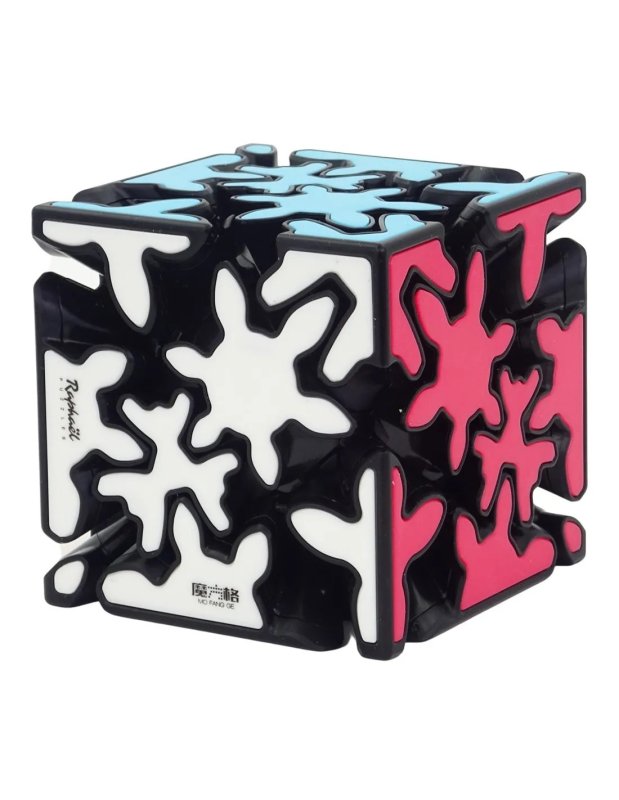
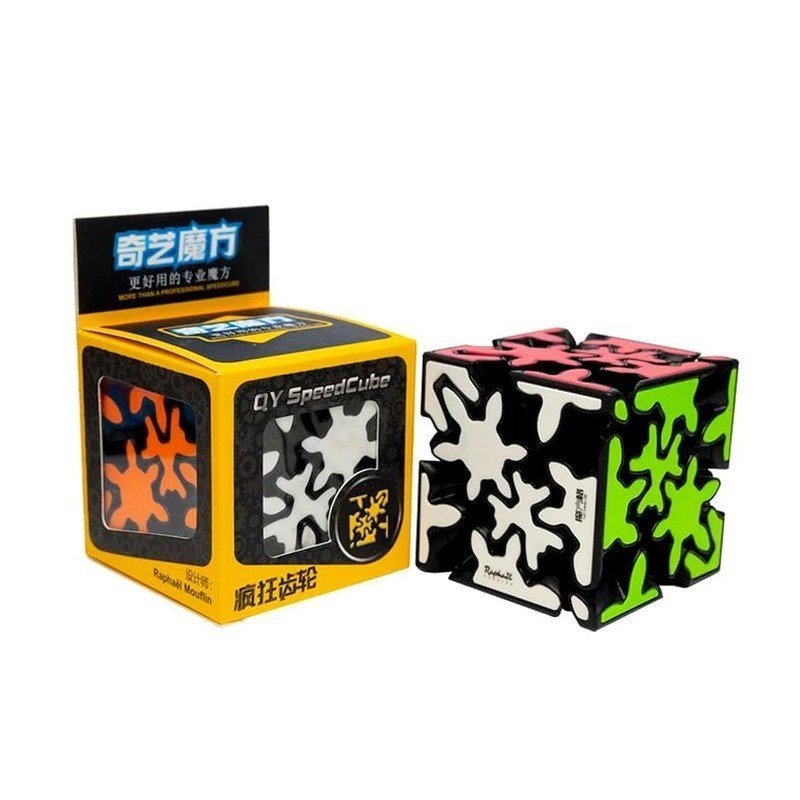 QiYi Crazy Gear Cube 3x3 - Puzzle con Engranajes
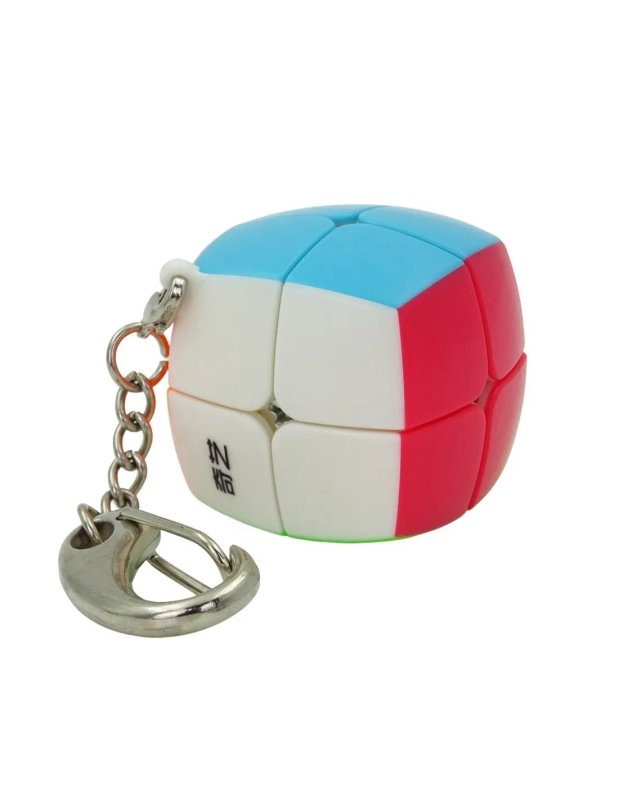
 QiYi 2x2 Mini Pillowed Llavero Stickerless Removible
 QiYi QiHeng S2 Megaminx Stickerless Dodecaedro
 QiYi Void 3x3 Magnético UV Coated Stickerless
Step 2: orient the last layer with the Sune
Keep the white layer on the bottom and the yellow face on top. From now on the bottom layer stays as it is (the algorithms mix it up for a moment but put it back by the end). The goal of this step is to make all four top stickers yellow, without worrying yet about whether the corners are in their places.
To remember it: it is the right hand going up and down (R and R') around three top-layer turns in the same direction, the last one a double.
How to hold the cube before each Sune
Count how many yellow stickers are on the top face and follow this rule:
- 4 yellow: step done.
- 1 yellow: turn the top layer (
U) until that corner is at the front left and do the Sune. - 0 or 2 yellow: turn the top layer until the front left corner has its yellow sticker facing left and do the Sune.
After each Sune, count again and repeat. With this rule you never need more than three Sunes.
| Case | How to hold it | Sunes to finish | ||||||||||||||||
|---|---|---|---|---|---|---|---|---|---|---|---|---|---|---|---|---|---|---|
| 1 yellow, the Sune “fish”. Yellow corner at front left; the front right corner faces you. | 1 | |||||||||||||||||
| 1 yellow, the other fish. Yellow corner at front left; the front right corner faces right. | 2 | |||||||||||||||||
| No yellow. Front left corner, yellow facing left. | 2 | |||||||||||||||||
| Two yellow. Front left corner, yellow facing left. | 3 |
The diagrams are a top view: the central square is the top face and the strips around it are the side stickers of those corners (the bottom strip is the one facing you).
Step 3: put the top corners in place
The top face is now all yellow, but the sides of the top layer may not match the bottom. First turn the top layer (U) to find the best alignment and look at the four sides of that layer. Only one of these three things can happen:
| What you see | What to do | Frequency |
|---|---|---|
All sides match (or match after turning U) | Adjust with U and you are done | 1 in 6 |
| One side has two matching stickers (the “headlights”) | T-perm | 4 in 6 |
| No side has two matching stickers | Y-perm | 1 in 6 |
Two adjacent corners swapped: the T-perm
Turn the top layer until the side with two matching stickers (the headlights) is on your left. The algorithm swaps the two corners on the right.
To memorize it, notice that it starts with the four moves from step 1 (R U R' U') and that the rest revolves around F and F'. When you finish, turn the top layer with U until all sides match.
Two diagonal corners swapped: the Y-perm
If no side has two matching stickers, two diagonal corners need to be swapped. Here you don't need any special position: do the algorithm with the yellow face on top, then adjust with U.
It is the longest algorithm in the method, but it splits into two halves: F R U' R' U' R U R' F' and R U R' U' R' F R F'. Practice each half separately, then put them together. After the last move, adjust the top layer with U and the cube is solved.
Need a 2x2 to practice on?
We stock magnetic 2x2 speedcubes, starter packs and shape mods.
Shop Rubik's cubesCommon mistakes when solving the 2x2
Rotating the whole cube in the middle of an algorithm
This is the most common mistake. If you change the front face partway through a sequence, the moves that follow apply to a different layer and the result is unpredictable.
- Steps 1, 2 and 3
White layer with mismatched sides
The bottom face is all white, but on some side the two bottom stickers don't match. That way step 3 cannot work.
- Step 1
How to fix it
Take out one of the misplaced corners with R U R' U' (with it at the bottom front right) and insert it again using the shared-color rule from section 1.2.
Stopping halfway through a long algorithm
During the Sune and the permutations, the white layer gets mixed up along the way and only returns to its place with the last move. If you stop early, or skip a turn, the bottom layer stays broken.
- Steps 2 and 3
How to recover
If you get lost halfway, the quickest fix is usually to redo the white layer (step 1) and carry on from there, rather than trying to undo the moves.
Mixing up R and R'
R turns the right layer upward (looking at the cube from the front) and R' turns it down. When in doubt, do the move on a solved cube and compare it with the notation table.
- Notation
A single twisted corner at the end
If everything is solved except one corner twisted in place, it is not a mistake in the method: someone twisted it by hand, or the cube was taken apart and put back together wrong. That position can't be reached by turning faces.
- “Impossible” cube
What to do
You need to pop out or twist that corner to fit it back correctly oriented. Do it carefully and follow the manufacturer's instructions for your model so you don't force the mechanism.
Forgetting the final top-layer adjustment
After the T-perm or Y-perm there is almost always one last U turn left. If the cube looks “almost” solved with the top sides shifted, that's it.
- Step 3
What's next: Ortega, CLL and EG
Once the layer-by-layer method comes naturally, the next step is to learn methods designed specifically for the 2x2. We don't explain them step by step here, but it helps to know what each one is and the order in which they are usually learned.
Ortega (or Varasano)
12algorithmsAn intermediate method. You build just one face (without worrying about the sides), orient the opposite face and then permute both layers at once.
- Face + OLL + PBL
- The natural next step
More detail
Orienting the last layer has 7 cases (the Sune is one of them) and permuting both layers, called PBL, has 5. Some sources count more algorithms because they split symmetrical cases; the usual figure is 12. The most common name comes from Victor Ortega, although the method is also credited to Jeffrey Varasano.
CLL
42algorithmsYou build the full first layer (as in step 1 of this guide) and then solve the whole top layer with a single algorithm.
- Layer + 1 algorithm
- Advanced level
More detail
The name stands for Corners of the Last Layer. It is the usual stepping stone between Ortega and EG.
EG
128algorithmsYou build just one face, as in Ortega, and finish the whole cube with a single algorithm. It includes the 42 CLL algorithms.
- Face + 1 algorithm
- Competition level
More detail
It was proposed by Erik Akkersdijk and Gunnar Krig (EG stands for their first names). It is split into three sets depending on how the first face ends up: CLL, EG-1 and EG-2.
Top cubers go further: during the 15 seconds of inspection the regulations allow before starting, they try to plan the whole solution of the cube in a single look (known as one-looking the solve).
The 2x2 world record
Official records are kept by the World Cube Association (WCA), which runs official speedcubing competitions. As of October 2026, the 2x2 world records are:
| Category | Time | Cuber | Competition |
|---|---|---|---|
| Single solve | 0.39 s | Ziyu Ye (China) | Hefei Open 2025, October 25, 2025 |
| Average of 5 solves | 0.86 s | Sujan Feist (United States) | Kids America Christmas Clash OH 2025, December 13, 2025 (repeated in August 2026) |
The average is calculated as in every WCA event: of five attempts, the best and worst are dropped and the remaining three are averaged. It is the figure that best reflects real skill, because a single can benefit from an especially easy scramble. To avoid trivial scrambles, the regulations require 2x2 scrambles to need at least 4 moves to solve.
Which 2x2 cube to choose for learning
You can learn the method on a toy 2x2, but a cube that turns badly makes algorithms catch and layers misalign. These are the features that matter most:
| Feature | Why it matters | Recommendation for beginners |
|---|---|---|
| Magnets | They make the layers snap into place at the end of each turn, so it is harder to leave a layer half turned and start the next move misaligned. | Magnetic if you plan to practice seriously Recommended |
| Size | Mini cubes and keychains look nice, but they are hard to hold and to run algorithms on without losing your grip. | Standard speedcube size, not a keychain |
| Stickers or stickerless | Stickerless cubes (colored plastic, no stickers) don't peel or wear out. | Stickerless More durable |
| Shape | Cubes shaped like animals or balls, and mirror cubes, use the same mechanism, but the cases are harder to see. | Start with a regular cube; special shapes later |
If you want to compare specific models from brands like MoYu, QiYi, YJ or GAN, our guide to the best Rubik's cubes for speedcubing covers what each one offers. And if you are thinking of giving one as a present, the guide on which Rubik's cube to give as a gift is sorted by age and level.
A good learning order is to start with the 2x2 and then move on to the 3x3: steps 2 and 3 of this guide are almost the same as the final steps of the 3x3 Rubik's Cube beginner method, except that on the 3x3 you also have to place edges and centers. To see what other puzzles there are from there, see our guide to types of Rubik's cubes.
Frequently asked questions
How many algorithms do you need to solve a 2x2?
With the beginner method in this guide, three sequences: R U R' U' for the first layer, the Sune for the yellow face and the T-perm or Y-perm to place the corners (four if you count T and Y separately). The Anti-Sune is optional.
Is the 2x2 easier than the 3x3?
Generally yes: it has only 8 pieces and takes fewer steps. The specific difficulty of the 2x2 is that it has no centers, so you have to watch the side colors from the first layer on.
How many combinations does a 2x2 have?
3,674,160 different positions. Any of them can be solved in 11 moves or fewer if 180° turns count as one move, or in 14 if only quarter turns are counted.
How long does it take to learn to solve a 2x2?
It depends on the person, but the layer-by-layer method can be learned in one or a few sessions because it has only three steps. With practice, getting under a minute is a reasonable goal; for times of a few seconds you need methods like Ortega or CLL.
What is the 2x2 world record?
According to the WCA (checked October 2026), 0.39 seconds for a single, by Ziyu Ye at the Hefei Open 2025, and 0.86 seconds for the average, by Sujan Feist.
What should I do if only one corner is twisted?
That position can't be solved by turning: the cube was assembled wrong or someone twisted a piece. You need to carefully pop out or twist that corner and put it back correctly oriented.
Who invented the 2x2 cube?
The first patent for a 2x2x2 cube belongs to Larry D. Nichols, filed in 1970 and granted in 1972 (its pieces were held together with magnets). Rubik's Pocket Cube arrived in the early 1980s, and in 1986 a US court upheld the finding that it infringed Nichols's patent.
If you are looking for your first 2x2 or want to move up to a magnetic one, our Rubik's cubes and speedcubing section has beginner models, multi-size packs and competition cubes.
Want more guides like this one? Sign up for our newsletter.
Keep exploring
- How to solve a Rubik's Cube step by step
- Types of Rubik's cubes: 3x3, 4x4, Megaminx, Pyraminx and more
- Best Rubik's cubes for speedcubing
- Rubik's Cube: the complete guide
- Which Rubik's cube to give as a gift
Rubik's Cubes and Speedcubing

YuXin 2x2 Baseball Shape Mod

YuXin 2x2 Basketball Shape Mod
YuXin 2x2 Ball Shape Mod Purple

Skewb Mirror DianSheng (Pink)
QiYi Magic Snake 60 Blocks Multicolour
QiYi Sail W 3x3 reinforced mechanism 56 mm

QiYi Sail 6x6 black classic beginner 60.5 mm
QiYi Sail 2x2 black compact for beginners
Contact our team for any clarification about this document. Contact us


