

How to Solve a Pyraminx: Beginner Method and Algorithms
Pyraminx tutorial for beginners: notation, the four steps of the layer method, the five last layer algorithms, common mistakes and the world record.
In short
To solve a Pyraminx with the beginner method there are four steps: turn the four tips so they match their center, orient the three centers of one color to build the bottom, place the three edges of that bottom layer with two short sequences (R U' R' and L' U L) and finish the last layer with one of five algorithms of six to eight moves. It is the easiest official WCA puzzle to learn.
- Pieces: 4 tips, 4 centers and 6 edges
- 933,120 positions if you ignore the tips
- Any position can be solved in 11 moves or fewer, not counting the tips
- World record: 0.73 seconds (Simon Kellum, 2023)
The Pyraminx, often sold as a pyramid Rubik's cube or triangle Rubik's cube, looks harder than it is. It is a four-sided pyramid with each face split into nine triangles, and once scrambled it seems like a hopeless mess of colors. In fact it has far fewer moving pieces than a Rubik's Cube, and a good part of it is solved with a single turn. This guide on how to solve a Pyraminx covers what it is and where it comes from, how to read the notation, the beginner method step by step with every algorithm, the most common mistakes and what to do once you can solve it comfortably.
What is a Pyraminx?
The Pyraminx is a mechanical puzzle shaped like a regular tetrahedron. Each of its four faces is divided into nine small triangles, and the puzzle turns around four axes, one per corner. Unlike the cube, you never turn a whole face here: you turn the part of the pyramid around one corner, in steps of 120 degrees.
Uwe Mèffert and the history of the Pyraminx
It was invented by Uwe Mèffert (1939-2022), a German who spent much of his life in Asia, first in Hong Kong and later in China. In the early seventies, around 1971, he was building polyhedra cut into layers and held together with rubber bands around a central ball as a hobby. Those wooden prototypes then sat forgotten in a drawer for almost a decade.
The Rubik's Cube craze of the early eighties brought them back. In 1981 he showed his designs to the Japanese toy company Tomy, which picked the pyramid and released it that same year. Mèffert's European patent also dates from 1981. The sales figures reported at the time spoke of more than ten million units in the first year alone.
One detail shows just how famous it became: when Mèffert brought out the Skewb, a puzzle designed by Tony Durham, he sold it as the "Pyraminx Cube" to ride on the pyramid's popularity. Decades later, the Pyraminx joined the official events of the World Cube Association (WCA): it was held at the 2003 World Championship in Toronto, won by American Andy Bellenir with 14.09 seconds. Today the best solvers average under two seconds. To see how it fits in with other puzzles, have a look at our guide to types of Rubik's cubes.
The pieces: tips, centers and edges
Before solving it, it helps to know what moves and what doesn't. Each small triangle is the sticker (or colored plastic) of a piece, and there are three kinds of pieces:
| Piece | How many | Colors | How it moves | Difficulty |
|---|---|---|---|---|
| Tip | 4 | 3 | Twists in place; never changes position | Trivial |
| Center (axial piece or corner) | 4 | 3 | Twists in place; never changes position | Very easy |
| Edge | 6 | 2 | Changes position and can end up flipped | The real challenge |
The tips (also called trivial tips, because they take one turn each) are attached to their center but can turn on their own. The centers, which many tutorials call axial pieces or corners, can only rotate around their axis: the center at the top will always stay at the top. That's why, as soon as tips and centers are aligned, the whole puzzle comes down to the six edges. There is even a version without tips, the Tetraminx, which is solved in exactly the same way.
How many combinations does it have?
The number of positions depends on whether you count the tips. The edges can take any slot and orientation, with two mechanical limits: they only flip in pairs and only allow even permutations. That gives the following numbers:
| What is counted | Positions |
|---|---|
| Everything, tips included | 75,582,720 |
| Without the tips | 933,120 |
| Only the six edges (tips and centers already aligned) | 11,520 |
| Maximum moves to solve any position (God's number), not counting tips | 11 |
For comparison: a 2x2 cube has 3,674,160 positions and the 3x3 more than 43 quintillion. The Pyraminx is by far the simplest of the official puzzles.
Pyraminx notation
To follow any algorithm you need to know how to hold the pyramid and what each letter means. The WCA defines it in its regulations: the puzzle is held with the bottom face perfectly horizontal and one face pointing toward you. That leaves four corners: top, left, right and back.
Each capital letter turns two layers (the tip and the center, along with the edges around them) around one corner. The lowercase letter turns only the tip. The direction is judged as if you were looking straight at that corner: without an apostrophe, 120 degrees clockwise; with an apostrophe, the other way.
| Letter | Corner | What turns | What it looks like from the front |
|---|---|---|---|
| U | Top | Two layers | The front part of the top layer moves to the left |
| L | Left | Two layers | The front part goes down toward the bottom |
| R | Right | Two layers | The front part comes up from the bottom |
| B | Back | Two layers | Doesn't touch the front face: moves colors from the right face to the left |
| u, l, r, b | Same ones | Tip only | Same as the capital, but only the corner triangle |
| U', L', R', B' | Same ones | Two layers | The opposite turn |
Two details that save confusion. First, the Pyraminx has no double turn: two U turns in a row equal one U', so you won't see a "U2" in the algorithms in this guide. Second, lowercase letters only appear in official scrambles (at most one per tip); solving algorithms always use capitals. If you come from the cube, R and L will feel familiar: R brings the front part up and L takes it down, just like on the 3x3.
Pyraminx beginner method: the four steps
The most widely used method for learning is layer by layer: first you build a complete bottom of one color, then you solve the top layer. It is the one most reference guides follow and the one we'll use. You only need to memorize seven sequences, and two of them are three moves long.
| Step | Goal | What you need to know |
|---|---|---|
| 1 | The four tips | One turn per tip, no algorithms |
| 2 | The three bottom centers | One turn per center, no algorithms |
| 3 | The three bottom edges | R U' R' and L' U L |
| 4 | Top center and last layer | Five algorithms depending on the case |
In the examples we use yellow as the bottom, because it is the color that goes on the bottom in competition, but you can start with any color.
Cubes for every level
From a first magnetic 3x3 to competition cubes and less common shapes such as the Megaminx or the Pyraminx. Take a look at our catalogue.
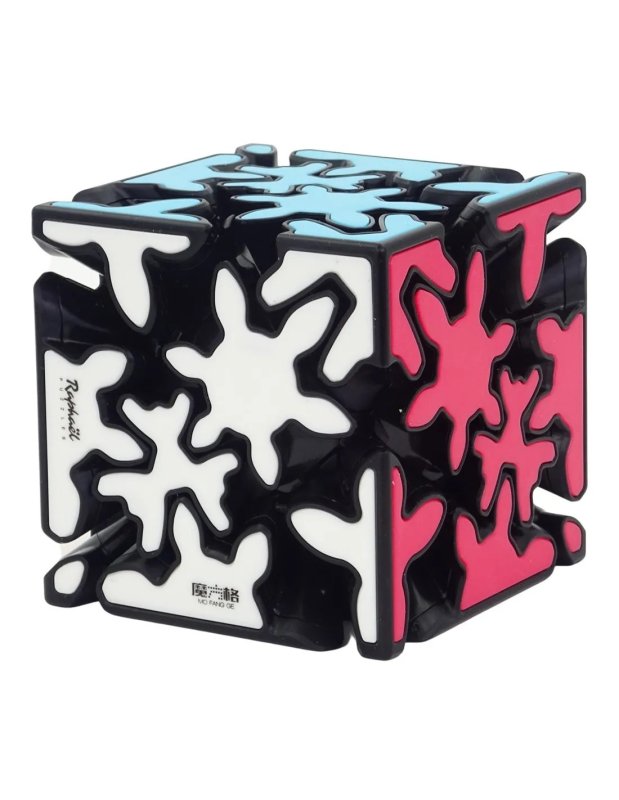
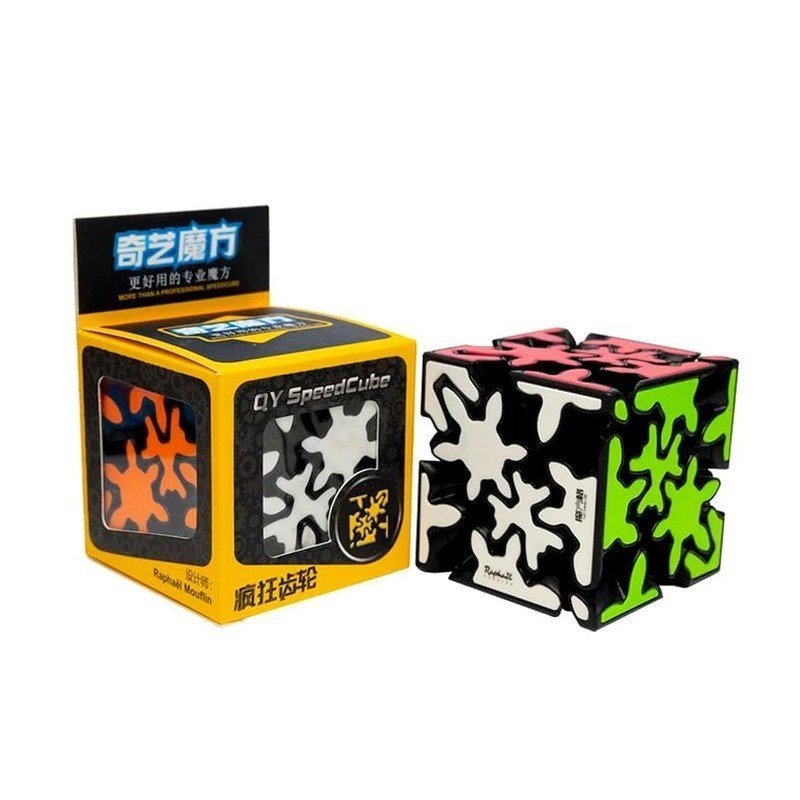 QiYi Crazy Gear Cube 3x3 - Puzzle con Engranajes
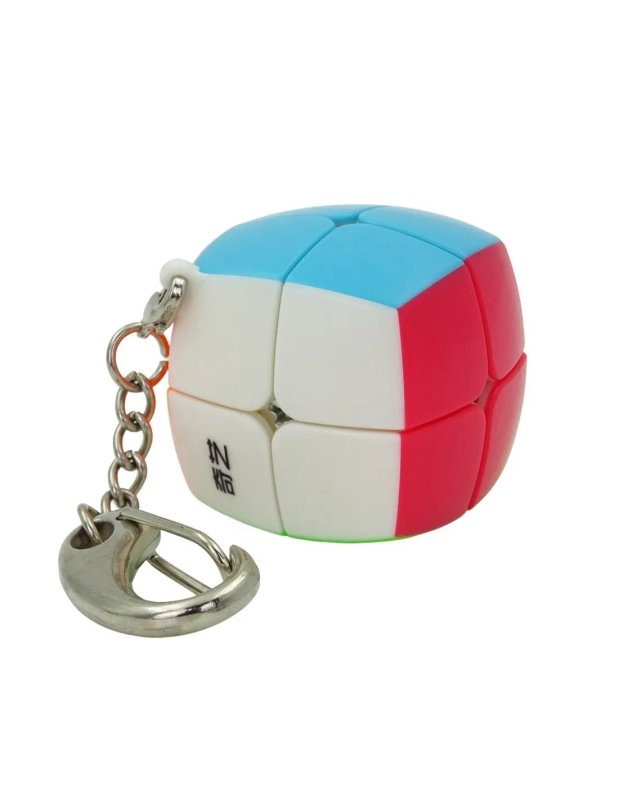
 QiYi 2x2 Mini Pillowed Llavero Stickerless Removible
 QiYi QiHeng S2 Megaminx Stickerless Dodecaedro
 QiYi Void 3x3 Magnético UV Coated Stickerless
Step 1: the tips
Each tip has three colors, and right next to it is its center, with those same three colors. Turn each tip (u, l, r or b, whichever direction is shorter) until its colors match the center. Since the tip travels with its center every time you turn two layers, it won't get out of place for the rest of the solve.
It is the easiest step and also the one people forget most often. In competition, one unturned tip means the puzzle is not solved.
Step 2: the bottom centers
This is the step some tutorials call "doing the three corners". Each center has three of the puzzle's four colors, so each color is missing from exactly one center. Find the center that has no yellow and hold the pyramid so that center is on top. The other three, the bottom ones, do have yellow.
Now turn each of those three corners with its capital letter (L, R or B) until its yellow triangle is facing down. The edges will move as you do this, but that's fine, because they aren't placed yet. When you're done, the bottom will have its three yellow centers and, on each side face, the two lower centers will show the same color. That is the color the whole face will end up.
Step 3: the bottom edges
The three edges with yellow are still missing. Each one goes between two bottom centers. Hold the puzzle with yellow on the bottom and the slot you want to fill at the front, on the bottom. The color of the front face comes from the two lower centers on that face: the edge you are looking for has yellow and that color.
If the edge is on top, turn U until it sits on the front face with its non-yellow color facing you. There are only two possibilities:
Edge on the right
3movesThe edge is on the right side of the front face, with yellow facing right.
- L'
- U
- L
What it does
L' lifts the bottom slot up, U brings the edge to the slot and L takes both back down together. The other bottom edges are not touched.
Edge on the left
3movesThe edge is on the left side of the front face, with yellow facing left.
- R
- U'
- R'
What it does
It is the exact mirror of the previous case: R lifts the slot, U' places the edge and R' brings both down.
If the edge you need is already on the bottom but in another slot, or in its slot but flipped (with yellow facing forward), turn the whole puzzle so that slot is at the front and do R U' R': the edge will go up to the top layer. Then bring the correct slot back to the front and apply the matching case.
Repeat with the other two edges, turning the whole puzzle (without moving layers) to bring each slot to the front. When you finish you will have the complete yellow bottom and the three side faces with their lower strip done.
Step 4: the top center and the last layer
First turn U or U' until the top center shows, on each face, the same color as the lower centers, and fix its tip with u if needed. All that's left are the three top edges: front-left, front-right and back.
With those three edges there are only twelve possible situations, and one of them is already solved. The other eleven come down to five cases. To recognize them, look at each top edge and check whether either of its two stickers matches the color of the face it is on:
| What you see | Case | How to hold it |
|---|---|---|
| No edge matches at all | Three-edge cycle, clockwise or counterclockwise | Any way |
| One perfect edge; the other two with colors swapped | Two flipped edges | Good edge at the back |
| Two edges with one color right; one with none | Cycle with two flipped edges | The one that matches nothing at the back |
The drawings show the Pyraminx from above, with the front face (green) at the bottom, the left face (red) and the right face (blue). The black dot is the top tip and the arrows show where each edge needs to go.
Clockwise three-edge cycle
7movesNo edge is in place or flipped. Seen from above, each one has to move one position clockwise: the front-left edge goes to the back.
- R
- U'
- R'
- U'
- R
- U'
- R'
Alternative
R' U' R U' R' U' R does exactly the same. Use whichever feels more comfortable.
Counterclockwise three-edge cycle
7movesLike the previous one, but the edges move counterclockwise: the front-left edge goes to the front-right.
- R
- U
- R'
- U
- R
- U
- R'
Alternative
R' U R U R' U R. If you apply the clockwise cycle by mistake, don't worry: do it once more and it will be solved, because two clockwise cycles equal one counterclockwise cycle.
Two flipped edges
8movesAll three edges are in place, but two have their colors swapped. Hold the puzzle with the correct edge at the back and the two flipped ones at the front.
- R'
- L
- R
- L'
- U
- L'
- U'
- L
Alternative
L R' L' R U' R U R' is its mirror version and does the same to the two front edges.
Cycle with flip, right
6movesPut the edge that matches nothing at the back. If the front-right edge shows the front face color on the front face, this is your case.
- L
- U
- R
- U'
- R'
- L'
Cycle with flip, left
6movesSame as the previous one, but the edge that matches the front face is the front-left one. It is the mirror of the previous case.
- R'
- U'
- L'
- U
- L
- R
The last two cases are the most common: of the eleven unsolved situations, six are cycles with a flip, three are plain flips and two are pure cycles. That's why it pays to make the rule "the one that doesn't match goes to the back" second nature. If another case appears after an algorithm, identify it and apply its own algorithm; it usually happens because the puzzle was held wrong, and with practice it stops happening.
Need a pyramid, or one that turns better?
We stock magnetic, stickerless and competition-level Pyraminx alongside the rest of our speedcubing puzzles.
See speedcubing cubes and puzzlesCommon mistakes when solving the Pyraminx
Turning a lowercase instead of a capital
If you do "r" instead of "R", you only move the tip and the algorithm stops working. Every solving algorithm turns two layers.
Judging the direction from the front
Clockwise is judged from the corner, not from the front face. If in doubt, remember: with U, the front goes left; with R, the front goes up; with L, it goes down.
Changing your grip mid-algorithm
The puzzle has to be held the same way from start to finish. Rotating it in the middle of a sequence is the most common reason it "doesn't work".
Starting step 4 without aligning the top center
All five algorithms assume the top center is already in place. If it isn't, case recognition breaks down.
Choosing the wrong top center
If you leave a center with the bottom color on top, you will never get three centers of that color on the bottom. The top one is always the only one without it.
Forgetting the tips
A "finished" puzzle with one tip turned is not solved. Check all four before calling it done.
Where to go once you can solve it
The layer-by-layer method is reliable, but it takes a lot of detours. Advanced methods cut the move count in exchange for learning more cases, and they fall into two families:
L4E (Last 4 Edges)
It is the natural next step after layer by layer. You place the tips, the centers and only two bottom edges, forming a "V", and solve the remaining four edges in one go.
- V-first family
- Dozens of cases
- Most used today
More detail
It has an algorithmic version, with a learned sequence for each case, and an intuitive one, where you plan the solution by looking at the puzzle. Michael Gottlieb's guide, for example, lists 96 possible cases for that final part. Most top speedcubers use methods from this family.
Top-first methods
Instead of starting with the bottom, you first solve the three edges around one center (the top) and finish the rest with algorithms.
- Keyhole
- One Flip
- OKA
More detail
In Keyhole you place two edges around the top and use the third edge's slot to solve the centers. In One Flip, the third edge is deliberately left flipped and fixed together with what remains. They were very popular, but carry less weight in competition today.
One tip before switching methods: learn to plan steps 1 and 2, and the first edge if you can, during the fifteen seconds of inspection allowed in competition. That alone will bring your times down a lot. If you're interested in the 3x3, the same layer logic is explained in how to solve the Rubik's Cube step by step.
Pyraminx world record
The WCA keeps two records: the best single solve and the best average of five attempts (the best and worst are dropped and the other three are averaged). As of October 2026 they are:
| Record | Time | Who | Where and when |
|---|---|---|---|
| World record single | 0.73 s | Simon Kellum (USA) | Middleton, Wisconsin, December 21, 2023 |
| World record average | 1.14 s | Lingkun Jiang (China) | Zhengzhou, December 27, 2025 |
| North American and US record average | 1.38 s | Jeriyah Griffin (USA) | Columbus, Ohio, March 2026 |
| US record single | 0.73 s | Simon Kellum (USA) | Middleton, Wisconsin, December 21, 2023 |
Simon Kellum's single is both the world record and the US record. Records change often, so it's worth checking the WCA website for the current mark. A curious detail from the regulations: for a competition scramble to be valid, the position must need at least six moves to solve, which rules out scrambles that are almost solved.
Which Pyraminx to choose
Any Pyraminx that turns without catching will do for learning, but a good puzzle makes algorithms flow with less effort and stops a layer from getting stuck halfway through a sequence. These are the differences that matter:
| Feature | What it gives you | Who it's for |
|---|---|---|
| Magnets | Layers snap into place at the end of each turn and don't stop halfway | Recommended for anyone who will practice |
| Stickerless | The plastic itself is colored: nothing peels or wears off | Kids and heavy use |
| Stickers or tiles | Higher-contrast colors on black plastic | Anyone who wants to tell the colors apart more easily |
| Ball core or maglev | Smoother, more stable turning | Anyone already timing their solves |
To get off to a good start, a simple magnetic model like the QiYi Warrior M covers everything a beginner needs. If you already time yourself, the YuFeng MagLev with ball core is a clear step up in smoothness. And when the classic is no longer enough, the Master Pyraminx adds one more layer (sixteen triangles per face) and is solved with many of the ideas in this guide. To compare it with other speed puzzles, see our pick of the best speedcubing cubes.
Frequently asked questions
Is the Pyraminx hard to solve?
It is the easiest of the official WCA puzzles. The tips and centers take one turn each, and the beginner method only needs seven short sequences.
How many algorithms do you need to solve the Pyraminx?
With the layer-by-layer method, seven: two three-move ones for the bottom edges and five for the last layer. Advanced methods such as L4E use many more.
What do lowercase letters mean in Pyraminx notation?
Lowercase letters (u, l, r, b) turn only the tip at that corner. Capitals (U, L, R, B) turn two layers: the tip and the center, along with the edges around them.
Why is there no U2 on the Pyraminx?
Because each turn is 120 degrees and three turns complete a full rotation. Two U turns in a row equal one U', so U and U' are all you need.
How many combinations does the Pyraminx have?
933,120 without counting the tips and 75,582,720 counting them. Any position can be solved in 11 moves or fewer, not counting tip turns.
Who invented the Pyraminx?
The German Uwe Mèffert, who came up with it in the early seventies. The Japanese toy company Tomy released it in 1981, at the height of the Rubik's Cube craze.
What is the Pyraminx world record?
0.73 seconds for a single solve, by Simon Kellum (USA), in 2023. The best average of five is 1.14 seconds, by Lingkun Jiang (China), in 2025.
What do I do if I'm left with two flipped edges at the end?
Hold the puzzle with the correct edge at the back and do R' L R L' U L' U' L. If no edge is right, it is one of the other four cases in step 4.
The Pyraminx is a great way into speedcubing and a good gift for someone who has already mastered the cube and wants something different. You'll find pyramids, cubes and other speed puzzles in our Rubik's cubes and speedcubing section.
Want more guides like this one? Sign up for the newsletter.
Keep exploring
- How to solve the Rubik's Cube step by step
- Types of Rubik's cubes
- Rubik's Cube: the complete guide
- Which Rubik's cube to give as a gift
- Brain teaser gifts
Rubik's Cubes and Speedcubing
YuXin 2x2 Baseball Shape Mod

YuXin 2x2 Basketball Shape Mod
YuXin 2x2 Ball Shape Mod Purple

Skewb Mirror DianSheng (Pink)
QiYi Magic Snake 60 Blocks Multicolour
QiYi Sail W 3x3 reinforced mechanism 56 mm

QiYi Sail 6x6 black classic beginner 60.5 mm
QiYi Sail 2x2 black compact for beginners
Contact our team for any clarification about this document. Contact us


