
Klondike solitaire rules: how to play patience step by step
Learn to play classic solitaire (Klondike patience): setting up the seven columns, the moves, draw one or draw three, and the strategy that wins more games.
On this page
Some games you learn and some games you just know, and solitaire belongs to the second group: few people remember who taught it to them. It is the most played card game on the planet (Microsoft put it into Windows in 1990 and, without meaning to, turned it into the most used video game in history), but long before computers it was already the universal pastime of kitchen tables, train carriages and waiting rooms. Its standard version is called Klondike, takes its name from a gold rush and hides more mathematics than it seems: only about one in three well-played deals ends in a win. In Britain the game is usually called patience, and both names are used in this guide. Here you have its documented history, the full rules, the drawing variants and the strategy that separates the player who wins one game in ten from the one who wins one in three.
What you need to play solitaire
- A standard 52-card poker deck (no jokers).
- One player: you. It is the great game against chance and against yourself.
- A table with some room: the layout takes up seven columns and four piles. Any kitchen table will do.
History: from European drawing rooms to the Yukon (and on to Windows)
The family of solitaire games was born in Europe at the end of the 18th century under the name patience, which is what it is still called across much of Europe, Britain included. The first written descriptions appear in Germany and Scandinavia around 1780-1790, and the 19th century made it a drawing-room fashion: whole collections of patience games were published, and famous players such as Napoleon in exile (according to legend, hard to prove) or Charles Dickens helped fix them in the popular imagination.
The variant we now simply call solitaire, Klondike, takes its name from the Yukon region of Canada, where the gold rush of 1896-1899 broke out. Tradition has it that prospectors played it to pass the endless Arctic nights; the name is documented from at least 1902. A century later came the game's second stroke of luck: Microsoft included it in Windows 3.0 (1990), officially to teach people how to use a mouse (drag and drop). The result was the most famous office pastime in the history of computing, and several generations who learned the game without ever touching a physical card.
The objective
Build the four foundations (one per suit), from ace to king, in ascending order: ace, 2, 3... up to the king. If all four foundations are complete, you have won. Everything else (columns, drawing, the waste pile) is the machinery for getting there.
Did you know decks like these exist?
At heart, every deck has the same cards. What changes is everything else: the design, the finish, metallic inks or gilded edges. Take a look at our catalogue and bring your own style to the card table.
Browse our playing cards →




How to set up and how to play
1 · The layout
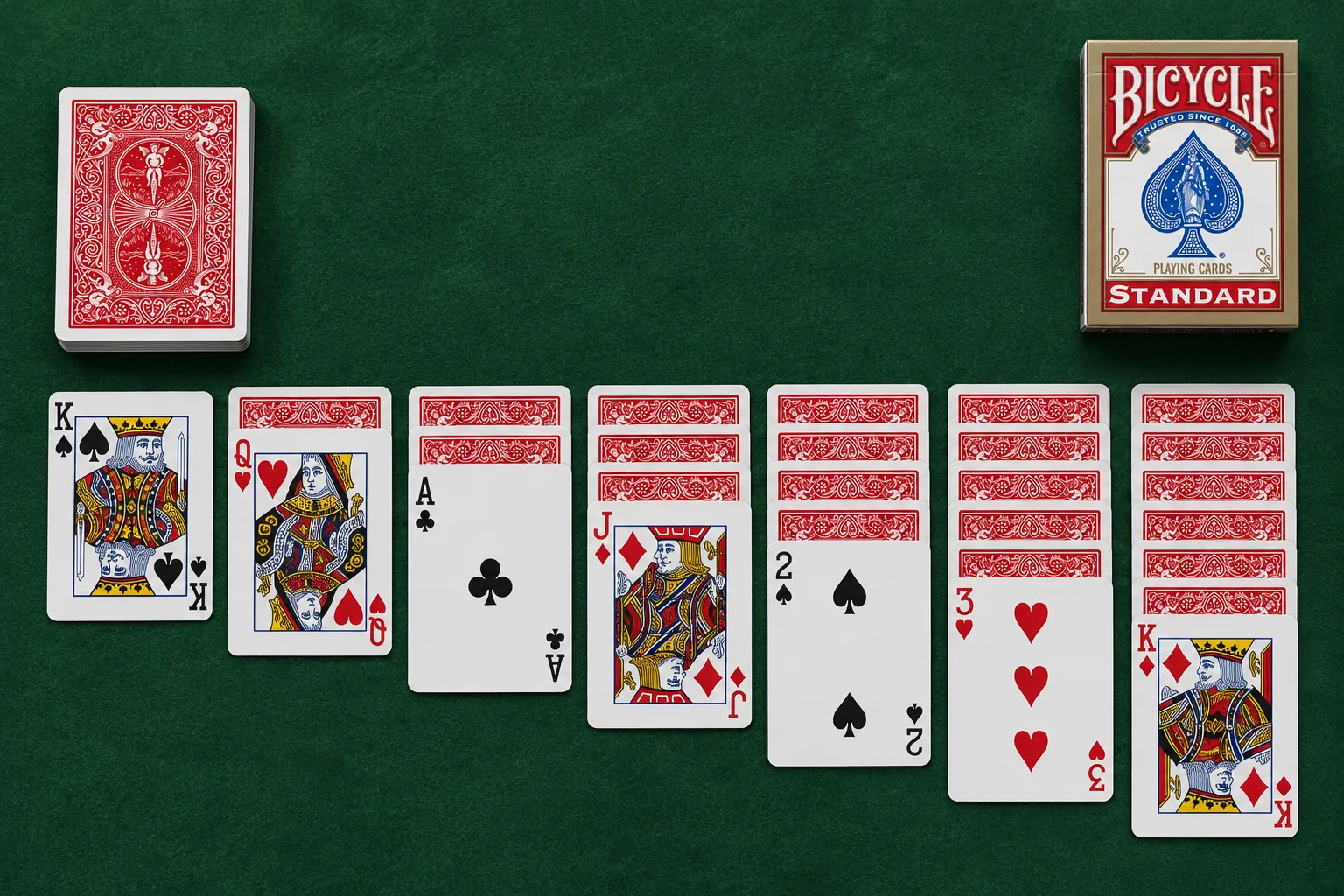
Deal 28 cards into seven columns: one card in the first, two in the second, three in the third... up to seven in the seventh. Only the top card of each column is face up; the rest stay hidden. The 24 cards left over form the stock.
2 · Legal moves
- In the columns you build downwards in alternating colours: only a black 8 can go on a red 9; on that 8, a red 7. You can move whole groups of ordered cards from one column to another if the join follows the rule.
- Turning cards over: when the hidden card at the bottom of a column becomes free, you turn it face up. That moment (turning hidden information into visible information) is the heart of the game.
- Spaces: an empty column can only be filled with a king (or a group headed by a king).
- To the foundations cards go up by suit and in ascending order, starting with the aces as soon as they appear.
- From the stock you draw when there are no more moves to make, or when it pays to wait.
3 · Draw one or draw three
The great fork in the road of solitaire:
- Draw one, with unlimited passes through the stock: the friendly version. Played well, you win about a third of your games.
- Draw three (only the top card of the three is playable): the classic casino version and the Windows default. Much harder, because a card buried under two others may never turn up at the moment you need it.
4 · The end
You win if you complete all four foundations. You lose when no legal move is left that changes the situation. Losing is the norm: even with perfect play, some Klondike deals are mathematically impossible to win.
Strategy: what improves your win rate
- Turn cards over before anything else. A move that turns a hidden card is almost always better than one that does not. And between two columns, go for the one with more hidden cards.
- Do not move cards to the foundations on reflex. A 2 played up too early can leave you without the link a column needed. A simple rule of thumb: always play aces and twos up; from the 3 onwards, only when it does not block anything.
- Spaces are very valuable, and kings use them up. Before emptying a column, make sure you have a useful king to put there, ideally in the colour that lets you keep building.
- Think about colour two moves ahead. If you have to choose between two eights to go on a red 9, check which sevens are lying around: picking the wrong colour closes the chain two moves later.
- In draw three, count the cycle. The order of the stock stays the same between passes: playing (or not playing) a card from the stock shifts which cards you will see on the next pass. Good players give up a minor move to "rotate" the stock towards a key card.
The numbers behind the game
- It is estimated that around 79% of deals are winnable in theory with perfect information... but nobody plays with the cards face up: in practice, a good player of the draw-one version wins around 30-35%.
- The possible combinations of the opening deal come to about 8×1067: there are more different deals than there are atoms in all the stars of the Milky Way. No game is ever repeated.
- Mathematicians have called the exact calculation of the odds of winning Klondike "one of the embarrassing open problems of applied mathematics": it looks like a simple question and it still has not been fully solved.
Other variants
- Spider: two decks, ten columns, building from king to ace in suit. The other big favourite thanks to Windows; longer and more tactical.
- FreeCell: all the cards visible and four free cells. Almost pure calculation: more than 99% of deals can be won with correct play.
- Pyramid: pair off cards that add up to 13 until the pyramid is cleared. Quick and very relaxed.
- Clock patience: cards dealt in a circle like a clock face; pure chance, no decisions at all, the one taught to children.
- Canfield and Yukon: for when Klondike is no longer enough; Canfield (known in Britain as Demon) was born in an 1890s casino that paid out for every card placed.
Did you know?
- Windows Solitaire was included to teach people to drag with the mouse; it became so ubiquitous that by 2000 it was estimated to have racked up more hours of use than any other program in the system.
- In many languages the game is called "patience", as it still is in Britain; in Spain, Latin America and the US the name that won describes the player's solitude rather than the virtue it demands.
- The cascade of cards bouncing across the screen when you win on Windows is probably the most famous victory animation in the history of software, and it was born in 1990 out of graphical limitations: it was cheap to program.
How much does a deck of cards cost?
From €5 to over €100. The 52 cards and the rules stay the same; this is what changes.
 To play€5.95 |  Designer€12.95 |  Premium€17.99 |  Collectible€34.94 | |
|---|---|---|---|---|
| Typical price | €5-9 | €9-15 | €15-30 | €30 or more |
| What sets it apart | Classic casino design | Artist illustration on back and faces | Special inks, embossing and foil on the box | Limited print runs and gilded edges |
| Who it is for | Games at home | Playing with something beautiful | Gifts or cardistry | Collecting and display |
| Example | Tally-Ho Fan Azul | theory11 Medallion | The Sandwich Series (Luncheon Meat) | Kings Wild LOTR Two Towers Gilded |
| See decks | See decks | See decks | See decks |
Frequently asked questions
How do you lay out the cards in solitaire?
Seven columns of 1, 2, 3, 4, 5, 6 and 7 cards (only the top one face up) and a stock with the remaining 24. The foundations start empty and are built from ace to king by suit.
Do you draw one card or three?
Both are legitimate: draw one is the more forgiving version; draw three, the demanding classic. Decide before you start and stick to it.
What can go in an empty column?
Only a king, or an ordered group headed by a king.
Can every game of solitaire be won?
No. Some deals are impossible even with perfect play. Winning a third of your games in the draw-one version already means you play very well.
Why is it called Klondike?
After the region of the Canadian Yukon and its 1896 gold rush: tradition says prospectors played it during the Arctic nights, and the name was documented in the early 20th century.
Solitaire is harder on cards than any other game: thousands of slides across the table. A deck with a good finish from our collection of poker decks glides better and lasts for years.
Would you like these rules as a PDF, along with our guides to the other games? Sign up for the newsletter.
Keep exploring
- Card games with a poker deck: the full index
- Gin rummy rules: for when you want a flesh-and-blood opponent.
- Blackjack rules: the other duel against chance.
- History of the poker deck
- Card games for two players
- Card games to play on your own
Keep learning
- Continental Rummy Rules Continental rummy rules: the seven contracts, decks and jokers, buying out of turn, scoring with examples, and how it…
- Canasta rules Canasta rules explained: natural and mixed canastas, red threes, how to freeze the discard pile, the full scoring and…
- Gin rummy rules Gin rummy rules: the two-player game invented in 1909, how knocking, going gin and the undercut work, plus scoring…
- Hearts card game rules How to play Hearts: the trick-taking game where winning means losing, the three-card pass, the 13-point queen of…
- President card game rules How to play President (Scum, Asshole, Capitalism): card ranking, legal plays, ranks, the card exchange, revolution…
- Cheat card game rules How to play Cheat (I Doubt It): cards face down, call the next rank whether it's true or not, when to challenge and…
- Blackjack rules Learn how to play blackjack: card values, hit, stand, double down and split, the dealer's turn, basic strategy…
Decks to play with: from our shop


Spanish, French, poker and collector decks, in stock in Madrid.
Poker decks in stock →Playing card shop →