
President card game rules: how to play Scum
How to play President (Scum, Asshole, Capitalism): card ranking, legal plays, ranks, the card exchange, revolution, house rules, scoring and strategy.
On this page
- 1. President, Scum, Asshole: one game, many…
- 2. Where does President come from?
- 3. What you need: players and decks
- 4. Card ranking: why the 2 is the highest…
- 5. Legal plays: singles, pairs, triples and…
- 6. How a hand is played, step by step
- 7. Ranks and the card exchange
- 8. Special rules: skips, four-of-a-kind…
- 9. House rules and variants
- 10. Scoring over several hands
- 11. Strategy: how to become President and…
- 12. Common rule mistakes
- 13. Frequently asked questions
- 14. Keep exploring
In short
President (also called Scum, Asshole or Capitalism) is a shedding card game for 4 to 7 players using a standard 52-card deck. The aim is to get rid of all your cards first by playing a single card, a pair, three of a kind or four of a kind that beats what is on the table. Finishing order sets everyone's rank (President, Vice-President, Citizens, Vice-Scum, Scum), and in the next hand the loser has to hand their best cards to the winner.
- Card ranking: 3 (lowest), 4, 5, 6, 7, 8, 9, 10, J, Q, K, A, and the 2 on top. Suits do not matter.
- To beat a play: the same number of cards, of a higher rank. A pair never beats a single.
- Card exchange: the Scum gives their 2 best cards to the President, who returns any 2 cards; the Vice-Scum and Vice-President swap 1.
- House rules to agree first: revolution, skips, jokers, bombs and whether you may go out on a 2.
President has one feature that very few card games share: hands never start from scratch. Whoever wins one hand receives the loser's best cards in the next, whoever loses gets the winner's junk, and the whole table sorts itself into a small social ladder that shifts every deal. That is why it works so well at parties, dorms and summer camps, and why it can feel a little cruel: climbing back from the bottom is possible, but it takes careful play. The basic rules fit in a few lines. The house rules change from one school, town or group of friends to the next, and that is where most arguments start. This guide sets out the common rules first, then every well-known variant, so you can decide in advance which ones your table plays.
President, Scum, Asshole: one game, many names
In English the game goes by more names than almost any other. President is the polite one, used by apps and rulebooks; Scum and Asshole (Arsehole in British English) are what you hear around real tables; Capitalism and P's and A's (Presidents and Assholes) are common too, and players often shorten the game to Prez. The choice is telling: some names honour whoever is on top, others the player at the bottom. The titles in between vary just as much.
| Place | Most common | Other titles |
|---|---|---|
| 1st | President | King, Boss |
| 2nd | Vice-President | Minister |
| Middle | Citizen (or Neutral) | Person, Merchant, Worker |
| Second to last | Vice-Scum | High-Scum, Peasant, Vice-Asshole |
| Last | Scum | Asshole, Beggar, Bum |
The same game is called président or trou du cul in France and Quebec, el culo in Spain and daifugō in Japan. In North America it is also widely played as a drinking game; the card rules stay the same.
Where does President come from?
President belongs to the family of climbing games: each player has to "climb" above the previous play or pass, and whoever makes the last play wins the right to lead again. The family comes from East Asia. It includes China's zheng shangyou, Vietnam's tiến lên and Japan's daifugō, which is President's closest relative: same card ranking with the 2 on top, same card exchange between first and last, and the same revolution triggered by four of a kind.
The Japanese name sums up the spirit of the game. Daifugō means roughly "grand millionaire", and the game is also called daihinmin, "grand pauper". The Japanese ranks follow exactly the same logic as ours:
| Japanese rank | Rough meaning | In President |
|---|---|---|
| Daifugō | Grand millionaire | President |
| Fugō | Rich man | Vice-President |
| Heimin | Commoner | Citizen |
| Hinmin | Poor man | Vice-Scum |
| Daihinmin | Grand pauper | Scum |
The game spread through the Western world towards the end of the 20th century, mostly among young people, passed on by word of mouth with no standard written rules, which is why there are so many versions. It even got a commercial edition: The Great Dalmuti, designed by Richard Garfield (the creator of Magic: The Gathering) and published by Wizards of the Coast in 1995, is President played with a special deck and a medieval theme.
What you need: players and decks
President uses a standard 52-card deck, without jokers in the basic game. All the cards are dealt one at a time, clockwise. If the number of players does not divide 52 evenly, some players get one card more than others; that is normal and nobody sets them aside.
| Players | Deck | Cards each | Notes |
|---|---|---|---|
| 3 | 52 cards | 17 or 18 | Playable, but the ladder shrinks to President, Citizen and Scum |
| 4 | 52 cards | 13 | Classic Even hands, two exchanges |
| 5 | 52 cards | 10 or 11 | Ideal First Citizen appears |
| 6-7 | 52 cards | 7 to 9 | Faster hands, more Citizens |
| 8 or more | Two decks shuffled together (104 cards) | 13 at 8 players | Bigger sets become possible; adjust the revolution rule |
With one deck, 4 to 7 players is the usual range, and 4 or 5 is the sweet spot. Beyond that, shuffle two decks together: hands stay reasonably full and you can see sets of five, six or more equal cards. To check that your deck is complete before dealing, our guide on how many cards are in a deck covers 52-, 54- and two-deck setups.
Card ranking: why the 2 is the highest card
This is the first thing that surprises new players. In President the usual order is shifted: the 3 is the lowest card and the 2 is the highest, above the ace. Suits play no part: a 9 of hearts and a 9 of spades are worth exactly the same.
With only four 2s in the deck, they are the most valuable cards: a single 2 cannot be beaten, so it ends the trick and gives the lead back to whoever played it. That is also why the Scum has to give them up first in the exchange. When jokers are added, they rank above the 2s.
| Version | Lowest to highest |
|---|---|
| Standard (52 cards) | 3, 4, 5, 6, 7, 8, 9, 10, J, Q, K, A, 2 |
| With jokers (54 cards) | 3 … A, 2, Joker |
| Aces high (some West Coast and Hawaiian tables) | 2, 3, 4 … K, A |
| During a revolution | 2, A, K, Q, J, 10 … 4, 3 |
Legal plays: singles, pairs, triples and quads
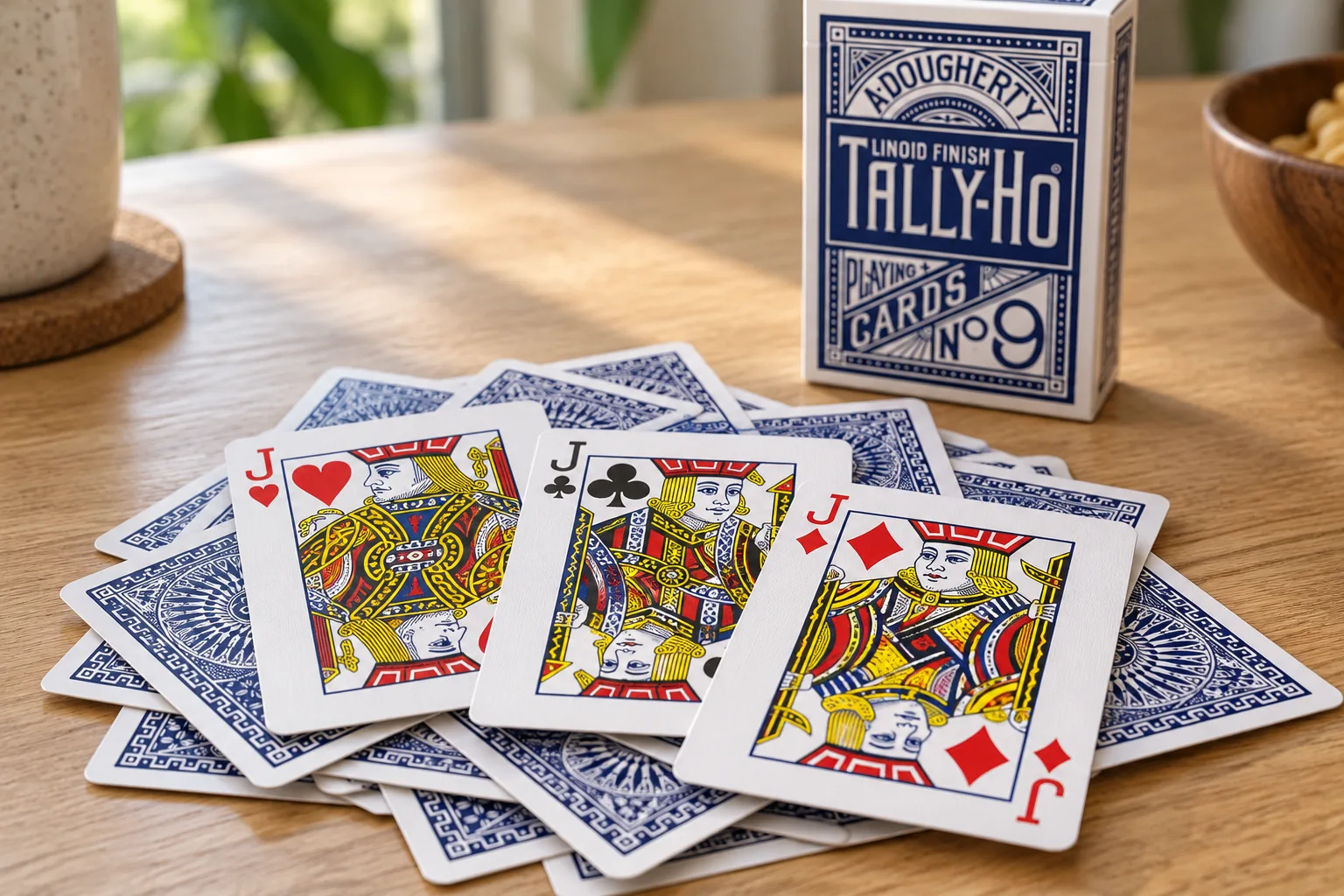
On your turn you play one or more cards of the same rank. The basic game has only four types of play:
| Play | Example | What beats it |
|---|---|---|
| Single | 8♣ | A higher single: 9, 10 … A or 2 |
| Pair | 6♠6♥ | A higher pair: 7-7 up to 2-2 |
| Triple | Q♣Q♦Q♠ | A higher triple: kings, aces or 2s |
| Quad (four of a kind) | 4♣4♦4♠4♥ | A higher quad (and it often triggers a revolution) |
The golden rule: you always answer with the same number of cards. On a pair of 6s you need a pair of 7s or higher; a single king, however strong, will not do, and neither will three 7s. Whoever leads sets the format for everyone, which is an important tactical lever: leading pairs when you hold many pairs shuts out players who only have strong single cards.
How a hand is played, step by step
1. The first deal
On the first deal nobody has a rank yet. Pick a dealer at random; they deal out the whole deck, and the player to the dealer's left leads. Many English-speaking groups instead have the holder of the 3 of clubs, the lowest card in the deck, start the first hand. There is no card exchange on the first deal.
2. Leading a trick
The first player puts down any play they like: a single, a pair, a triple or a quad. That sequence is called a trick (or a round).
3. Beat it or pass
Going clockwise, each player chooses:
- Beat it: play the same number of cards, of a strictly higher rank.
- Pass: play nothing. You may always pass, even if you could play.
Play keeps going around the table as many times as needed, until everyone passes on the last play.
4. Ending the trick
When nobody can or will beat the last play, the trick is over. The cards are turned face down and set aside, and whoever made the last play leads the next trick with anything they like. A single 2 ends the trick at once, since nothing can beat it.
If the player who made the last play has just gone out, the lead passes to the next player still holding cards, to their left.
5. Going out and taking a rank
As soon as a player has no cards left, they are out of the hand. The first one out becomes President, the second Vice-President, and so on. Play continues until only one player is left holding cards: the Scum. In the traditional version, players then change seats to sit in rank order, with the Vice-President on the President's left and the Scum on the President's right, and the Scum gathers, shuffles and deals the cards.
Did you know decks like these exist?
At heart, every deck has the same cards. What changes is everything else: the design, the finish, metallic inks or gilded edges. Take a look at our catalogue and bring your own style to the card table.
Browse our playing cards →




Ranks and the card exchange
From the second deal onwards, the ladder kicks in. Once the cards are dealt and before play starts, the players at the bottom must give their best cards to those at the top, who hand back cards they do not want. The loser has no choice: they give their highest cards, even if that breaks up a pair. The winner returns any cards they choose, usually their weakest.
| Players | Ranks | Exchanges |
|---|---|---|
| 3 | President, Citizen, Scum | Scum ↔ President: 2 cards (1 at some tables) |
| 4 | President, Vice-President, Vice-Scum, Scum | Scum ↔ President: 2 cards; Vice-Scum ↔ Vice-President: 1 card |
| 5 | President, Vice-President, Citizen, Vice-Scum, Scum | As with 4; the Citizen does not trade |
| 6 or more | More Citizens in the middle | As with 4; some tables add a third level (3, 2 and 1 cards) |
The simplest written rules use a one-card tax only: the Scum gives the President their single highest card and gets any card back. The two-card version above is the one most groups play today.
A worked example with four players. The Scum has been dealt, among others, a 2, an ace and a pair of 5s. They must hand over the 2 and the ace. The President, who had a lone 3 and a lone 4, passes those back. The Vice-Scum gives their best card, a queen, to the Vice-President, who returns a lone 6. The hand starts with deliberately lopsided hands.
Who leads after the exchange?
Both customs exist. In many versions the Scum leads the next hand, a small consolation for a weakened hand. In others the President leads. The first makes the game a little less unfair; the second tightens the grip of whoever is on top.
Perks and chores that come with the rank
President is not only about cards. Many groups add small rituals: the President picks the best seat, the Scum shuffles, deals and clears the table, and at some tables only the Scum may touch the cards on the table once play has started. It is purely social, but it is part of the fun. If you deal a lot, our guide on how to shuffle cards explains how many shuffles it takes to break up the sets left over from the last hand.
Special rules: skips, four-of-a-kind clears and the revolution
These are the house rules that cause most debate. None of them is compulsory, but they are common enough that you should know them by name and announce which ones apply before dealing.
Equal plays and skips
In many versions you may play a set of the same rank as the last one instead of beating it: a 9 on a 9, a pair of jacks on a pair of jacks. Doing so skips the next player, who loses their turn. It is a simple way to block a player who is about to go out. When only two players remain, an equal play gives the same player another turn.
Same rank or nothing
French players take the skip one step further with a rule they call ou rien ("or nothing"). Once two players in a row have played the same rank, the next player must play that same rank or pass: after two 7s, it is "7 or nothing". They may not jump in with an 8 or a king to take control.
Two points are worth agreeing on: whether a 2 (or a joker) may break the chain, and whether the rule also applies to pairs. With a single deck, a chain of pairs of the same rank cannot get past two plays, since there are only four cards of each rank, so the pairs version only makes sense with two decks.
Four of a kind clears the pile
Equal plays lead naturally to this rule, played in Denmark and in much of France, where it is called the carré magique ("magic square"). If all four cards of one rank end up on top of the pile one after another, whether played by one player or several, whoever plays the fourth card ends the trick and leads next, just as if they had played a 2. Some tables even let the holder of the missing card play it out of turn to complete the four. That speeds things up but breaks the turn order and leads to arguments about who was quicker.
The revolution
The revolution is the rule that gives the Scum a chance. When a player lays down a quad (all four cards of one rank at once), the card ranking flips: the 3 becomes the highest card, the 2 the lowest, and everything in between follows. Jokers, if used, usually keep their place at the top.
How long does it last? Tables disagree, so spell it out:
- Until the end of the hand: the most common choice, and the rule in Japanese daifugō.
- Until the end of the current trick: a short, milder version.
- Until the next revolution, even across several hands: the long version.
In every case, another quad during a revolution triggers a counter-revolution that restores the normal order. Some groups also reverse the direction of play. And the "no going out on a 2" rule carries over: during a revolution, you may not go out on a 3.
No going out on a 2
A very common rule: you may not play a 2 as your last card. Anyone who does automatically becomes Scum, even if they finished first. The idea is to stop players hoarding their 2s to finish safely. A player down to their 2s plus one other card must play the 2s before the last card. Depending on the table, the ban extends to jokers and, during a revolution, to 3s.
House rules and variants
President has no governing body or official rulebook, so every table ends up with its own rules. These are the variants you will meet most often. Pick two or three at most for a first game.
Jokers
54cardsOne or two jokers join the deck and rank above the 2s. A single joker beats any play and wins the lead.
- Higher than a 2
- Ends the trick
- Often banned as a last card
More detail
There are three ways to use jokers: as top cards (a lone joker beats even a pair of 2s), as wild cards that complete a set (6-6-joker counts as three 6s), or both. When jokers are wild, tables split on whether a natural triple beats a triple of the same rank with a joker in it. With two jokers, the coloured one often beats the black one. For the card's own story, see our article on the history of the joker.
Bombs
A special play, usually a set of 2s, that clears the current trick whatever is on the table.
- Only on your own turn
- Cannot lead a trick
More detail
In bomb rules a single 2 (or a set of 2s, depending on the group) can be played on any combination, even a triple of aces, and ends the trick. The player who bombed leads next. A bomb may only be played in turn and may never be used to open a trick.
Eights end the trick
Playing one or more 8s ends the trick at once, and the same player leads again. Borrowed from Japanese daifugō.
- Clears the pile
- Must still follow the format
- Banned as a last card
More detail
The 8 still has to be a legal play: a single 8 only cuts a lower single, a pair of 8s a lower pair. In Japan the rule is known as 8-giri, "eight cut". Like the 2, many tables forbid going out on an 8 when this rule is in play.
Jack back
Playing a jack triggers a short revolution that lasts until the end of the trick. Another daifugō import.
- Temporary reversal
- Order returns next trick
More detail
Known in Japan as 11-back, after the jack's number. Once the trick ends, the normal ranking comes back. It makes high jacks a defensive card: they let a player with low cards win one trick.
Suit lock
If two plays in a row share a suit, the rest of the trick must follow that suit.
- Japanese shibari
- Makes suits matter
More detail
For example, after a 7 of hearts and a 9 of hearts, only higher hearts may be played until the trick ends. With sets, the suits of every card must match. A lone joker can stand in for any suit but cannot start a lock.
Runs
Consecutive cards (5-6-7) are allowed, sometimes only in one suit, sometimes as runs of pairs (5-5-6-6-7-7).
- Same length to beat
- Closer to tiến lên and Big Two
More detail
A three-card run is beaten by a higher three-card run. Some versions require all cards in one suit, and in daifugō a run of four or more can even trigger a revolution. Runs change the game a lot: low singletons become useful and hands get shorter. Try them for one hand before adopting them.
President's downfall
If the sitting President does not go out first, they drop straight to Scum.
- Punishes the President
- Japanese miyako-ochi
More detail
As soon as another player goes out first, the old President throws in their cards and becomes Scum for the next deal; the others play on for the remaining places. It makes the top of the ladder much less stable.
Merchants
6playersWith bigger groups, the middle ranks become merchants who must trade one card with each other.
- Haggling allowed
- Everyone trades
More detail
In a six-player version the ranks run from top to bottom with two merchants in the middle. The bottom players pay their best cards to the top ones as usual, while the two merchants must swap one card each. They can negotiate which cards; if they cannot agree, each still gives an unwanted card.
Scoring over several hands
Many groups never keep score: hands follow one another and the fun comes from the ladder moving. To name an overall winner at the end of the night, the usual method gives points by rank:
| Players | President | Vice-President | Citizen(s) | Vice-Scum | Scum |
|---|---|---|---|---|---|
| 4 | 3 | 2 | - | 1 | 0 |
| 5 | 4 | 3 | 2 | 1 | 0 |
| 6 | 5 | 4 | 3 and 2 | 1 | 0 |
In other words, each player scores one point for every opponent they finished ahead of. Agree on a target total or a number of deals. A simpler scheme only rewards the top: 2 points for the President, 1 for the Vice-President, first to 11 wins.
Strategy: how to become President and stay there
The deal matters a lot in President, but two players with the same hand do not get the same result. Here is what makes the difference.
Think of your hand as sets
As soon as you pick up your cards, group them: pairs, triples, singletons. Your real problem is low singletons, because you will have to get rid of them at some point and only a lead lets you do that. You will get the lead only a limited number of times, so each lead should dump something nobody would otherwise let you play.
Do not break pairs without a reason
A pair of kings is usually worth more than two separate kings. Breaking a pair to win a trick of singles rarely pays off: at the end of a hand, sets are what let you go out in one move. On the other hand, if you hold three 4s, leading them early is attractive, as few players will have a higher triple.
Keep a high card to regain the lead
A 2 (or a joker) is your ticket to end a trick and lead whatever you want. Spending it on an average card early in the hand is usually regretted later. The right moment is when winning the lead lets you shed a low card or a set that nobody can follow.
Count the 2s and aces
There are only four 2s and four aces. If three 2s have gone, the last one is somewhere; if you hold it, your ace is almost unbeatable. Tracking those eight cards is easy for anyone and is enough to know, late in the hand, whether your high card will hold.
Passing is a move too
You can always pass, even with a legal play. Letting a trick die with another player is sometimes stronger than winning it, especially if that player will then have to lead with only high cards left. Watch who passes: a player who passes on low cards is saving something; one who passes on everything is probably short of good cards.
Plan your exit
Count backwards: with three cards left, which leads do you need to go out? If going out on a 2 is banned, play it before your last card. And in the final cards, a pair nobody can beat is worth more than two middling singles.
By rank
- President: hand back low singletons, never a card that belongs to a pair. With two 3s and a lone 4, give the 4 and another singleton, and keep the pair of 3s, which you can shed in one go.
- Citizen: you have gained and lost nothing; it is often the best seat for annoying the President with skips.
- Scum: your hand lacks high cards but is often rich in low sets. Look for triples and quads, lead pairs to strand the others' strong singles, and keep the revolution in mind if your table plays it.
If your group enjoys this kind of pressure and table talk, Cheat and Hearts use the same 52-card deck and suit the same number of players.
Common rule mistakes
- Beating a pair with a higher single. Not allowed: always the same number of cards.
- Treating the ace as the top card. In standard President it is the 2.
- Exchanging cards on the first deal. There are no ranks yet, so there is no exchange.
- The Scum handing over "two good cards" instead of the two best. The Scum has no choice: it is their two highest, no exceptions.
- Discovering house rules mid-game. Revolution, skips, going out on a 2: anything not announced does not apply.
How much does a deck of cards cost?
From €5 to over €100. The 52 cards and the rules stay the same; this is what changes.
 To play€5.95 |  Designer€12.95 |  Premium€17.99 |  Collectible€34.94 | |
|---|---|---|---|---|
| Typical price | €5-9 | €9-15 | €15-30 | €30 or more |
| What sets it apart | Classic casino design | Artist illustration on back and faces | Special inks, embossing and foil on the box | Limited print runs and gilded edges |
| Who it is for | Games at home | Playing with something beautiful | Gifts or cardistry | Collecting and display |
| Example | Tally-Ho Fan Azul | theory11 Medallion | The Sandwich Series (Luncheon Meat) | Kings Wild LOTR Two Towers Gilded |
| See decks | See decks | See decks | See decks |
Frequently asked questions
How do you play the card game President?
Deal out a 52-card deck. The leader plays a single, pair, triple or quad; each player in turn must play the same number of cards of a higher rank or pass. When everyone passes, the last player to play leads again. The first to run out of cards is President, the last is Scum, and in the next hand the Scum gives their two best cards to the President for two cards of the President's choice.
What is the highest card in President?
The 2, above the ace. The lowest is the 3. If you play with jokers, they rank above the 2s. During a revolution the order flips and the 3 becomes the highest card. A few tables play aces high with the 2 at the bottom.
Is President the same game as Scum, Asshole or Capitalism?
Yes. They are regional names for the same climbing game; only the titles and some house rules change. The Japanese daifugō and the commercial game The Great Dalmuti are close relatives with the same structure.
How many players do you need for President?
From 4 to 7 with one 52-card deck, ideally 4 or 5. Three players can play, but the ladder is short. With 8 or more, shuffle two decks together. With only two players the exchange loses its point; our list of two-player card games has better options.
Who goes first in President?
On the first deal, the player to the dealer's left, or in many groups the holder of the 3 of clubs. After that, most versions have the Scum lead after the exchange; some have the President lead.
Can you go out on a 2 in President?
Under the most common house rule, no: a player who goes out on a 2 automatically becomes Scum, so 2s must be played before your last card. Simpler versions allow it, so agree before you start.
What is a revolution in President?
A house rule where playing four of a kind reverses the card ranking: the 3 becomes the highest card and the 2 the lowest, usually until the end of the hand. Another four of a kind triggers a counter-revolution that restores the normal order.
Can you play President with jokers?
Yes. Jokers usually rank above the 2s and a single joker beats any play; some groups use them as wild cards to complete sets instead. Decide which before dealing.
President wears out cards faster than most games: they are played, gathered and shuffled non-stop, often on a kitchen table. A 52-card deck with a plastic-coated finish lasts much longer; you will find plenty in our playing cards section.
Want more guides like this one? Sign up for the newsletter.
Keep exploring
Keep learning
- Klondike solitaire rules Learn to play classic solitaire (Klondike patience): setting up the seven columns, the moves, draw one or draw three…
- Continental Rummy Rules Continental rummy rules: the seven contracts, decks and jokers, buying out of turn, scoring with examples, and how it…
- Canasta rules Canasta rules explained: natural and mixed canastas, red threes, how to freeze the discard pile, the full scoring and…
- Gin rummy rules Gin rummy rules: the two-player game invented in 1909, how knocking, going gin and the undercut work, plus scoring…
- Hearts card game rules How to play Hearts: the trick-taking game where winning means losing, the three-card pass, the 13-point queen of…
- Cheat card game rules How to play Cheat (I Doubt It): cards face down, call the next rank whether it's true or not, when to challenge and…
- Blackjack rules Learn how to play blackjack: card values, hit, stand, double down and split, the dealer's turn, basic strategy…
Decks to play with: from our shop


Spanish, French, poker and collector decks, in stock in Madrid.
Poker deck shop →Unique playing cards →