
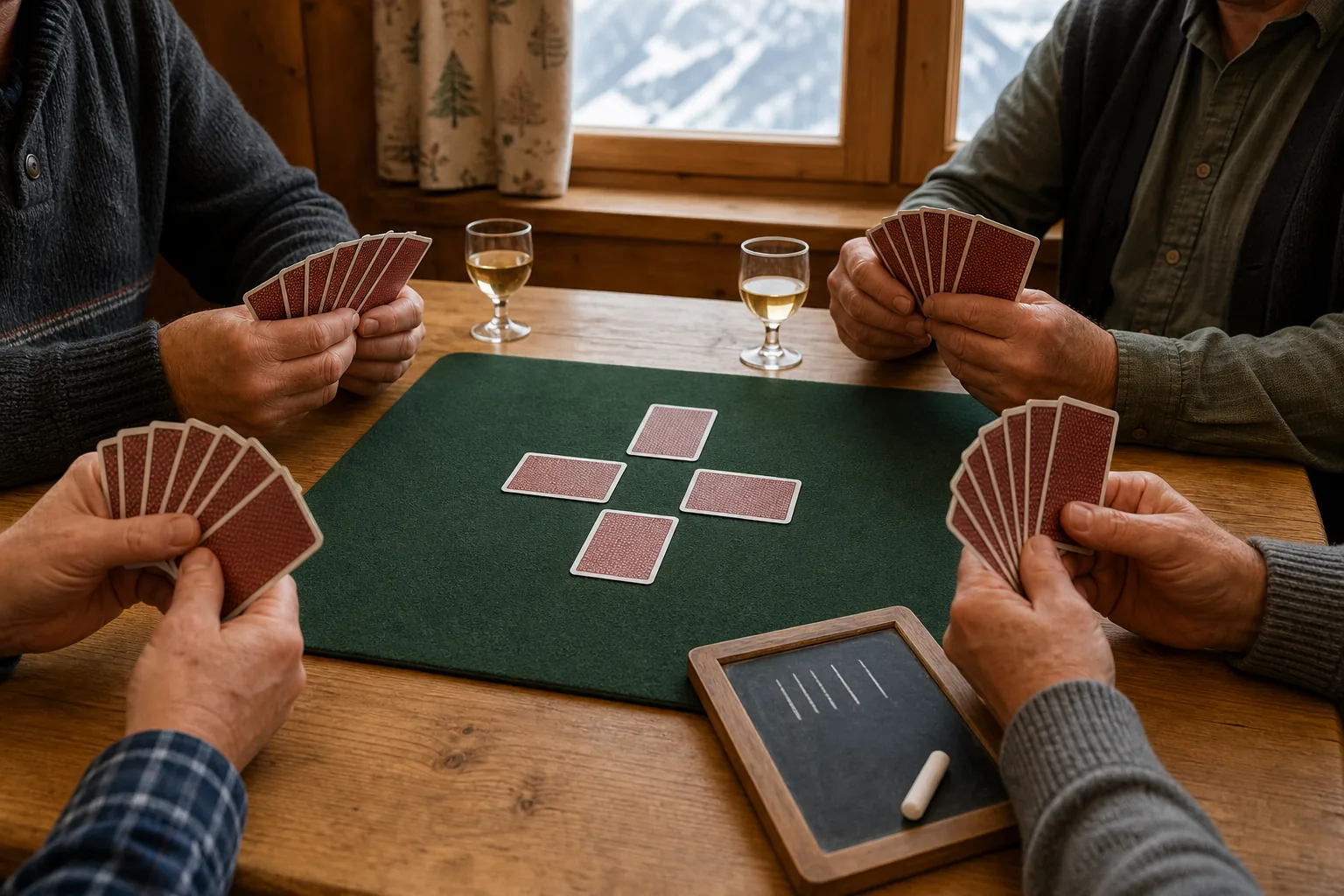
Jass rules: how to play Schieber, the Swiss card game
Jass rules explained: 36-card deck, Puur and Nell, Obenabe and Undenufe, Weis and Stöck, 157 points per hand, Jasstafel scoring and the main variants.
In short
Jass is the national card game of Switzerland: a family of trick-taking games played with a 36-card deck in which, in the trump suit, the jack (Puur, 20 points) and the nine (Nell, 14 points) are the top cards. The most widely played form is Schieber: four players in two partnerships, and the player who has to choose trumps can "push" (schieben) that decision to their partner.
- Deal: 9 cards each, in threes, counterclockwise.
- Game types: a trump suit, Obenabe (no trumps, highest card wins) or Undenufe (no trumps, lowest card wins).
- Points per hand: 152 in the cards plus 5 for the last trick, 157. Taking all nine tricks (Match) is worth 257.
- Bonuses: melds declared on the first trick (Weis) and the king and Ober of trumps together (Stöck, 20 points).
- Game: to 1,000 points without multipliers or to 2,500 with multipliers, depending on the table.
In Switzerland Jass is played in village bars, at home, on trains, in club tournaments and on public television, which has been broadcasting games every week for years. Many people learn it from their family, so the game is passed on by word of mouth more than in writing, and every family and every bar has its own small rules. These Jass rules cover the common ground found in tournament rulebooks and in the country's reference rulebook, and at each step we point out what changes from one table to another, so you can agree on it before the deal.
We keep the Swiss German terms (Puur, Nell, Weis, Stöck, Match, Obenabe, Undenufe), because they are what you hear at any table, and we give the equivalent used in French-speaking Switzerland (Romandy), where Schieber is called chibre. If you already play belote, much of what follows will sound familiar: the two games are close relatives.
What Jass is and where it comes from
"Jass" is not one single game but the name of a whole family. All its members share the 36-card deck, the same point values and the same oddity in the trump suit: the jack becomes the highest card and the nine the second highest. The French belote, the Dutch klaverjas and klaberjass share that feature too, which is why card game historians speak of the jack-nine family.
The origin lies in the Netherlands. Jas was the Dutch name for the trump jack, the strongest card in the game, and the whole game took its name from it. The trump nine, the Nell, also has a name of Dutch origin. According to the most widely accepted account, the game reached Switzerland in the last third of the 18th century with Swiss Protestant soldiers who served as mercenaries in the Netherlands, and within a few decades it pushed aside Tarock, until then the most widespread card game in much of the country.
The first Swiss document that names the game dates from 1796 and comes from the canton of Schaffhausen: two pastors reported two farmers for playing a game "called Jassen" with wine as the stake. During the 19th century it became popular across the country, and in the 20th it moved from bars to clubs, tournaments, radio and television.
| Date or fact | What happened |
|---|---|
| Last third of the 18th century | Arrives in Switzerland with Protestant mercenaries and replaces Tarock |
| 1796 | First written mention in Switzerland, in the canton of Schaffhausen |
| 19th century | Becomes popular throughout Switzerland |
| 1969 | Göpf Egg publishes Puur, Näll, As, the rulebook that would become the country's standard reference |
| Today | Included in the list of living traditions of Switzerland drawn up by the Federal Office of Culture |
The book by Göpf Egg (1921-2010), a player from Winterthur whose television appearances earned him the nickname Jasspapst, "the pope of Jass", covers dozens of variants and is still reprinted in an edition revised by Albert Hagenbucher. Many tournaments refer to it as the "official Swiss Jass rulebook". Even so, Egg's rulebook is an accepted reference and not a law: each tournament also publishes its own rules, and at home tables local custom has the last word.
The decks: Swiss German and French suits
A Jass deck has 36 cards: four suits of nine cards, from 6 to ace. What makes Switzerland unusual is that two completely different decks coexist depending on the region, and the border between them does not exactly follow the language border.
The Swiss German deck
This is the traditional deck of central and eastern Switzerland, east of the so-called Brünig-Napf-Reuss line: Central Switzerland, Zurich, Schaffhausen and Eastern Switzerland. It has its own suits, which are neither French nor German:
- Schellen: bells.
- Rosen: roses (sometimes called Blumen, flowers).
- Schilten: shields.
- Eicheln: acorns.
The cards of each suit are the As (ace; in some areas, Sau), the König (king), the Ober (the upper court card, which plays the role of the queen), the Under (the lower court card, which plays the role of the jack) and the Banner, which is the ten: instead of ten pips it shows a flag, hence the name. Then come the 9, 8, 7 and 6. In the trump suit, the Under becomes the Puur (or Bauer, the farmer) and the 9 becomes the Nell.
The French-suited deck of Romandy
In French-speaking Switzerland (Romandy), in Ticino and in Valais, but also in Bern, Solothurn and the two Basel cantons, which are German-speaking, people play with French suits: hearts, diamonds, spades and clubs, with ace, king, queen, jack and 10 down to 6. It is a 36-card deck with its own Swiss design, but structurally it is a poker deck without the 2s, 3s, 4s and 5s. Players in Romandy call the trump jack bour or buur and the trump nine nell, just as in German.
| Swiss German deck | French-suited deck (Romandy) | In English | In trumps |
|---|---|---|---|
| As (Sau) | As | Ace | Ace |
| König | Roi | King | King |
| Ober | Dame | Queen | Ober or queen |
| Under | Valet | Jack | Puur / bour |
| Banner | Dix | Ten | Banner or ten |
| 9 | Neuf | Nine | Nell / nell |
| 8, 7, 6 | Huit, sept, six | 8, 7, 6 | 8, 7, 6 |
Which French suit matches each Swiss suit?
This is one of the most frequent questions, and the honest answer is that there is no official equivalence. At least two correspondences circulate in Jass literature, and some manufacturers print one of them on double-index cards:
| Swiss suit | Equivalence most often given in books | Equivalence printed on some decks |
|---|---|---|
| Schellen (bells) | Hearts | Diamonds |
| Schilten (shields) | Diamonds | Spades |
| Eicheln (acorns) | Spades | Clubs |
| Rosen (roses) | Clubs | Hearts |
For actual play, the equivalence matters for one thing only: the multipliers, which depend on the trump suit (more on this below). When players from both traditions share a table, the practical approach is to state which suits "count double" in each deck and forget about card-by-card equivalences.
Schieber Jass rules: players, deal and choosing trumps
Schieber is the most played form of Jass in Switzerland and what "playing Jass" means unless someone says otherwise. It is played by four people in two fixed partnerships; each player sits opposite their partner, so turns alternate between the two teams.
Who deals and how
For the first hand the dealer is usually drawn by lot: everyone draws a card and the lowest card deals. The dealer shuffles and offers the pack to an opponent to cut, leaving at least three cards in each part. The dealer then gives nine cards to each player, in batches of three, starting with the player on their right and continuing counterclockwise, the direction in which everything in Jass is played. No cards are left over: all 36 are dealt.
Who chooses trumps
In every hand one player has both the right and the duty to decide what is played. This player is called the Vorhand, the "forehand":
- In the first hand of the game, trumps are chosen by whoever holds a particular card, usually a seven of a suit agreed beforehand. At many tables and tournaments it is the 7 of bells in the Swiss German deck or the 7 of diamonds in the French deck; other rulebooks use the 7 of roses. What matters is to agree on it before looking at the cards.
- In the following hands, the player to the right of the dealer chooses. The turn to choose rotates to the right, so it alternates between the two teams.
- The player who had the right to choose leads to the first trick and deals the next hand.
Schieben: pushing the decision to your partner
This is what gives the game its name. If the player who must choose has no clear hand, they can say "schiebe" (in Romandy, chibre) and pass the decision to their partner. The partner is obliged to choose: under the usual rules they cannot pass it back. Even when the partner has chosen, the player who pushed still leads to the first trick.
Some tables allow zurückschieben, pushing the decision back to the first player, who then has to choose no matter what. It is a house rule and should be settled before you start.
Game types: Trumpf, Obenabe and Undenufe
The chooser does not just name a trump suit: they can also choose to play without trumps, in two opposite versions. These three options are the basis of Schieber.
Trumpf (a trump suit)
9trumpsOne of the four suits is chosen as trumps. In that suit the jack (Puur) is the highest card and the nine (Nell) the second. The other three suits keep their normal order, with the ace on top.
- Puur 20, Nell 14
- Stöck counts
- Multiplier ×1 or ×2
More detail
This is the most common game type. It calls for several cards of the suit, ideally including the Puur or the Nell. When playing with multipliers, two of the four suits usually score double; exactly which ones depends on the deck and the table, as we will see in the scoring section.
Obenabe ("top down")
0trumpsThere are no trumps. Each suit follows its natural order: ace, king, Ober, Under, Banner, 9, 8, 7 and 6. The trick is won by the highest card of the suit led.
- No trumps
- The 8 is worth 8 points
- Multiplier ×3
More detail
Since there is no Puur or Nell, the 8 is given a value so that the hand still adds up to 157. It suits hands with aces and long, well-covered suits: if you hold an ace with no cards to back it up, your opponents will strip you of that suit.
Undenufe ("bottom up")
0trumpsThere are no trumps either, but the order is reversed: the 6 is the highest card in each suit and the ace the lowest. The trick is won by the lowest card of the suit led.
- No trumps
- The 6 is worth 11, the ace 0
- Multiplier ×3 (sometimes ×4)
More detail
In the most common Swiss version the 6 takes over the ace's 11 points, the ace drops to 0, and the 8 is worth 8. It is the game type for hands full of sixes and sevens. At some tables Undenufe is multiplied by four instead of three.
The same cards can be played in very different ways, and a large part of the art of Schieber lies in choosing well. A hand without a single court card can make an excellent Undenufe; a hand with three aces and long suits may be worth more as Obenabe than with trumps.
Jass card values and ranking
As in belote or Skat, you need to tell the ranking (which card beats which) apart from the point value (what each card adds at the end of the hand).
The trump suit
In the trump suit the order is: Puur (jack), Nell (nine), ace, Banner (ten), king, Ober (queen), 8, 7 and 6. With the French deck, hearts as trumps look like this:
The non-trump suits
In the other three suits the order is the usual one: ace, king, Ober, Under, Banner, 9, 8, 7 and 6. Note one difference from belote: in Jass the ten does not rank above the king, even though it is worth 10 points. It ranks below the jack, in its natural place.
In Obenabe every suit follows this same order. In Undenufe it is completely reversed: the 6 is the highest card and the ace the lowest.
Points for each card
| Card | Trump suit | Non-trump suit | Obenabe | Undenufe |
|---|---|---|---|---|
| Under / jack | 20 (Puur) | 2 | 2 | 2 |
| 9 | 14 (Nell) | 0 | 0 | 0 |
| Ace | 11 | 11 | 11 | 0 |
| Banner / 10 | 10 | 10 | 10 | 10 |
| King | 4 | 4 | 4 | 4 |
| Ober / queen | 3 | 3 | 3 | 3 |
| 8 | 0 | 0 | 8 | 8 |
| 7 | 0 | 0 | 0 | 0 |
| 6 | 0 | 0 | 0 | 11 |
| Suit total | 62 | 30 | 38 | 38 |
Why it always adds up to 157
The numbers work out in every game type. With trumps: 62 in the trump suit plus 30 in each of the other three, 62 + 90 = 152. Without trumps: 38 × 4 = 152. Add 5 points for the last trick and a hand always totals 157. This number is the backbone of Jass scoring: it lets you check that the count is right, and many players only count the tricks of the team with fewer points and subtract that from 157 to get the other team's score.
How a trick is played
The first trick is led by the player who had the right to choose trumps, whether they chose or their partner did. Each player plays one card in turn, counterclockwise, and the winner of the trick leads to the next. Nine tricks are played. The Schieber rules on following suit are these:
- If a non-trump suit is led, you may follow suit or ruff with a trump, even if you hold cards of that suit. This is a major difference from many games: in Jass you may always trump.
- If you have no cards of the suit led, you may play any card: a trump, or a card of another suit as a discard.
- If trumps are led, you must play a trump if you have one, with one exception: the Puur, explained below.
- You may not undertrump (untertrumpfen). If someone has already ruffed a trick in another suit, you cannot play a lower trump than theirs. This is only allowed when you have nothing left but lower trumps.
The trick is won by the highest trump played or, if there is none, by the highest card of the suit led (the lowest in Undenufe). A card of another suit, played because you could not follow, never wins.
Did you know decks like these exist?
At heart, every deck has the same cards. What changes is everything else: the design, the finish, metallic inks or gilded edges. Take a look at our catalogue and bring your own style to the card table.
Browse our playing cards →




Weis: Jass melds
Weis (pronounced and often written Wys or Wiis; in Romandy, annonces) are card combinations held in the hand from the deal that score extra points. There are two kinds:
- Sequences (Blatt): three or more consecutive cards of the same suit. Sequences always use the natural order (ace, king, Ober, Under, Banner, 9, 8, 7, 6), in the trump suit as well: here the Puur and the Nell count as an ordinary jack and nine.
- Four of a kind: all four cards of the same rank, for example the four kings. The classic form only accepts four aces, kings, Ober, Banner, nines or Under; some modern tables also count four 8s, 7s or 6s, at 100 points.
| Weis | Name | Points |
|---|---|---|
| 3 consecutive cards of the same suit | Dreiblatt | 20 |
| 4 consecutive cards | Vierblatt | 50 |
| 5 consecutive cards | Fünfblatt | 100 |
| 6, 7, 8 or 9 consecutive cards | Sechsblatt to Neunblatt | 100 under the classic rule; 150, 200, 250 and 300 with "large Weis" |
| Four aces, kings, Ober or Banner (and, depending on the table, 8s, 7s or 6s) | Vier Gleiche | 100 |
| Four nines | Vier Näll | 150 |
| Four Under (jacks) | Vier Puure | 200 |
Sequences of six or more cards cause more disagreement than anything else in the rules. The classic form, found in many manuals, keeps them at 100 like any sequence of five or more. Many clubs and tournaments today, on the other hand, add 50 points for each card beyond the fifth: 150 for six, 200 for seven, 250 for eight and 300 for all nine. Both versions are legitimate; you just need to know which one you are playing.
Above, an ace-high Vierblatt in diamonds: 50 points.
When to declare
Weis is declared only on the first trick, as you play your card: you state the value ("zwänzg", twenty; "füfzg", fifty, and so on). If the next player has already played their card, you have missed your chance. The declared Weis are then compared and, if needed, each player specifies theirs (for example, which card the sequence starts from). A Weis not declared in time does not score.
Only the team with the best Weis scores
This is the key rule: only the team holding the highest Weis at the table scores melds. That team scores all of its Weis, including its partner's lower ones; the other team scores none, even if it had some. To decide which Weis is better, look at the following, in this order:
- The point value. A Vierblatt (50) beats any Dreiblatt (20).
- With equal value, the number of cards. A Fünfblatt (100) beats four kings (100), because it has five cards.
- With equal value and length, the highest card in the sequence. An ace-high Dreiblatt beats a king-high one. In Undenufe it works the other way round: the sequence with the lowest card wins.
- If it is still a tie, the one in trumps, and if neither is in trumps, the one declared first in playing order.
Some tables allow the same card to be used in two Weis at once (for example, the king of a sequence that is also part of four kings), which is called Kreuzweis, while others do not. It is another thing worth agreeing on.
Stöck: the king and Ober of trumps
A player holding the king and the Ober (or queen) of the trump suit can score 20 points for Stöck. Unlike Weis, it is not declared on the first trick but when playing the second of the two cards: you play the card and say "Stöck". Stöck does not compete with Weis: it is always scored by whoever holds it, even if the other team has the best Weis. It only exists when there is a trump suit, so it does not count in Obenabe or Undenufe. It is the direct equivalent of the French "belote and rebelote".
Match and Kontermatch
If a team takes all nine tricks, it makes a Match and adds 100 bonus points to the 157 of the hand: 257. With multipliers, the Match is multiplied too: 514 in a suit that counts double, 771 in Obenabe or Undenufe if they count triple.
When all the tricks are taken by the team that did not choose trumps, it is called a Kontermatch. It is the big risk of choosing a game type without at least one sure trick, especially when the choice has been pushed to you and you have to decide with a weak hand. Exactly how a Kontermatch is rewarded varies from table to table.
Jass scoring: multipliers and target score
At the end of each hand, each team adds up the points in its tricks (including the 5 for the last one), its Weis if it is entitled to them, and its Stöck. There are two very common ways of scoring:
All single, to 1,000
1,000pointsAll game types are worth the same and you play to 1,000 points. This is the form recommended for learning, and the most common in Romandy and in family games.
- No multipliers
- Short games
- Recommended for beginners
With multipliers, to 2,500
2,500pointsEach game type has a multiplier that applies to everything scored in that hand: tricks, Weis, Stöck and Match. The game is extended to 2,500 points (some play to 2,000 or 3,000).
- Suits ×1 or ×2
- Obenabe and Undenufe ×3
- More risk, more tactics
| Game type | Swiss German deck | French deck | Multiplier |
|---|---|---|---|
| Single trumps | Eicheln and Rosen | Diamonds and hearts (red) | ×1 |
| Double trumps | Schellen and Schilten | Spades and clubs (black) | ×2 |
| Obenabe | No trumps, top down | ×3 | |
| Undenufe | No trumps, bottom up | ×3 (×4 at some tables) | |
The table shows the version most often found in tournament and club rulebooks. It is not universal: some manuals make the red suits double and the black suits single, and others multiply Undenufe by four. Whatever the table, the logic is the same: the harder game types are worth more, and the team that is behind has a reason to take risks.
A complete hand, worked through
Teams A and B are playing. A player from team A chooses Schellen as trumps, which counts double.
- On the first trick, a player from A declares a Vierblatt (50) and one from B a Dreiblatt (20). A's Weis wins, so only A scores Weis: 50.
- Midway through the hand, a player from A plays the Ober of Schellen after having played the king and says "Stöck": 20 for A.
- At the end, A has 98 points in tricks (including the last one) and B has 59. Check: 98 + 59 = 157.
| Team | Tricks | Weis | Stöck | Subtotal | × 2 (Schellen) |
|---|---|---|---|---|---|
| A | 98 | 50 | 20 | 168 | 336 |
| B | 59 | 0 | 0 | 59 | 118 |
If A had instead taken all nine tricks, it would have made a Match: (257 + 50 + 20) × 2 = 654, and B would score nothing in that hand.
The Jasstafel: how to keep score
Schieber is traditionally scored in chalk on a slate (Jasstafel or Schiefertafel), and writing down the points has its own verb: schreiben. Each team appoints a scorer and uses its half of the slate. On each half a large Z is drawn, and each line of the Z is used for one kind of amount:
| Line of the Z | What is marked | How |
|---|---|---|
| Top line | Hundreds (100) | One stroke per 100; at many tables, 500 is marked by grouping strokes or with a V |
| Diagonal | Fifties (50) | A slanted stroke or a cross, depending on custom |
| Bottom line | Twenties (20) | One stroke per 20 |
| Outside the Z | The remainder, under 20 | The figure is written down and turned into a stroke once it reaches 20 |
So 336 points would be recorded as three 100 strokes at the top, no 50 and one 20 stroke at the bottom, with 16 written alongside. The exact shape of the strokes varies from region to region, but the principle of the Z (hundreds, fifties and twenties) is shared. Many tables now use paper or an app, and nobody minds; the slate is still the classic image of Jass and can be seen in almost every bar with a card table.
Bergpreis, Schneider and Striche
In tournament scoring and at many clubs, besides the winner of the game, other things are rewarded with Striche (strokes noted on a separate sheet):
- Bergpreis ("mountain prize"): for the team that first reaches half the target, for example 1,000 in a game to 2,000. It is awarded only once per game.
- Schneider: if the losing team has not reached half the target when the other team wins, it is left "Schneider" and the winners note an extra bonus.
Who wins if both teams get there at once
A game of Schieber ends as soon as a team reaches the target, even in the middle of a hand. If both teams are close, the Stöck-Weis-Stich rule applies: Stöck counts first, then Weis, and tricks last. A team that reaches the target with its Stöck wins, even if the other team has a higher Weis. Some tables use the order Stöck-Stich-Weis, so this is also something to agree on beforehand.
The game is closed by thanking the opponents (sich bedanken): this is the traditional way of saying "we're out". If a team gives thanks without really having reached the target, under many rulebooks it loses the game.
All you need to play Jass is a poker deck
Remove the 2, 3, 4 and 5 of each suit and you will have the 36 French-suited cards used in Romandy.
See playing cardsThe main Jass variants
There are said to be more than seventy forms of Jass, and the reference rulebook covers dozens. These are the most played ones and the ones worth knowing after Schieber. Almost all of them use the same cards, the same values and the same 157 points per hand.
Differenzler
0ideal differenceAfter looking at their cards, each player announces how many points they will make in the hand. At the end the difference between the forecast and the result is recorded, and the player with the smallest total difference wins.
- 3 or 4 players
- Every player for themselves
- The TV favourite
More detail
Trumps are not chosen but decided by chance. In the classic form they are the suit of the dealer's last card, which is shown to everyone. Each player forecasts a figure from 0 to 157 and then tries to hit it, which sometimes means losing tricks on purpose. In the traditional form Weis, Stöck and Match do not count, only card points. There are two ways to announce: out loud, in turn, or secretly in writing, revealed at the end. It is the variant that has been played for many years on the Swiss television programme Samschtig-Jass, and the one that has done most to fix its rules.
Coiffeur
8-10contractsA Schieber in which each team has to play every game type once, each with its own multiplier. It combines Jass with the logic of a Yahtzee-style score sheet.
- Partnerships
- Each contract once
- Multipliers from 1 to the number of contracts
More detail
The list of contracts is written on a sheet: the four suits, Obenabe, Undenufe and, depending on the table, free contracts (the "wild cards", where you pick whatever you like) or extra game types such as Slalom (Obenabe and Undenufe alternate trick by trick) or Gusti. Each contract carries a different multiplier, from 1 to 8 or from 1 to 10 depending on whether there are eight or ten contracts, and the trick is to play each one in the hand that suits it best. In the most common version there is no Weis. The choice is not pushed to your partner but to the next player.
Bieter
3-5playersA variant with bidding: players bid how many points they will make, and the highest bidder chooses trumps and calls a card. Whoever holds that card becomes their partner for the hand.
- 3 or 5 players
- Secret partner
- The closest to Skat
More detail
With five it is two against three: the pair formed by the winning bidder and the holder of the called card tries to reach the bid, and the other three try to stop them. With three, the winning bidder plays alone against the other two. For much of the hand nobody knows for sure who the partner is, and that is where the fun lies. In Vorarlberg (Austria) it is also known as Steigerer.
Kreuzjass
4playersThe Jass of Vorarlberg, Austria's westernmost region, on the Swiss border. It is played in two partnerships, like Schieber, but with the German-suited Salzburg pattern deck and some rules of its own.
- Austria
- Salzburg pattern
- The Weli
More detail
The Vorarlberg deck uses German suits (hearts, bells, leaves and acorns), and its 6 of bells carries the printed word Weli, a card with special roles in several games of the area. Card values and the 157 points per hand are the same as in Swiss Jass. Sources disagree on the rest: some describe trumps decided by cutting the pack, with no pushing to your partner and games to 1,000 points; others describe a system very similar to Schieber, with its own "push" (schiaba). In some parts of Switzerland the name is used for different games, so if someone suggests a Kreuzjass, ask what they mean by it.
Molotow
0ideal pointsEvery player is on their own and the aim is the opposite of usual: to take as few points as possible. Trumps are not chosen at the start; they are set by the first card someone plays because they cannot follow suit.
- Every player for themselves
- Negative game
- Surprise trumps
More detail
The hand starts with no trumps. As soon as a player cannot follow suit and plays a card of another suit, that suit becomes trumps for the rest of the hand. Weis do not score for the player who holds them: they are shown on the table and their points go, as a penalty, to whoever takes the trick.
Three-player Jass
9cards in the middleWith three players there are nine cards left over, which are placed face down as a "dead" hand. The best-known forms are Handjass and Königsjass, in which everyone plays alone.
- Every player for themselves
- You can swap your hand
- The trump 6 takes the turned card
More detail
Each player is dealt nine cards and nine more go to the middle. The top card of the middle pile is turned up and its suit is trumps; whoever holds the 6 of that suit may exchange it for the turned card. Then, in turn, each player decides whether to play their hand, drop out or swap it for the nine in the middle (only one player can do so). In Handjass you have to reach a minimum score (traditionally 21, today almost always 26) to avoid a penalty point, and the game is played to seven strokes. In Königsjass each player adds up their own points towards the agreed target.
Two-player Jass
2playersFor two players there is not one game but several. The simplest is two-player Handjass: each player gets nine cards and the rest stay in the middle, with trumps shown by a turned card.
- Nine cards each
- No Weis
- Every player for themselves
More detail
In two-player Handjass, the non-dealer decides first whether to play, drop out or swap their hand for the cards set aside; then the dealer decides. If both play, the stroke goes to whoever scores more, provided they reach the agreed minimum. In most two-player forms no Weis are declared. There are also versions in which part of each player's cards lie on the table, some face down and some face up, and players bid for trumps, but their rules vary a lot from house to house. If you are looking for more games for this situation, we have a selection of two-player card games.
There are many more, such as Sidi Barrani, a partnership game in which players bid for the contract and the opponents can double, or Mittlere, for three, in which you try not to finish in the middle on points. If you are interested in games for larger tables, our page on card games for four or more players has other options with a French-suited deck.
Basic Schieber strategy
Schieber is a partnership game, and almost everything that marks out a good player has to do with understanding your partner without speaking. These are the ideas experienced players repeat most often.
When choosing trumps
- Count your sure tricks, not your nice cards. For a trump suit, five cards of the suit are usually enough, or four if one of them is the Puur. Obenabe or Undenufe need more: five or six sure tricks, or at least the ability to cover three suits.
- Don't push by habit. An average hand can work very well with your partner; pushing too often loads them with decisions that are not theirs to make. But if you have nothing, push: your partner has information you don't.
- If the choice is pushed to you with a weak hand, pick a low-multiplier game type in which you have at least one trick. The worst that can happen is a Kontermatch.
- When you are behind, the higher-multiplier game types are the way to catch up. When you are ahead, play safe.
During the hand
- Draw trumps if you have them. The player who chose trumps and holds the Puur or the Nell usually starts by leading trumps so that the opponents cannot ruff their aces. But don't do it out of routine: leading trumps without aces to cash afterwards only gives cards away.
- Recognise the Bock. This is the name for a card that can no longer lose the trick because every card that beat it has already been played. Knowing which of your cards are Bock at any moment is the foundation of counting in Jass.
- Schmieren: load points onto your partner. If you can see the trick is going to your partner, give them a high-scoring card (a ten or an ace you don't need) instead of a blank card.
- Read your partner's cards. The first card someone plays in a suit, or the one they throw as a discard, says a lot about their hand. For example, in Obenabe where you hold the ace, if your partner plays the king of the same suit on the first trick, they are telling you that the suit belongs to your team.
- Count trumps and points. There are nine trumps in total. Knowing how many are left, and whether the Puur has been played, completely changes how the last tricks are played. And remember: the 5 points for the last trick can decide a close game.
Basic Jass vocabulary
To follow a game in Switzerland, or an app in German or French, these are the terms you will hear most often:
| Swiss German | French (Romandy) | Meaning |
|---|---|---|
| Schieber | Chibre | Partnership Jass in which the choice can be pushed |
| Trumpf | Atout | The trump suit |
| Puur, Bauer | Bour, buur | The trump jack, 20 points |
| Nell, Näll | Nell | The trump nine, 14 points |
| Weis, Wys | Annonces | Melds declared on the first trick |
| Stöck | Stöck | King and Ober (queen) of trumps, 20 points |
| Stich | Pli | Trick |
| Match | Match | Taking all nine tricks |
| Obenabe | Obenabe | No trumps, highest card wins |
| Undenufe | Undenufe | No trumps, lowest card wins |
| Bock | The German term is used | A card that is now the highest left in its suit |
| Schmieren | The German term is used | Throwing points onto your partner's trick |
If you enjoy comparing trick-taking games from different countries, German Skat and Portuguese sueca use the same idea of counting points inside the tricks, with very different solutions for choosing trumps.
How much does a deck of cards cost?
From €5 to over €100. The 52 cards and the rules stay the same; this is what changes.
 To play€5.95 |  Designer€12.95 |  Premium€17.99 |  Collectible€34.94 | |
|---|---|---|---|---|
| Typical price | €5-9 | €9-15 | €15-30 | €30 or more |
| What sets it apart | Classic casino design | Artist illustration on back and faces | Special inks, embossing and foil on the box | Limited print runs and gilded edges |
| Who it is for | Games at home | Playing with something beautiful | Gifts or cardistry | Collecting and display |
| Example | Tally-Ho Fan Azul | theory11 Medallion | The Sandwich Series (Luncheon Meat) | Kings Wild LOTR Two Towers Gilded |
| See decks | See decks | See decks | See decks |
Frequently asked questions
How many cards are in a Jass deck?
Thirty-six: four suits of nine cards, from 6 to ace. In German-speaking Switzerland the suits are bells, roses, shields and acorns; in Romandy French suits are used. A poker deck without the 2s, 3s, 4s and 5s works perfectly.
How much are the Puur and the Nell worth?
The Puur, the jack of the trump suit, is worth 20 points and is the highest card in the game. The Nell, the trump nine, is worth 14 and is the second highest. Outside trumps, the jack is worth 2 points and the nine is worth nothing.
Why does every hand add up to 157 points?
Because the cards total 152 (62 in the trump suit and 30 in each of the other three, or 38 per suit without trumps) and the last trick gives 5 more points. If a team takes all nine tricks, 100 points for Match are added: 257.
What does "schieben" mean in Jass?
Pushing the choice of trumps to your partner. The player who must choose can say "schiebe" and their partner has to decide, without being able to push it back under the usual rules. That is why partnership Jass is called Schieber, and chibre in French.
Do you have to play the Puur when trumps are led?
No. The trump jack is the only card you are never obliged to play: if trumps are led and your only trump is the Puur, you may play any other card.
Which Weis wins if two players have one?
The one with more points wins; with equal value, the one with more cards; then the one with the higher card (the lower in Undenufe); and if it is still a tie, the one in trumps or the one declared first. Only the team with the best Weis scores its melds.
How many points is a game of Jass played to?
Without multipliers, the usual target is 1,000 points. With multipliers (suits that count double and Obenabe and Undenufe triple), 2,500, although some tables play to 2,000 or 3,000.
What is the difference between Jass and belote?
They belong to the same family: in both, the trump jack and nine are worth 20 and 14. But Jass uses 36 cards instead of 32, gives 5 points for the last trick instead of 10, lets you trump even when you can follow suit, protects the Puur and has the no-trump game types Obenabe and Undenufe.
Jass is played with 36-card Swiss decks, which we don't stock, but the Romandy version is a shortened French-suited deck, so any poker deck will do once you take out the 2s to 5s. In our playing cards section you will find durable French-suited decks, the kind that hold up through many afternoons of Schieber. And if you want to see where Jass fits among other trick-taking games, it is in our complete list of card games.
Want more guides like this one? Sign up for our newsletter.
Keep exploring
- Belote rules: cards, bidding, points and variants
- Skat rules: cards, bidding, values and scoring
- Types of playing card decks: French, Spanish, German and more
- Poker deck suits: names, order and origin
- Card games with a poker deck: the 9 most popular
Poker
Bicycle Ghost in the Shell – Spielkarten
Bicycle Bridge Black – Playing Cards

Tally-Ho Circle Expert Touch Blue – Playing Cards

Tally-Ho Circle Expert Touch Red – Playing Cards

Bicycle Brown Back – Playing Cards

Tally-Ho Fan Blue – Playing Cards

Tally-Ho Circle Blue – Playing Cards

Tally-Ho Circle Red – Playing Cards
Contact our team for any clarification about this document. Contact us