
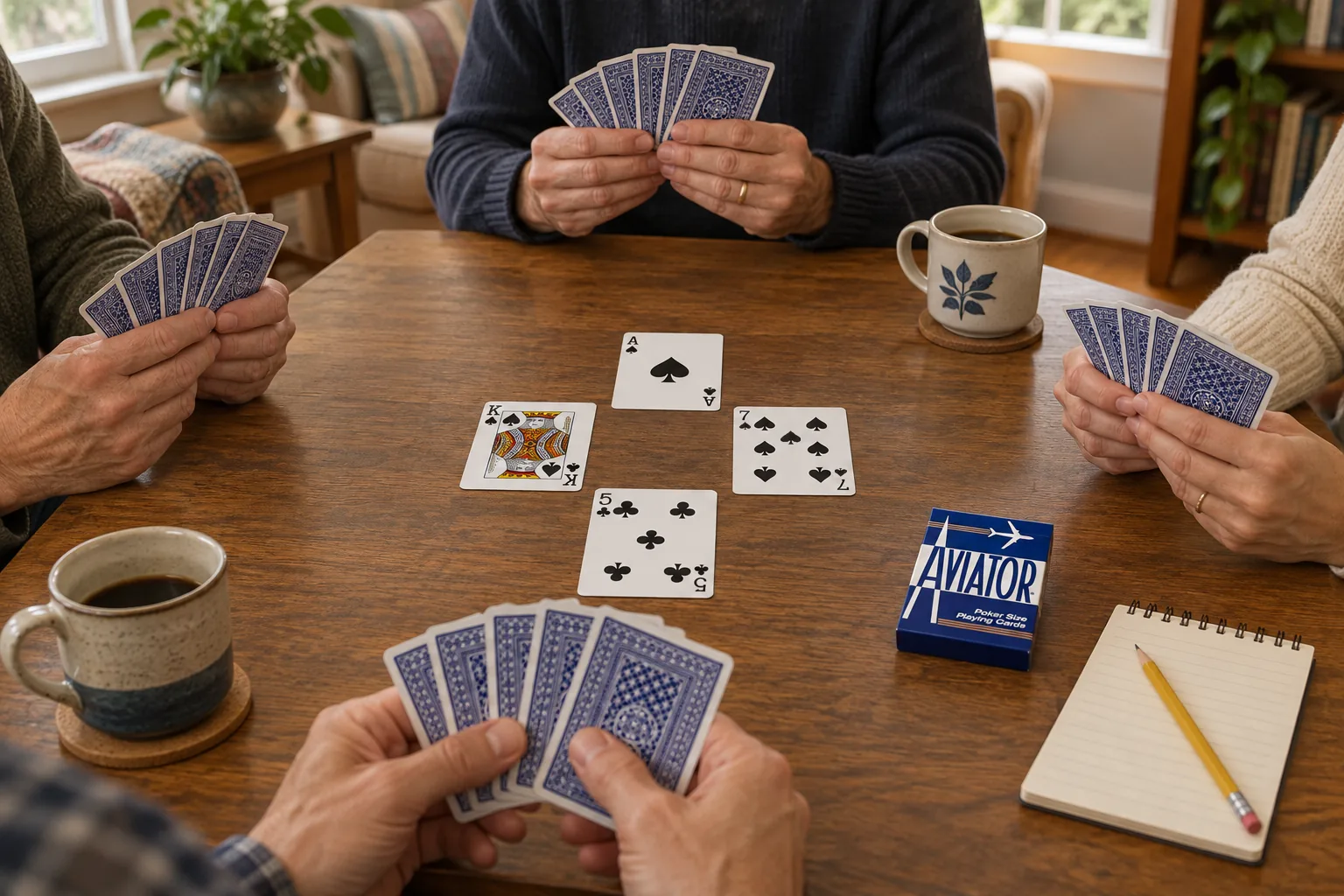
4 Player Card Games and Card Games for Large Groups
Card games for 4 or more players: partner games like bridge, spades and euchre, group and party games for 5 to 10, and how many decks you need.
In short
With four players, the card games that work best are nearly always partnership games: bridge, spades, euchre, canasta and burraco with a standard deck; mus, tute and truco with the Spanish deck; and each country's great classics, such as French belote, Portuguese sueca, Italian tressette or German Doppelkopf. From five players upwards the logic changes and the best card games for groups are the ones where everyone plays for themselves: president, cheat, hearts, oh hell, crazy eights, blackjack, poker or spoons.
- 4 player card games with a standard deck: bridge, spades, euchre, canasta, burraco and hearts.
- 4 player card games with the Spanish deck: mus, partnership tute, guiñote, brisca, truco and escoba.
- Card games for 5 to 10 players: president, cheat, oh hell, chinchón, siete y media, blackjack, poker, spoons and Kemps.
- With six or more, many games need two decks; at the end there is a table showing how many you need.
Four is the number many of the most studied card games were designed for. With four players seated crosswise, partners face each other and each player has an opponent on either side, so the turn always alternates between the two teams. That arrangement lets you deal the whole deck without anyone knowing what the others hold, and it means part of the game is understanding what your partner is telling you through the cards they play (and, in some games, through permitted signals). That is what mus, belote, bridge and tressette have in common: games from different countries that are far more alike than their names suggest.
When the table grows, partnership games stop fitting and other families take over: shedding games (getting rid of your cards first, as in president or crazy eights), bluffing games (cheat), banking games (siete y media, blackjack, poker), rummy games with two decks (chinchón, continental) and speed games, designed for everyone to play at once. This guide is laid out as follows: first the partnership games for four, grouped by deck and by country; then group games for five to ten players; and at the end how many decks you need, a summary table and another for choosing according to who is playing. If there are three of you, there is a separate guide to three player card games, and if there are two, see two player card games.
Spanish card games for 4: mus, tute, truco and more
The 40-card Spanish deck (suits of coins, cups, swords and clubs) has its great four-player games in Spain and Latin America. Almost all of them share the values of the tute family (ace 11, three 10, king 4, knight 3 and jack 2, with the odd exception) and are played with partners sitting opposite each other. The most visible difference between them is how partners communicate: in mus and truco signals are part of the rules, while tute and guiñote are played in silence and everything is worked out from the cards.
Mus
4cardsA betting game of Basque origin and one of the most played in Spain. There are no tricks and no trumps: you bet on four different contests with only four cards, and signals between partners are allowed and regulated.
- Basque Country, all of Spain
- 40-card Spanish deck
- 45-90 min
- Medium
How to play
Each player gets four cards. If all four say "mus", they discard and draw; one "no mus" is enough to start betting. Four rounds are played in order: grande (the highest cards win), chica (the lowest), pares (pairs, three of a kind or two pairs) and juego, which you hold when your cards add up to 31 or more (31 is the best). If nobody has juego, punto is played instead. In the most common version threes count as kings and twos as aces, so there are eight kings and eight aces.
In each round you can pass, bet, raise or call órdago, which puts the whole game at stake. Signals (biting your lip, showing your tongue, winking) tell your partner what you hold. Most often the game is to 40 points, counted with stones and five-point markers; in some areas it is to 30. Full details in our mus rules and signals.
Partnership tute
10cardsThe social form of tute, a Spanish trick-taking game. The whole deck is dealt, ten cards each, and from the first trick you must follow suit, play higher and trump. It is a memory game: the partnership that always knows which cards are left wins.
- Spain
- 40-card Spanish deck
- 15-20 min per hand
- Medium
How to play
All 40 cards are dealt one at a time. The last one, which belongs to the dealer, is shown and its suit is trumps. You must follow suit; if you can beat the highest card on the table, you must play higher; if you have none of the suit, you must trump, and if there is already a trump on the table, play a higher one if you have it.
After winning a trick, a player holding the king and knight of the same suit can declare them: 20, or 40 in trumps. The last trick adds 10, so there are 130 points at stake. Collecting all four kings or all four knights is tute and at many tables wins outright. Games are played to an agreed number of hands or games. Full rules in our tute rules.
Guiñote
101pointsThe game of Aragon, Navarre and part of Castile. It belongs to the tute family, but the jack ranks above the knight, declarations are king and jack, and the game is to 101 points, so you need to keep an accurate count.
- Aragon and Navarre
- 40-card Spanish deck
- 20-40 min
- Medium
How to play
It is played by two partnerships sitting opposite each other. The values are those of tute with one change: the jack is worth 3 and beats the knight, which is worth 2. Declarations are made with the king and jack of the same suit (20, or 40 in trumps) after winning a trick, and the last trick adds ten points.
The first partnership to reach 101 wins. If neither does, there is a second deal, "la vuelta", made by whoever won the last trick, and the two hands are added together. Claiming 101 without having it, or reneging (not following suit, playing higher or trumping when required), loses the game. More in our guiñote rules.
Partnership brisca
120pointsGood old brisca, the Spanish twin of Italian briscola, for four. Three cards in hand, a draw after each trick and no need to follow suit. In partnerships it gets more interesting because partners can share the work: one holds on to trumps and the other piles up points.
- Spain and Italy (briscola)
- 40-card Spanish deck
- 10-15 min per hand
- Easy
How to play
Each player gets three cards and a card is turned up to set trumps. Everyone plays whatever card they like, and the trick goes to the highest trump or the highest card of the suit led. Then each player draws a card. The ace is worth 11, the three 10, the king 4, the knight 3 and the jack 2: 120 points, and the partnership that passes 60 wins.
In Italian briscola for four most tables allow some kind of communication between partners, spoken or by gestures, mainly to flag high trumps. With six players there are two teams of three. Rules in our brisca rules.
Truco
30pointsThe bluffing game of Argentina and Uruguay, with roots in Valencia and the Balearic Islands. It is most often played by four in two partnerships, and also by six in two teams of three. Signals to your partner are part of the game.
- River Plate, Valencia and Balearics
- 40-card Spanish deck
- 30-45 min to 30
- Medium
How to play
Each player gets three cards and the round goes to the team that takes two of the three tricks. Above everything else are the ace of swords, the ace of clubs, the seven of swords and the seven of coins. During the round players can call envido (a bet on two cards of the same suit) and truco, which can be raised to retruco and vale cuatro.
Partners pass information with gestures (the truco signals), which can also be used to mislead opponents who see them. The game is to 30 points, split into 15 "malas" and 15 "buenas". Full guide in our truco rules.
Escoba for four (and six)
15the sumEscoba de 15, a Spanish fishing game, is also played in partnerships, with the same rules as for two: each card played captures the table cards it makes fifteen with. With six players there are two sides of three.
- Spain, Argentina, Uruguay
- 40-card Spanish deck
- 20-30 min to 21
- Easy
How to play
Each player gets three cards and four go face up on the table. The jack counts 8, the knight 9 and the king 10. With four players the deck allows three deals in all, so there are fewer hands than with two and each sweep counts for more. At the end you count cards, coins, the seven of coins and the sevens, plus sweeps, and play to 21 or 31. Rules in our escoba de 15 rules.
Cuarenta
40pointsEcuador's most popular fishing game, for two or for four in partnerships. You capture by matching value, by adding up and by runs, and the name comes from the target: 40 points.
- Ecuador
- 40 cards (standard deck without 8s, 9s and 10s)
- 30-45 min
- Medium
How to play
Each player gets five cards; with four there are two deals per hand. A card captures a matching card or several that add up to its value (court cards only by matching), and can also take the run that follows. Capturing the card the previous player has just played is a caída (2 points) and clearing the table is a limpia (2 points). Being dealt three of a kind is a ronda, worth 4. Captured cards also score at the end of the hand, and the eights, nines and tens taken out of the deck are used to keep score. More in our cuarenta rules.
Partnership card games from Italy, France, Portugal, Germany and Switzerland
Every European country has its great four-player game, and the resemblance between them is down to history: almost all are trick-taking games with values very close to those of tute, and with one card that shoots up in value when its suit is trumps. Several can be played with a stripped standard deck; we explain how in the next section.
Italy
Tressette
3the highest cardOne of Italy's three great national card games along with scopa and briscola, recorded since the early 18th century. It has no trumps: the three is the highest card, followed by the two and the ace, and you must always follow suit.
- Italy
- 40-card Italian deck
- 30-45 min to 21
- Medium
How to play
It is played by two partnerships sitting opposite each other, with no trumps and an obligation to follow suit. The ranking is three, two, ace, king, knight, jack, seven, six, five and four. Each ace is worth a full point, and each three, two and court card a third of a point; the last trick adds one more point. The game is to 21.
Talking to your partner is forbidden, but three classic signals are allowed: busso (knocking on the table), volo (dropping the card, meaning it is your last of that suit) and striscio (sliding the card, meaning you hold many of that suit). Some regions do not accept the slide. The ace, two and three of the same suit together are called a napoletana and score extra in the variant with declarations.
Scopone
40cardsPartnership scopa. The whole deck is dealt with no stock to draw from, which makes it a game of calculation where you know exactly which cards are still to come.
- Italy
- 40-card Italian deck (or a standard deck without 8s, 9s and 10s)
- 20-30 min to 11
- Medium
How to play
There are two ways to deal: nine cards per player and four face up on the table, or ten per player and none on the table. You capture as in scopa: a card takes another of equal value or several that add up to the same, and clearing the table is a scopa. At the end of each hand four things score, most cards, most coins, the seven of coins (settebello) and the highest primiera, plus one point for each scopa. The first partnership to 11 wins, although many tables play to 21.
France and Portugal
Belote
162pointsFrance's most popular trick-taking game, found in cafés, homes and tournaments with federation rules. It is played with 32 cards, and its trademark is that the jack and the nine become the highest cards when their suit is trumps.
- France
- 32-card deck (7 to ace)
- 45-60 min to 1,000
- Medium
How to play
Each player gets five cards and one card is turned up to propose trumps. If someone accepts it, the deal is completed to eight cards (whoever took it adds it to their hand). In the trump suit the ranking is as follows:
The jack of trumps is worth 20 and the nine 14; in the other suits the ace (11) leads, followed by the ten (10). Cards and last trick together make 162 points, and the partnership that chose trumps needs more than half. King and queen of trumps in the same hand are the belote-rebelote and add 20. The most played variant with bidding is coinche. Full rules in our belote rules.
Sueca
120pointsPortugal's great partnership game, also widely played in Brazil and Angola. It is related to brisca, with the seven as the second highest card, and is played without talking or signalling to your partner.
- Portugal, Brazil, Angola
- 40 cards (standard deck without 8s, 9s and 10s)
- 5-10 min per hand
- Easy
How to play
Each player gets ten cards and the dealer's last card is turned up to set trumps. You must follow the suit led. The ranking is ace, seven, king, jack, queen and then six down to two:
They are worth 11, 10, 4, 3 and 2 points, 120 in total. Passing 60 wins one game; reaching 91, two; taking every trick (the bandeira), four. At 60 all, the game at stake carries over to the next hand. More in our sueca rules.
Germany and Switzerland
Doppelkopf
48cardsThe four-player game of northern Germany, which began as a variant of Schafkopf. Its most curious feature is that partnerships are secret: the two players holding the queens of clubs play together, and nobody knows who they are at the start.
- Northern Germany
- Two 24-card decks (9 to ace)
- 15-20 min per hand
- Hard
How to play
It uses 48 cards: two copies of each ace, ten, king, queen, jack and nine. The two players dealt the queens of clubs form the Re team and the other two the Kontra team; who is on which side comes out during the hand.
There are lots of trumps: the ten of hearts, then the queens, the jacks and the diamonds. There are 240 points in the cards (ace 11, ten 10, king 4, queen 3, jack 2) and the Re team needs 121. There are special plays such as the Hochzeit (the holder of both queens of clubs looks for a partner) and solos. The German Doppelkopf Association keeps a set of tournament rules; at home every table has its own.
Schafkopf
32cardsThe national card game of Bavaria. The player who chooses to play "calls" an ace, and whoever holds it becomes their secret partner, so the partnerships change every hand.
- Bavaria
- 32-card German deck
- 10-15 min per hand
- Hard
How to play
Each player is dealt eight cards. In the normal game (Sauspiel) the declarer names an ace of a non-trump suit and its holder plays with them without saying so. The trumps are always the four Ober, the four Unter and the rest of the hearts: 14 in all. There are 120 points in the deck and the declarer's team needs 61. You can also play alone, in a Solo (you choose the trump suit) or a Wenz (only the Unter are trumps). Its official rules were set in 1989.
Jass (Schieber)
157pointsSwitzerland's national card game, in its most played partnership form. It belongs to the same family as belote: the jack and nine of trumps are the strongest cards. Its name comes from the fact that you can "push" the choice of trumps over to your partner.
- Switzerland
- 36 cards (6 to ace)
- 1-2 hours
- Medium
How to play
Each player is dealt nine cards. The player who leads chooses the mode or passes it (schieben) to their partner, who must then choose. You can play with a trump suit or no trumps, top down (Obenabe) or bottom up (Undenufe). In trumps, the jack (Puur) is worth 20 and the nine (Nell) 14. Each hand shares out 157 points, counting 5 for the last trick, and taking all nine tricks earns a 100-point bonus. The game is to a high agreed total, often 1,000 or 2,500 points. You can use a standard deck with the twos to fives removed.
Short decks: how to make them from a standard deck
Many four-player games use 40, 36, 32 or 24-card decks that you may not have at home. There is no need to buy them: you can put them together from a normal poker deck by taking cards out. The euchre deck, for example, comes down to four suits of six cards, from nine to ace:
| Cards | What to remove | Four-player games |
|---|---|---|
| 40 | The 8s, 9s and 10s | Sueca, scopone, cuarenta (and tressette or brisca at a pinch) |
| 36 | 2s to 5s | Jass |
| 32 | 2s to 6s | Belote, coinche |
| 24 | 2s to 8s | Euchre |
| 48 | 2s to 8s from two decks, combined | Doppelkopf |
If you are going to play one of these games often, it is worth having a dedicated deck rather than taking cards in and out of your good one. All the equivalents are in how many cards are in a deck.
Did you know decks like these exist?
At heart, every deck has the same cards. What changes is everything else: the design, the finish, metallic inks or gilded edges. Take a look at our catalogue and bring your own style to the card table.
Browse our playing cards →




Partnership card games with a standard deck
With a standard 52-card deck, the most widespread partner card games come from two traditions. One is English whist, from which bridge and spades descend: thirteen cards per player, thirteen tricks and a bid on how many you will win. The other is rummy, with Uruguayan canasta and Italian burraco, both played with two decks and jokers.
Bridge
13tricksThe great competitive partnership trick-taking game, with national federations, championships and a world federation founded in 1958. It descends from whist, and its current form, contract bridge, was settled in the 1920s.
- English-speaking world, international
- 52-card deck
- 7-10 min per hand
- Hard
How to play
Each player is dealt thirteen cards. First comes the auction: each bid states how many tricks above six the partnership undertakes to win and in which trump suit, from "one club" (seven tricks) to "seven no trumps" (all thirteen). The suits rank bids from lowest to highest: clubs, diamonds, hearts, spades and, above them, no trumps. The auction ends after three passes in a row and the last bid is the contract.
The player in the winning partnership who first named that suit is the declarer. Their partner, the dummy, lays their cards face up after the opening lead and the declarer plays both hands. The opponents try to stop the contract being made. It takes a long time to learn, but the trick-taking mechanics are those of any follow-suit game.
Spades
500pointsA simple relative of bridge, born in the United States in the 1930s. Spades are always trumps and each player bids how many tricks they will take.
- United States
- 52-card deck
- 45-60 min to 500
- Easy
How to play
Each player is dealt thirteen cards. Everyone says how many tricks they expect to win, with no option to pass, and the partnership adds its two bids together. You cannot lead spades until someone has trumped with one or until the leader holds nothing but spades.
Making your bid scores 10 points per trick bid and 1 for each extra trick (a bag); failing costs 10 per trick bid. Collecting ten bags costs 100 points, so nobody underbids on purpose. Bidding zero is a nil: make it and you score 100; take a single trick and you lose 100. The first partnership to 500 wins.
Euchre
24cardsA fast five-card game, very popular in the American Midwest, Canada, Australia, New Zealand and Cornwall. It is the game for which the joker was added to the American deck in the 1850s.
- North America, UK, Oceania
- 24 cards (9 to ace)
- 20-30 min to 10
- Easy
How to play
Each player gets five cards and one card is turned up. In turn, players can accept it as trumps ("order it up"); the dealer then picks it up and discards another card. The partnership that sets trumps needs at least three of the five tricks. The fun is in the jacks: the jack of the trump suit is the highest card, and the other jack of the same colour becomes a trump and the second highest.
Three or four tricks score 1 point; all five, 2. If the partnership that set trumps takes fewer than three, the opponents score 2. A player who is very confident can go alone, with their partner sitting out, and taking all five tricks scores 4 points. The game is to 10, although 5 or 7 are also agreed. The story of the joker and euchre is in our history of the joker card.
Canasta
108cardsBorn in Montevideo in 1939, it became a worldwide craze within a few years. It is the partnership melding game par excellence: you meld groups of cards of the same rank, and a canasta is a meld of seven.
- Uruguay, 1939
- Two 52-card decks and 4 jokers
- 1-2 hours to 5,000
- Medium
How to play
With four, each player is dealt eleven cards. On each turn you draw from the stock, or take the whole discard pile if you can use its top card, and discard one. Jokers and twos are wild cards. To go out you need at least one canasta, and your first meld must reach a minimum count that rises with your score. The classic version is played to 5,000 points.
With six players you use three decks with six jokers, thirteen cards each, and play in three partnerships or two teams of three. Full rules in our canasta rules.
Burraco
11cardsItaly's most played partnership melding game, with federation rules. It is similar to canasta, but allows runs in the same suit and has two reserve piles, the pozzetti, which change the pace of the hand.
- Italy
- Two 52-card decks and 4 jokers
- 1-2 hours to 2,000
- Medium
How to play
Each player is dealt eleven cards and two piles of eleven, the pozzetti, are set aside. You meld sets of three or more of a kind or runs in the same suit, with at most one wild card per meld (jokers and twos). A burraco is a meld of seven or more cards: a clean one is worth 200 and one with a wild card 100. The first player in each partnership to run out of cards takes a pozzetto and carries on playing with it. To go out you must have taken the pozzetto and have at least one burraco. The game is to 2,000 points. More in our burraco and scala 40 rules.
Hearts also works very well with four, although without partnerships: everyone plays for themselves, and we cover it in the next section because it is one of the games that adapts best to tables of three to six players.
Card games for 5 to 10 players
With five or more people, fixed-partnership games stop working, apart from exceptions such as canasta, escoba or truco for six. The games that hold up well at large tables have a different structure: everyone plays for themselves, rounds are short, and whoever drops out of a hand does not wait long. These are the card games for groups that work best at home, after a meal or with friends.
President
4-8playersA shedding game of Asian origin, related to Japanese daifugō. You have to get rid of your cards before everyone else, and the finishing order hands out ranks that give an advantage or a disadvantage in the next hand.
- Asia, now played worldwide
- 52-card deck (two with many players)
- 5-10 min per hand
- Easy
How to play
The whole deck is dealt. The two is the highest card, followed by the ace and king down to the three. The leader plays a card or a group of matching cards, and the following players must beat it with the same number of cards or pass. When everyone passes, the last player to play leads again.
The first to run out of cards is the president, then the vice-president, and the last gets the least flattering title. In the next hand the last player hands their best card to the president, who gives back one they do not want. It works for four to seven or eight players; with more, two decks are mixed. Rules in our president card game rules.
Cheat
3-10playersThe simplest bluffing game: you play cards face down saying what they are, and you do not have to tell the truth. The more players there are, the harder it is to tell who is lying.
- International (cheat, I doubt it)
- 52-card deck (two for large tables)
- 10-20 min
- Very easy
How to play
The whole deck is dealt. The first player puts down one or more cards face down and says "aces"; the next, "twos", and so on upwards. Anyone can call "cheat". The cards are turned over: if they were what was claimed, the accuser picks up the whole pile; if not, the liar does. The first to get rid of all their cards wins. At large tables two decks are mixed, and many groups do so from five players. More in our cheat card game rules.
Hearts and its variants
26penalty pointsTrick-taking in reverse: every heart you take is a point against you and the queen of spades thirteen. Its ideal number is four, but it adapts to three to six, and for bigger tables there is a two-deck version.
- United States, late 19th century
- 52-card deck
- 30-45 min to 100
- Easy
How to play
Before each hand three cards are passed: to the left, to the right, across, and one hand with no passing, in turn. The two of clubs leads and hearts cannot be led until someone has played one. Taking all the hearts and the queen of spades is shooting the moon: instead of scoring 26 yourself, you add them to each opponent. The game ends when someone reaches 100 and the lowest score wins.
For other numbers, low cards are removed: with three, the two of diamonds (17 cards each); with five, the two of diamonds and the two of clubs (10 cards each). For six or more players you play cancellation hearts with two decks: when two identical cards fall in the same trick they cancel out and the next highest wins. A well-known variant, omnibus hearts, adds a diamond that subtracts points. Everything is in our hearts card game rules.
Oh hell (pocha and podrida)
3-7playersTrick-taking games where you have to predict exactly how many tricks you will win. In English it is oh hell, also called contract whist or up and down the river; in Spanish it is called pocha when played with the Spanish deck and podrida when played with a standard deck.
- Spain and international
- Spanish 40 (pocha) or standard 52 (oh hell)
- 45-60 min
- Medium
How to play
The number of cards changes every hand: you start with one and go up until as many as possible are dealt, then come back down (or the other way round). Before play, everyone says how many tricks they will win. The last to bid cannot say a number that makes the total of bids equal the number of tricks available, so somebody always fails. Making your bid scores 10 plus one point per trick (scoring systems vary a little from house to house). It works for three to seven, at its best with four, five or six. The Spanish rules are in our cinquillo and pocha (sevens and oh hell) rules.
Chinchón
2-8playersSpanish rummy. With one deck up to four can play; for five to eight players two are mixed. It is the most common after-dinner game in many homes that play with the Spanish deck.
- Spain
- Spanish 40 or 48 (two decks for 5 to 8 players)
- 30-60 min
- Easy
How to play
Seven cards are dealt. On each turn you draw from the stock or the discard pile and throw one away, looking for sets of three or four of a kind and runs in the same suit. When almost everything is melded and your loose cards are worth little, you go out and the others add up what they have left. Anyone who goes over 100 (or 70) is out and the last player standing wins. Going out with all seven cards in a run of the same suit is chinchón. Rules in our chinchón rules.
Continental
7roundsA contract rummy: seven rounds, each with a different required combination before you can meld. It needs two decks with jokers and an afternoon ahead of you, and works best with four or five players.
- Spain (contract rummy family)
- Two 52-card decks with jokers
- 2-3 hours
- Medium
How to play
It is played by three to six, each for themselves, and with many players a third deck is added. In each round you must complete a specific contract (for example, two sets of three, or a set and a run) before you can meld. Out of turn you can "buy" the discard in exchange for drawing an extra penalty card. At the end of each round the cards left in your hand count against you and the lowest total wins. The seven rounds and buying are explained in our continental rummy rules.
Cinquillo
3-6playersThe family game par excellence with the Spanish deck, similar to sevens (or fan tan): all the cards are dealt and each suit is built up in rows on the table, starting from the five. Children pick it up easily and it takes up to six players.
- Spain
- 40-card Spanish deck
- 10-15 min per hand
- Very easy
How to play
The holder of the five of coins starts. In turn, each player places a five of another suit or a card that extends a row up or down. You must play if you can, and you only pass when no card fits. The first to run out of cards wins. More in our cinquillo and pocha rules.
Siete y media
7½pointsThe banking game of Spanish Christmas, with its Italian twin, sette e mezzo. One player deals against everyone else, and the others ask for cards trying to get as close as possible to seven and a half without going over. The size of the table is the only limit on players.
- Spain and Italy
- 40-card Spanish deck
- Open-ended
- Very easy
How to play
The cards from ace to seven are worth their number and the court cards half a point. Each player bets, gets one card, and then asks for more or stands. Anyone who goes over seven and a half loses their bet on the spot. Then the bank plays, and wins ties. The bank changes hands when a player gets exactly seven and a half. In Italy one court card (usually the king of coins) is often wild. Rules in our siete y media rules.
Blackjack at home
21pointsThe standard-deck version of the same idea: make 21 or get close without going over, against a bank that can rotate. It takes as many players as there are chairs around the dealer.
- International
- One or two 52-card decks
- Open-ended
- Easy
How to play
Court cards are worth 10, the ace 1 or 11 and the rest their number. Each player gets two cards and decides whether to hit, stand, double the bet or split a pair. The bank plays last by fixed rules. At home one deck is enough for a few players and two for a big table. Basic strategy and rules in our blackjack rules.
Poker (Texas Hold'em)
10per tableThe standard-deck group game by definition. Each player gets only two cards of their own and the other five are shared, so a single deck is enough for a full table of ten.
- United States
- 52-card deck and chips
- 2-4 hours
- Medium
How to play
Each player gets two face-down cards and there are four betting rounds while three cards are turned up in the middle, then one more, then another. The best five-card hand made from your own and the shared cards wins, or whoever gets everyone else to fold. With ten players 20 cards go into hands, 5 onto the table and a few are burned, far short of 52. To get started, see how to play Texas Hold'em and, to organise it, our guide to a home poker night.
Crazy eights
2-8playersThe standard-deck ancestor of Uno: you must play a card of the same suit or rank as the top card, and eights can go on anything. In Germany it is played as Mau-Mau and in France as huit américain.
- International
- 52-card deck (two from 6 players)
- 10-15 min per hand
- Very easy
How to play
Each player gets five cards (seven if there are two of you) and one card is turned up. In turn, each player plays a card matching the top card in suit or rank, or draws. An eight can be played on any card and whoever plays it chooses the next suit. Many households give other cards effects: the queen skips a turn, the ace reverses direction and the two makes the next player draw two. The first to get rid of their cards wins. With more than five players two decks are mixed.
Briscola chiamata
5playersThe Italian way to play briscola with five. The right to choose trumps is auctioned, and the winner "calls" a card: whoever holds it is their partner, but nobody knows who that is until the card is played.
- Italy
- 40-card deck
- 10-15 min per hand
- Medium
How to play
Each player is dealt eight cards. Players bid for the right to call, and the winner names a card (for example, the three) and chooses its suit, which becomes trumps. The holder of that card plays with them in secret: it is two against three. The values are those of brisca, and the caller's team needs 61 points, or whatever was promised in the auction.
Quick party card games for large groups
There is a type of game that is not about strategy but about everyone playing at once, with rules you can explain in a minute. These party card games work well at birthdays, on camps, with teenagers and at mixed tables of adults and children.
Spoons
3-13playersCards are passed round the circle at full speed in search of four of a kind, and in the middle there is one spoon fewer than there are players. When someone completes their set they grab one, and the rest have to react.
- United States
- 52-card deck and spoons
- 10-20 min
- Very easy
How to play
You use as many sets of four as there are players (with five players, for example, aces, kings, queens, jacks and tens). Each player gets four cards and, with no turns, everyone passes a card to the left at the same time and picks up the one coming from the right. Whoever collects four of a kind grabs a spoon; from that moment anyone can grab one, even without a set. The player left without a spoon gets a letter (S-P-O-O-N) and is out when they complete the word. It is also known as pig, in a version where you touch your nose instead of grabbing spoons. With more than thirteen players you need two decks.
Kemps
2per teamA cross between spoons and a signalling game: you play in partnerships, collect four of a kind and tip off your partner with a secret signal agreed in advance. The opponents can try to spot the signal.
- United States
- 52-card deck
- 15-20 min
- Easy
How to play
It is played in teams of two, with partners sitting opposite each other, and two to six teams can play. Each player gets four cards and four are placed face up in the middle. With no turns, everyone swaps cards from their hand for those on the table; when nobody wants the table cards, they are removed and four new ones are laid out. A player who has four of a kind gives the signal to their partner, who must call out "Kemps". If they are right, the opposing team gets a letter; if wrong, their own team does. If you suspect an opposing pair, you can stop them with "Stop Kemps" and the same applies in reverse. The team that completes K-E-M-P-S loses.
Nerts (racing demon)
1deck per playerA competitive patience game where everyone plays at once on shared foundations. Each player needs their own deck, ideally with different backs, and the only limit is the space on the table.
- United Kingdom and United States
- One 52-card deck per player
- 5-10 min per hand
- Medium
How to play
Each player lays out a pile of 13 cards in front of them (the nerts pile) and some columns as in Klondike solitaire. In the middle, anyone can start a foundation with an ace and build it up by suit. There are no turns: the hand ends when someone empties their pile of 13 and calls it. In scoring, the cards each player has placed on the foundations count for them and the ones left in their pile count against. In the UK it is called racing demon and in the United States also pounce.
How many decks you need for each number of players
A 52-card deck holds up well for five or six players in almost every shedding game. Beyond that, either the hands get very short or two decks are mixed. Melding games such as canasta or continental start from two decks with jokers anyway:
| Game | With one deck | When you need more |
|---|---|---|
| Cheat | Small tables | Large tables, two (many groups from 5) |
| Crazy eights | Up to 5 | From 6, two |
| President | Up to 7 or 8 | Larger tables, two |
| Chinchón | 2 to 4 | 5 to 8, two Spanish decks |
| Hearts | 3 to 6 | From 6, cancellation version with two |
| Spoons | Up to 13 | More than 13, two |
| Kemps | Up to 6 teams | Not usually needed |
| Poker, siete y media | The whole table | Not needed |
| Blackjack | A few players | Big table, two |
| Canasta, burraco | Always two | Canasta for 6: three decks and 6 jokers |
| Continental | Always two | With many players, three |
| Nerts | One per player | One more for each new player |
All the games at a glance
| Game | Players | Partners | Deck | Length | Difficulty |
|---|---|---|---|---|---|
| Mus Popular | 4 | Yes | Spanish 40 | 45-90 min | Medium |
| Partnership tute | 4 | Yes | Spanish 40 | 15-20 min per hand | Medium |
| Guiñote | 4 | Yes | Spanish 40 | 20-40 min | Medium |
| Brisca | 4 or 6 | Yes | Spanish 40 | 10-15 min per hand | Easy |
| Truco | 4 or 6 | Yes | Spanish 40 | 30-45 min | Medium |
| Escoba | 4 or 6 | Yes | Spanish 40 | 20-30 min | Easy |
| Cuarenta | 4 | Yes | 40 cards | 30-45 min | Medium |
| Tressette | 4 | Yes | Italian 40 | 30-45 min | Medium |
| Scopone | 4 | Yes | Italian 40 | 20-30 min | Medium |
| Belote | 4 | Yes | 32 cards | 45-60 min | Medium |
| Sueca | 4 | Yes | 40 cards | 5-10 min per hand | Easy |
| Doppelkopf | 4 | Secret | 2 × 24 | 15-20 min per hand | Hard |
| Schafkopf | 4 | Secret | German 32 | 10-15 min per hand | Hard |
| Jass (Schieber) | 4 | Yes | 36 cards | 1-2 hours | Medium |
| Bridge | 4 | Yes | Standard 52 | 7-10 min per hand | Hard |
| Spades Popular | 4 | Yes | Standard 52 | 45-60 min | Easy |
| Euchre | 4 | Yes | 24 cards | 20-30 min | Easy |
| Canasta Popular | 4 or 6 | Yes | 2 × 52 + 4 jokers | 1-2 hours | Medium |
| Burraco | 4 | Yes | 2 × 52 + 4 jokers | 1-2 hours | Medium |
| President Popular | 4-8 | No | Standard 52 | 5-10 min per hand | Easy |
| Cheat | 3-10 | No | Standard 52 (or two) | 10-20 min | Very easy |
| Hearts | 3-6 (more with two decks) | No | Standard 52 | 30-45 min | Easy |
| Oh hell / pocha | 3-7 | No | Spanish 40 or standard 52 | 45-60 min | Medium |
| Chinchón Popular | 2-8 | No | Spanish (two from 5) | 30-60 min | Easy |
| Continental | 3-6 | No | 2 × 52 with jokers | 2-3 hours | Medium |
| Cinquillo | 3-6 | No | Spanish 40 | 10-15 min per hand | Very easy |
| Siete y media | No limit | No | Spanish 40 | Open-ended | Very easy |
| Blackjack | No limit | No | Standard 52 (one or two) | Open-ended | Easy |
| Poker | Up to 10 per table | No | Standard 52 | 2-4 hours | Medium |
| Crazy eights | 2-8 | No | Standard 52 (two from 6) | 10-15 min per hand | Very easy |
| Briscola chiamata | 5 | Secret | 40 cards | 10-15 min per hand | Medium |
| Spoons | 3-13 | No | Standard 52 | 10-20 min | Very easy |
| Kemps | 4-12 | Yes | Standard 52 | 15-20 min | Easy |
| Nerts | 2-8 or more | No | One 52-card deck per player | 5-10 min per hand | Medium |
Durations are a rough guide: they depend a great deal on the pace of the table and on the target score you agree.
Which card game to choose for each table
The same group of four friends might want a serious game of bridge one Friday and something you can explain in two minutes the day a newcomer joins. This table matches the most common situations with the games that suit them best.
| Situation | What works | Games |
|---|---|---|
| Four keen players with a Spanish deck | Fixed partnerships and a long game | Mus, partnership tute, guiñote, truco |
| Four keen players with a standard deck | Trick-taking with bidding, or melding | Bridge, spades, canasta, burraco, belote |
| Two couples who have never played as a team | Short rules and quick hands | Euchre, spades, partnership brisca, escoba |
| Family with children (5-8 people) | No calculation, and anyone can win | Crazy eights, spoons, cheat, cinquillo |
| Party of 8 to 10 people | Everyone plays at once, or very short turns | Cheat, spoons, Kemps, siete y media |
| A long evening with 4 to 6 adults | Running scores | Continental, oh hell, chinchón, canasta for six |
| Christmas with the whole family | Banking games, token stakes and people coming and going | Siete y media, blackjack, poker played for chickpeas |
| Five people | Games that do not need even partnerships | President, oh hell, briscola chiamata, hearts for five |
For a big table, two matching decks are best
Most of the games in this guide are played with standard 52-card decks; with five or more players, use two with different backs.
Browse playing cardsHow much does a deck of cards cost?
From €5 to over €100. The 52 cards and the rules stay the same; this is what changes.
 To play€5.95 |  Designer€12.95 |  Premium€17.99 |  Collectible€34.94 | |
|---|---|---|---|---|
| Typical price | €5-9 | €9-15 | €15-30 | €30 or more |
| What sets it apart | Classic casino design | Artist illustration on back and faces | Special inks, embossing and foil on the box | Limited print runs and gilded edges |
| Who it is for | Games at home | Playing with something beautiful | Gifts or cardistry | Collecting and display |
| Example | Tally-Ho Fan Azul | theory11 Medallion | The Sandwich Series (Luncheon Meat) | Kings Wild LOTR Two Towers Gilded |
| See decks | See decks | See decks | See decks |
Frequently asked questions
What card games can four people play?
Almost all the great partnership games: bridge, spades, euchre, canasta and burraco with a standard deck; mus, tute, guiñote, brisca, truco and escoba with the Spanish deck; and belote, sueca, tressette, scopone or Doppelkopf in other countries. Without partnerships, hearts, president, oh hell and chinchón also work well with four.
What is the easiest partner card game?
With a standard deck, euchre or spades, which you can learn in one game. With the Spanish deck, brisca: three cards, no need to follow suit and only five scoring cards.
What card games work for large groups?
For tables of five to ten: president, cheat, siete y media, blackjack, poker, chinchón with two decks, spoons and Kemps. Siete y media and blackjack have no player limit because everyone plays against the bank.
How many decks do you need for eight players?
It depends on the game. Poker, siete y media or spoons work for eight with a single deck. For cheat, crazy eights or chinchón it is best to mix two. Canasta and continental always use two decks with jokers, and canasta for six uses three.
Can you play mus with more than four players?
Mus is designed for four in two partnerships. There are adaptations for six in two teams of three, but if there are more than four of you it usually works better to split the table or choose a group game such as president or siete y media.
Which partnership card game has the most strategy?
Bridge is the most studied, with federations and competitions all over the world. Among traditional games, mus, tressette, Doppelkopf and belote reward memory and understanding with your partner a great deal.
What are good party card games?
The ones where everyone plays at once and that you can explain in a minute: spoons, Kemps, nerts and cheat. If there are token stakes, siete y media or blackjack with chips or chickpeas.
If you are setting up a table for four or a big game, our shop has playing cards: well-finished 52-card decks made to last through plenty of games, and a poker section with decks and accessories.
Want more guides like this? Sign up for the newsletter.
Keep exploring
- Two player card games: 25 classics by deck
- Three player card games
- Solitaire card games to play alone
- List of card games by type and number of players
- Spanish deck games: mus, tute, brisca, guiñote and more
- Doppelkopf Rules
- Jass rules
- Scala 40 rules
Playing Cards
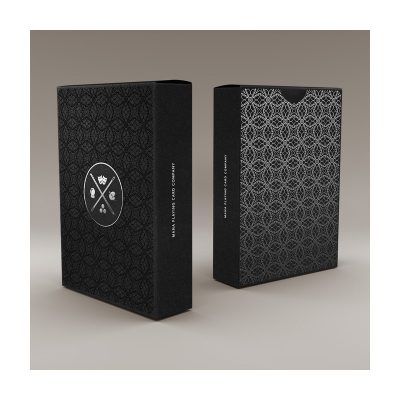
- New
Buskers Exclusive Edition by Erik Mana
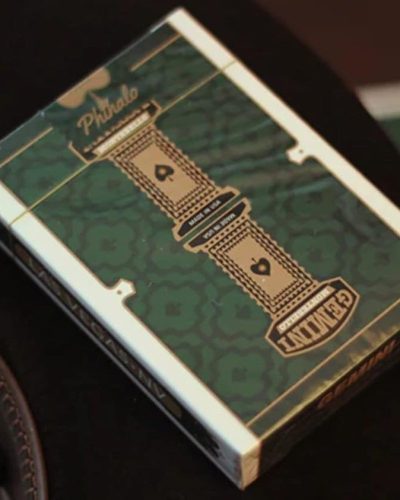
Gemini Casino Phthalo Green – Playing Cards
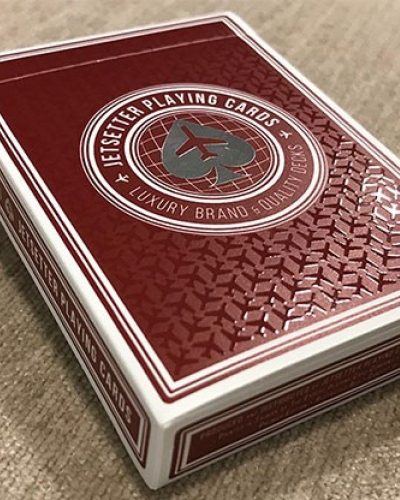
Premier Edition Restricted Red – Playing Cards
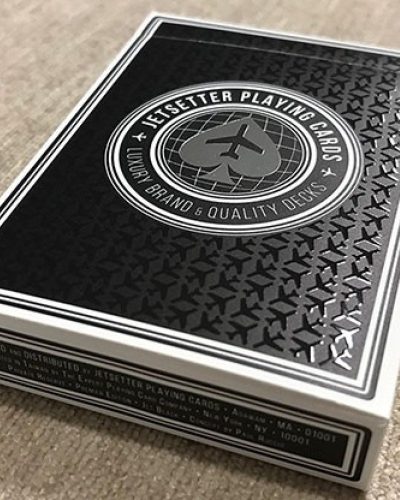
Premier Edition Jet Black Private Reserve – Playing Cards
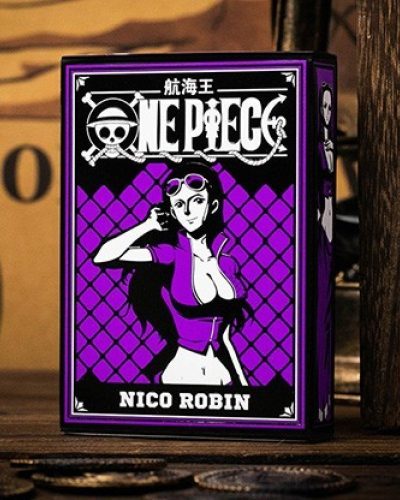
Card Mafia One Piece Robin – Playing Cards
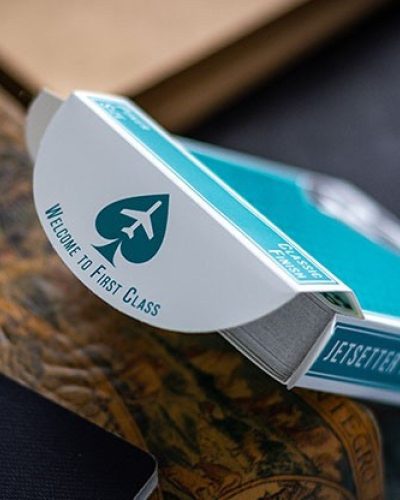
Lounge Edition Terminal Turquoise – Playing Cards
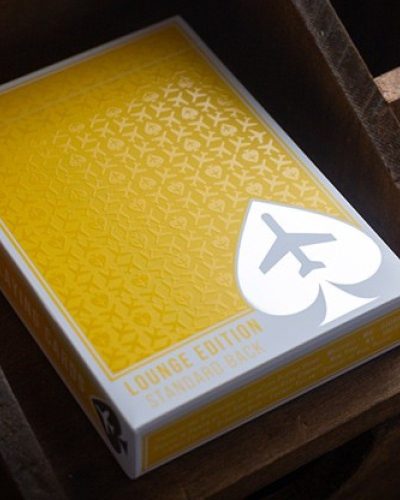
Lounge Edition Taxiway Yellow – Playing Cards
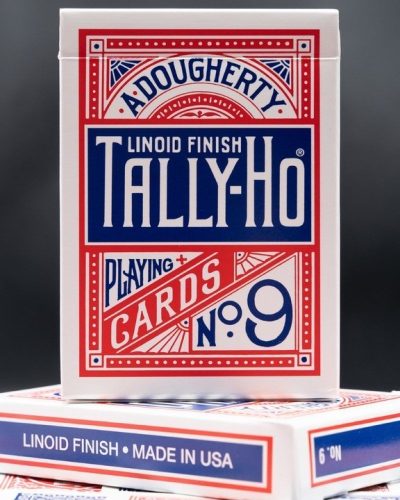
Tally-Ho Gaff – Playing Cards
Contact our team for any clarification about this document. Contact us