
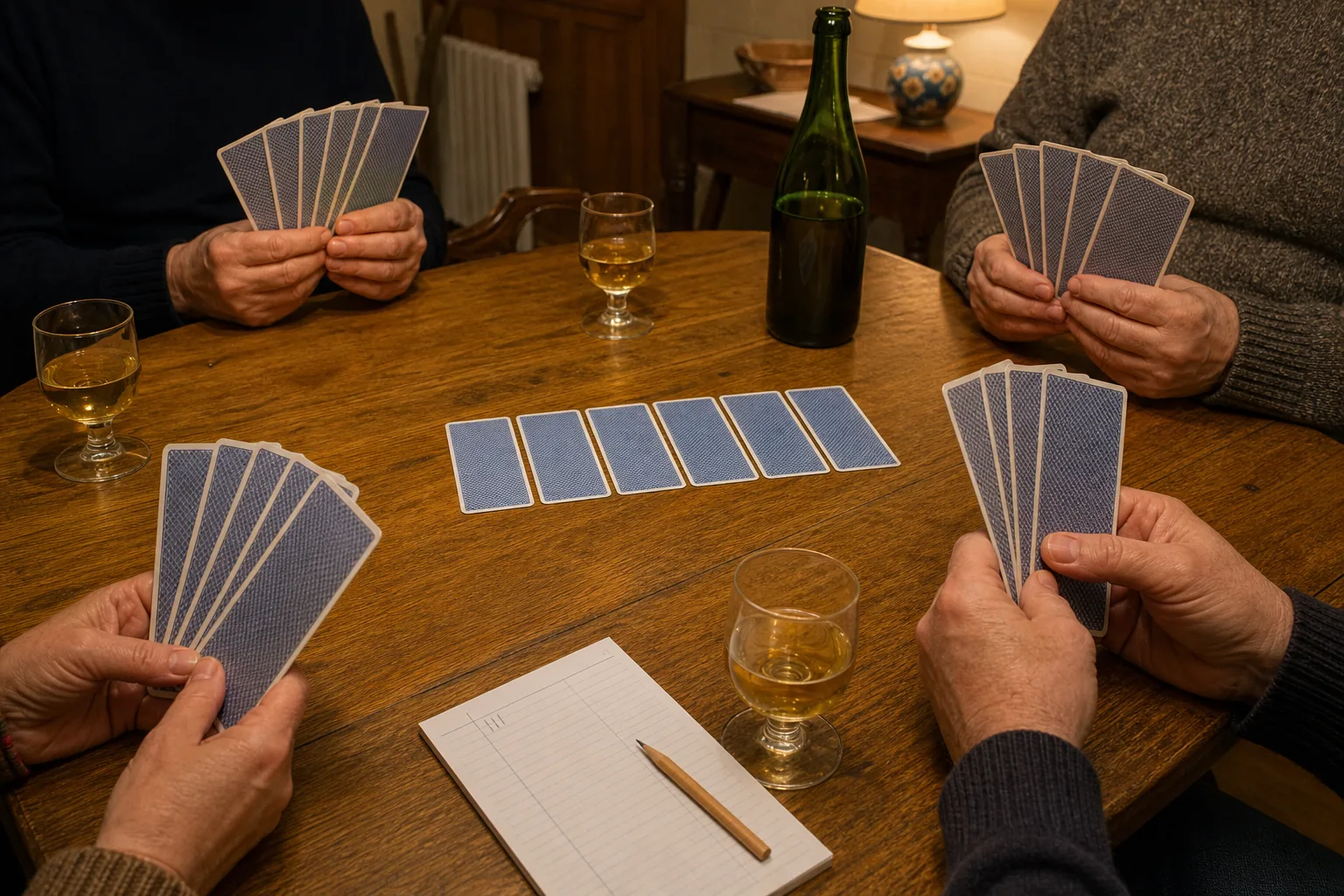
French tarot rules: how to play and score
French tarot rules, the card game: 78-card deck, bouts, bidding, chien, poignée, petit au bout and scoring, plus the three- and five-player games.
In short
French tarot is a trick-taking card game, not a fortune-telling method. It is played with a 78-card deck, usually by four players: in each hand one player, the preneur (the taker), commits to playing alone against the other three, who team up. To win, the taker needs a number of points that depends on how many bouts (the three key cards) end up in their tricks: 56 with none, 51 with one, 41 with two and 36 with all three.
- Deck: 21 numbered trumps, the Excuse and four suits of 14 cards (king, queen, knight, jack and 10 down to 1).
- Four-player deal: 18 cards each, dealt in threes, and 6 face down in the middle, the chien (“dog”).
- Contracts: prise (×1), garde (×2), garde sans le chien (×4) and garde contre le chien (×6).
- Scoring: (25 + point difference) × multiplier, plus the bonuses for poignée, petit au bout and chelem.
If you came here looking for how to lay out tarot cards or what the Fool means in a reading, this article is not about that. It covers the card game played in France in cafés, homes and clubs with a 78-card deck, which is by far the oldest use of those cards: for more than three centuries tarot was only a game, and card reading came much later. At the end of the article we explain where the confusion comes from.
French tarot is one of Europe’s great trick-taking games, a distant cousin of the games played in Spain with the Spanish deck: you must follow suit, trumps beat everything and points are counted at the end. What sets it apart is its one-against-three structure, which changes every hand, and a very precise scoring system. We follow the rules of the Fédération Française de Tarot (FFT), the French tarot federation, whose rulebook is used both in championships and in friendly games all over France. We keep the French terms, because they are the ones you will find at any table, in any app and on any score sheet.
The French tarot deck: 78 cards
French tarot is not played with an ordinary deck. It needs its own 78-card deck, made up of three distinct parts:
- Four suits of 14 cards: spades, hearts, diamonds and clubs. Each suit has four court cards, called honneurs or habillés in French: king (R), queen (D), knight (C, cavalier) and jack (V, valet). Below them come the number cards, from 10 down to 1. The knight is the card a poker deck does not have: it sits between the queen and the jack.
- 21 trumps (atouts), numbered 1 to 21. They form a separate suit that beats any card of the other four. The number shows their strength: 21 is the highest and 1, called the petit (“little one”), the lowest.
- The Excuse (l’excuse), an unnumbered card marked with a star, showing a musician with a mandolin. It works a bit like a wild card, with very specific rules: it “excuses” you from following the suit or trump that was led.
The decks used in France today follow a pattern known as Tarot Nouveau: French suits, double-headed court cards and trumps showing scenes of 19th-century life, with the number in the corners. It is a practical design made for play, and it has nothing to do with the illustrated arcana of divination decks, even though the 78-card structure is the same. If you are curious how tarot fits among the world’s other decks, see how many cards are in a deck.
Within each suit, rank follows value: king, queen, knight, jack, 10, 9, 8, 7, 6, 5, 4, 3, 2 and ace, which is the lowest card here.
The cards drawn in this article use the French indices printed on the decks: R (roi, king), D (dame, queen), C (cavalier, knight) and V (valet, jack). The suits have the same names and symbols as in a poker deck; if you want to know where they come from, we explain it in poker deck suits.
The bouts and card values
Three cards play a central role in French tarot: the 21, the petit (the 1 of trumps) and the Excuse. They are called bouts, a word meaning “ends” (the 1 and the 21 are the two ends of the trump series), or oudlers, a term widely used in clubs. The whole strategy revolves around them for two reasons: they are worth a lot of points and, above all, each bout the taker holds in their tricks at the end of the hand lowers the number of points they need to win.
French tarot points: what each card is worth
French tarot cards are worth half points. The whole deck adds up to 91:
| Card | How many | Value of each | Total |
|---|---|---|---|
| Bouts (21, petit and Excuse) | 3 | 4.5 | 13.5 |
| Kings | 4 | 4.5 | 18 |
| Queens | 4 | 3.5 | 14 |
| Knights | 4 | 2.5 | 10 |
| Jacks | 4 | 1.5 | 6 |
| All other cards (10 to ace in each suit, and trumps 2 to 20) | 59 | 0.5 | 29.5 |
| Total | 78 | 91 |
Ordinary trumps, from 2 to 20, are worth the same as a low card: half a point. A 20 of trumps wins almost every trick, but in the count it is worth no more than a 3 of spades. That split between power and value is one of the keys to the game: trumps are for winning tricks, while the points lie mostly in the court cards and the bouts.
How it is counted in practice: in pairs
To avoid adding up half points, French players count cards in pairs: each scoring card is paired with a low card, and the leftover low cards are paired with each other. That way everything comes out in whole numbers.
| Pair | Points |
|---|---|
| Bout + low card | 5 |
| King + low card | 5 |
| Queen + low card | 4 |
| Knight + low card | 3 |
| Jack + low card | 2 |
| Two low cards | 1 |
That is why many players say a king “is worth 5” and a queen “is worth 4”: it is the value of the pair, not of the single card. A handy way to check the count: the taker’s points and the defence’s points always add up to 91. Just count the smaller pile and subtract.
How many points the taker needs
| Bouts in the taker’s tricks | Points needed | Points that are enough for the defence to win |
|---|---|---|
| None | 56 | 36 |
| 1 bout | 51 | 41 |
| 2 bouts | 41 | 51 |
| 3 bouts | 36 | 56 |
The gap between holding one bout and holding two is huge: ten points off the target, plus the 4.5 the bout itself is worth. That is why bouts decide hands. What counts is the bouts in the taker’s tricks at the end, not the ones in hand at the start: a bout lost along the way no longer counts, and one captured from an opponent counts in the taker’s favour.
Not all bouts run the same risk. The 21 is the highest trump and cannot be lost: it always wins the trick it is played to. The Excuse does not change sides either, except in the last trick, as we will see. The one in danger is the petit: it is the lowest trump and any other trump can capture it. Much of the game is about protecting your own petit or trying to take your opponents’, which French players call the chasse au petit, the hunt for the petit.
Players and the deal
French tarot is played by three, four or five players, but the reference form, the one used in tournaments, is the four-player game. We explain that first and the differences for three and five at the end. One important detail if you are used to other card games: in tarot everything moves anticlockwise, that is, to the right: the deal, the bidding and the play.
Who deals
Before the first hand the deck is spread face down and each player draws a card. The player with the lowest card deals. If the two lowest cards tie, suit order decides: spades, hearts, diamonds and clubs, so the ace of clubs is the lowest card of all. Trumps rank above suit cards, and anyone who draws the Excuse draws again. After that, the deal passes to the right after each hand.
Shuffling, cutting and dealing
- The player opposite the dealer shuffles.
- The player to the dealer’s left cuts, leaving more than three cards in each part.
- The dealer deals the cards in threes, to the right, until each player has 18 cards.
- While dealing, the dealer puts down, one at a time and face down in the middle of the table, the 6 cards of the chien. Neither the first nor the last card of the pack may go into the chien.
- At the end, the dealer shows that there are exactly six cards in the chien. Nobody may pick up their cards until the deal is over.
The arithmetic works out: 4 × 18 = 72 cards in hand and 6 in the chien, 78 in all.
Petit sec: the hand is cancelled
There is only one situation in which a hand is cancelled before the bidding. If a player holds the petit sec (bare petit), meaning the petit as their only trump and without the Excuse, they must announce it and show their cards, and the cards are dealt again. The reason is obvious: that petit is doomed, because the first trump led forces it out and anyone can capture it.
Bidding and contracts
With the cards in hand, the bidding begins. The player to the dealer’s right speaks first and the turn passes to the right, ending with the dealer. Each player speaks only once: either pass or announce a contract higher than the last one bid. Whoever makes the highest bid becomes the preneur (the taker) and the other three form the défense. If all four pass, the cards are dealt again by the player on the right.
There are four contracts, from lowest to highest:
Prise (or petite)
×1multiplierThe basic contract. The taker turns the chien face up for everyone to see, adds it to their hand and then sets aside six cards face down: the écart (discard).
- Sees the chien
- Makes an écart
- Average hand
When to bid it
The FFT rules describe it as the contract for an average hand, with roughly a 50% chance of winning, often relying on the hope of finding something good in the chien. It used to be called the petite almost everywhere; the rules accept both names.
Garde
×2multiplierIt works the same way as the prise: the taker picks up the chien and makes the écart. The difference is the stake, which is doubled.
- Sees the chien
- Makes an écart
- The usual contract for a good hand
When to bid it
It can be a bid to overcall another player’s prise, but more often it is the opening bid of a player who thinks their chances of winning are clearly better than their chances of losing.
Garde sans le chien
×4multiplierThe taker plays without looking at the chien. The six cards stay face down in front of them, nobody sees them during the hand, and at the end they count for the taker.
- Nobody sees the chien
- No écart
- The chien counts for the taker
Detail
The points in the chien give the taker a small cushion. If there is a bout in the chien, it counts as one of the taker’s bouts when setting the target.
Garde contre le chien
×6multiplierThe highest contract. Nobody looks at the chien, and its six cards go face down to the defender sitting opposite the taker: at the end they count for the defence.
- Nobody sees the chien
- No écart
- The chien counts for the defence
Detail
It is a contract for exceptional hands: the taker gives up six unseen cards and hands them to the opponents as well. If there was a bout in the chien, it is a bout the taker can no longer have.
In tournaments, anyone who bids a garde sans or a garde contre must call the referee and show them their hand, sorted. At home, naturally, saying it is enough.
The chien and the écart
In a prise or a garde, the dealer passes the chien to the taker, who turns it face up for everyone to see. The taker then adds it to their hand (which now has 24 cards) and sets aside six, face down, to get back to 18. Those six cards, the écart, stay secret for the whole hand and are added to the taker’s tricks at the end.
The écart has limits:
- No kings and no bouts may be discarded. If they could be, the taker would bank those points without any risk.
- Trumps may be discarded only if there is no alternative, and in that case they must be shown to the defence.
Everything else is allowed, and choosing the écart well is an important part of the game. Two common ideas are discarding queens or knights that are at risk, to secure their points, and getting rid of every card in a suit (creating a void), so you can trump when that suit is led. When the taker is done, they say “jeu” and play begins; from then on the écart may not be touched or looked at.
How each trick is played
The player to the dealer’s right leads to the first trick, whoever the taker is. Each player plays one card in turn, moving to the right. The trick is won by the highest trump played or, if no trump was played, by the highest card of the suit led. The winner of a trick leads to the next one.
The obligations are strict, and this is where beginners make most of their mistakes:
| Situation | Obligation |
|---|---|
| A suit is led and you have cards in it | Follow suit (fournir). You do not have to play a higher card. |
| A suit is led and you have none | Trump (couper), even if the trick belongs to your partner. |
| Someone has already trumped before you and you cannot follow either | Overtrump with a higher trump (surcouper). If you cannot, play a lower trump (sous-couper). |
| Trumps are led | Go higher: play a trump above the highest one in the trick, even if it is your partner’s. If you cannot, play any trump. |
| You have neither the suit led nor any trumps | Play any card you like (se défausser, to discard). |
The duty to go higher in trumps is the rule that shapes the game most. If the 15 is led and you hold the 18 and the 3, you must play the 18, even if you would rather keep it. When you have no higher trump and play a small one, French players call it pisser. Note that the plain suits carry no such duty: if the 7 of diamonds is led and you hold the king and the 2, you may play the 2.
An example. Player A leads the 5 of clubs. B has no clubs and trumps with the 9. C has no clubs either and must play a trump higher than the 9 if possible; holding only the 4 and the 7, C plays one of them. D has clubs and follows with the king, but the trick goes to B, because a trump beats any suit card.
The Excuse
The Excuse has rules of its own, and they are worth learning properly:
- It can be played to any trick, instead of following suit, trumping or going higher. It is the only card that releases you from the obligations.
- It never wins the trick (except in a chelem, as we will see), but it still belongs to whoever played it. That player takes it back into their own tricks and, in exchange, gives the side that won the trick a half-point low card from their own tricks. If they have not won a trick yet, they leave the Excuse face up and hand over the card as soon as they can.
- If the Excuse is led, the next card played sets the suit of the trick.
- It must not be played to the last trick: if it is, it changes sides and goes to whoever wins that trick. The only exception is the chelem.
So the Excuse is a bout that cannot be lost if it is used in time. It is also a tactical tool: it lets you protect a valuable card, or avoid spending a high trump on a trick you do not care about.
Did you know decks like these exist?
At heart, every deck has the same cards. What changes is everything else: the design, the finish, metallic inks or gilded edges. Take a look at our catalogue and bring your own style to the card table.
Browse our playing cards →




French tarot bonuses: poignée, petit au bout and chelem
Besides the card points, three situations earn a bonus: holding a lot of trumps, taking the petit in the last trick and winning every trick.
The poignée (handful bonus)
A player with many trumps may announce a poignée (“handful”) and show them, sorted, just before playing their first card. Any player can do it, taker or defender, and it is optional: a poignée that is not announced is not scored.
| Poignée | 3 players | 4 players | 5 players | Bonus |
|---|---|---|---|---|
| Single | 13 trumps | 10 trumps | 8 trumps | 20 |
| Double | 15 trumps | 13 trumps | 10 trumps | 30 |
| Triple | 18 trumps | 15 trumps | 13 trumps | 40 |
Three details are worth knowing:
- You show the exact number. With 11 or 12 trumps you show 10 and hide the rest; with 14 you show 13. That way the defence gets no more information than necessary.
- The Excuse can stand in for a missing trump, but only if you have no other trumps: showing it in a poignée tells everyone you have no hidden trumps.
- The bonus goes to the side that wins the hand, not to whoever announced it, and it is not multiplied by the contract. If the taker shows a poignée and loses, the taker pays the bonus to each defender. If a defender shows a poignée and the taker wins, the taker collects it.
That last rule surprises a lot of people. It makes sense: showing a poignée gives information to the other side, and if that helps them win, the bonus goes to them. That is why a defender with ten trumps thinks twice before announcing it.
Petit au bout
If the petit is in the last trick of the hand, it is said to be “au bout” (at the end). The side that wins that last trick, as long as the petit is in it, scores a bonus of 10 points multiplied by the contract, whether the hand is won or lost. It is worth 10 in a prise, 20 in a garde, 40 in a garde sans and 60 in a garde contre.
The bonus works both ways. If the taker manages to bring their petit to the last trick and win it (mener le petit au bout), the taker scores the bonus. If the defence wins the last trick with the petit in it, the defence scores it, even if the taker made the contract: in that case it is taken off what the taker wins. Bringing the petit home requires enough trumps that nobody can capture it earlier, which is why it is usually attempted by a player with a long trump holding.
Chelem (slam)
Making a chelem means winning every trick. The taker may announce it after the contract and, if they do, they lead to the first trick, whoever dealt.
| Situation | Bonus |
|---|---|
| Announced and made | +400 |
| Not announced but made | +200 |
| Announced and failed | −200 |
These bonuses are added to the contract result and are not multiplied. Two special rules:
- If the taker going for the chelem holds the Excuse, they must play it to the last trick, and in that case the Excuse does win the trick. As a result, if the petit is played to the second-to-last trick, it counts as “au bout”.
- If the defence holds the Excuse, the taker can still make the chelem by winning all the other tricks: the Excuse is played normally and stays with the defence, along with its points.
The reverse can happen too: the defence wins every trick. It is rare, but the rules allow for it, and in that case each defender scores a 200-point bonus on top of the normal result.
French tarot scoring
At the end of the hand, count the points in the taker’s tricks (with the écart, or with the chien in a garde sans) and see how many bouts they hold. That tells you whether the taker won and by how much. The calculation always follows the same steps:
- Difference: points scored minus points needed. If the taker reaches the target exactly, the difference is 0 and the contract is “juste fait” (just made).
- Add 25, the fixed value of any contract.
- Add or subtract the petit au bout (10), if there is one.
- Multiply by the contract: ×1, ×2, ×4 or ×6.
- Add the bonuses for poignée and chelem, which are not multiplied.
As a formula: (25 + difference ± petit au bout) × multiplier ± poignée ± chelem. The result is what each defender pays the taker if the taker wins, or what the taker pays each defender if the taker loses.
Keeping score with four players
With four players, each defender writes the result down as a negative number if the taker wins, and as a positive one if the taker loses. The taker writes three times that result with the opposite sign, because they collect from or pay three opponents. So the four scores for each hand always add up to zero, and that is the quickest way to check the sheet.
| Difference | Prise ×1 | Garde ×2 | Garde sans ×4 | Garde contre ×6 |
|---|---|---|---|---|
| Exact (0) | 25 | 50 | 100 | 150 |
| 5 points | 30 | 60 | 120 | 180 |
| 10 points | 35 | 70 | 140 | 210 |
| 15 points | 40 | 80 | 160 | 240 |
| 20 points | 45 | 90 | 180 | 270 |
The table works for both wins and losses. A garde won by 10 points is worth 70: each defender writes −70 and the taker +210. A garde lost by 10 points is worth the same, the other way round: each defender writes +70 and the taker −210.
Scoring examples
1. Prise won
+96takerThe taker plays a prise and ends with one bout (the 21) and 58 points. The target was 51.
- 58 − 51 = 7
- (25 + 7) × 1 = 32
Score sheet
Each defender writes −32 and the taker +96 (32 × 3).
2. Garde lost
−174takerThe taker plays a garde and ends with two bouts and 37 points. The target was 41: four points short.
- 41 − 37 = 4
- (25 + 4) × 2 = 58
Score sheet
Each defender writes +58 and the taker −174. Missing points are added to the 25 just like surplus points: losing by a lot costs more than losing by a little.
3. Garde with the petit lost
+102takerThe taker wins a garde with one bout (the 21) and 53 points, but the defence brings the petit to the last trick and wins it.
- 53 − 51 = 2
- (25 + 2 − 10) × 2 = 34
Score sheet
Without the petit au bout the taker would have scored (25 + 2) × 2 = 54; the defence’s bonus (10 × 2 = 20) is deducted. Each defender writes −34 and the taker +102.
4. Garde sans with a poignée
+648takerThe taker plays a garde sans, shows a single poignée, takes all three bouts and 50 points, and brings the petit home in the last trick.
- 50 − 36 = 14
- (25 + 14 + 10) × 4 = 196
- + 20 for the poignée = 216
Score sheet
Each defender writes −216 and the taker +648. The petit au bout is multiplied (10 × 4 = 40), the poignée is not.
5. Garde contre lost, defender’s poignée
−546takerThe taker plays a garde contre and stops at 39 points with two bouts. A defender had shown a single poignée.
- 41 − 39 = 2
- (25 + 2) × 6 = 162
- + 20 for the poignée = 182
Score sheet
Since the defence wins, the poignée bonus goes to them. Each defender writes +182 and the taker −546.
6. Announced chelem
+1,740takerThe taker plays a garde and announces a chelem. They hold all three bouts and win every trick (91 points), with the Excuse in the last trick and the petit in the second-to-last.
- 91 − 36 = 55
- (25 + 55 + 10) × 2 = 180
- + 400 for the chelem = 580
Score sheet
The petit played to the second-to-last trick counts as “au bout” because the Excuse takes the last one. Each defender writes −580 and the taker +1,740.
Three-player French tarot
The three-player game is recognised by the FFT and is almost identical to the four-player one. The contracts, the six-card chien, the bonuses and the scoring are the same. These things change:
- Cards are dealt in fours and each player gets 24 cards (3 × 24 = 72, plus the 6 in the chien).
- Poignées require more trumps: 13, 15 and 18.
- Since tricks have three cards, the count can produce half points. Points are counted to the half, and the leftover half point always goes to the winning side. If the taker needs 41 and makes 40.5, they lose by one point (it counts as 40). If they make 41.5, they win by one (it counts as 42).
- On the score sheet, the taker writes double the result, because there are only two opponents.
Example: the taker wins a garde with two bouts and 44.5 points. The half point goes to the taker, so it counts as 45: (25 + 4) × 2 = 58. Each defender writes −58 and the taker +116.
With three players each hand has more cards and the defence has only two players to hunt the petit or load up points, which makes the game more open. If you want more options for three, we have a selection of three-player card games, including Skat, another one-against-two game.
Five-player French tarot: calling a king
With five players there is a rule that changes the feel of the table: the taker does not play alone, but with a secret partner chosen by calling a king.
- Cards are dealt in threes: 15 cards each and a chien of only 3 cards (5 × 15 = 75, plus 3).
- The bidding and the contracts are the same.
- Before turning over the chien, the taker calls a king of any suit, out loud. Whoever holds that king is the taker’s partner for the hand, but may not say so: the partnership comes to light when the called king is played.
- If the taker holds all four kings, they call a queen (and with four kings and four queens, a knight, and so on).
- If the called king is in the chien, or if the taker calls a king they hold themselves, they play alone against four.
- Nobody may lead the called king’s suit to the first trick, unless they lead the king itself.
- Poignées are 8, 10 and 13 trumps, and half points are handled as in the three-player game.
On the score sheet, each of the three defenders writes the hand’s result as in the four-player game. The attacking side splits the total: the taker gets two thirds and the partner one third. If a garde is worth 58, each defender writes −58, the taker +116 and the partner +58. If the taker played alone against four, the taker alone writes four times the result: +232 in this case. The bouts that set the target are those in both attackers’ tricks.
The interesting part of the five-player game is in the first few tricks: the partner knows who they are, the others do not, and the partner can help the taker by loading points onto their tricks before being revealed. Five-player tarot is a good option for larger groups; if there are more or fewer of you, card games for 4 or more players has other ideas.
Variants and house customs
The FFT rules have taken over almost all of France, but older forms and house rules are still around. It is worth knowing them to avoid arguments in the middle of a game:
The pousse
An old contract ranked between the prise and the garde. It is not in the official rules, but some groups keep it.
- Unofficial
- Fallen out of use
Other multipliers
Some tables value the garde contre at ×5 or ×8 instead of ×6, and in some areas contracts have fixed values instead of multipliers.
- Agree on it before you start
Misère and petit chelem
Some tables pay a bonus for a hand with no trumps and no court cards (misère), or to a player who wins all but a few tricks.
- House bonuses
- Unofficial
Two-player tarot
There is a form for two, with some of the cards laid out in face-up piles on the table and no bidding. It is rarely played.
- No bidding
- Rare
Basic strategy
Before bidding
- Count your bouts and your trumps. They are the two factors that weigh most. A hand with two bouts needs 15 fewer points than a hand with none, and a hand long in trumps controls the play.
- Be wary of a short petit. A petit with few trumps to protect it is more of a burden than an asset: the defence will hunt it, and losing it would cost you a bout and 4.5 points.
- Value kings and supported court cards. A king is the highest card in its suit and can only be lost to a trump, so it usually wins its trick if it is played before the opponents run out of that suit.
As the taker
- Use the écart to create voids. Running out of a suit lets you trump when the defence leads it.
- Draw trumps if you have plenty, so the defence cannot trump your court cards. If you hold the petit, cutting down the opponents’ trumps is also the way to protect it.
On defence
- Load points onto your partner. When you know a trick belongs to another defender, play a court card on it. The defence needs a lot of points and cannot afford to hold back its good cards.
- Go after the taker’s petit. Leading trumps forces everyone to go higher and can leave the taker’s petit unprotected.
- Be careful leading suits the taker is void in. Every time the taker trumps, they win a trick with a half-point card and collect the defence’s court cards.
History of the tarot card game
Tarot cards were born in northern Italy in the mid-15th century as a deck for playing games. To the four suits of the Italian deck was added a fifth series of picture cards, the trionfi (“triumphs”), which beat all the others, plus a single odd card, the Fool. The first documents that mention them date from the 1440s and come from courts such as Milan, Ferrara, Florence and Bologna, and the oldest surviving cards are those painted for the Visconti and the Sforza, lords of Milan. The name tarocchi, from which “tarot” comes, appears in the early 16th century; its origin is unclear.
The word “trump”, used in so many card games, comes from that idea: a permanent suit of cards that “triumph” over the rest. The tarot deck was the first to have one; games that choose a trump suit for each hand came later.
| Date | What happened |
|---|---|
| 1440s | First mentions of trump cards at courts in northern Italy |
| 16th century | Tarot reaches France and Switzerland during the Italian Wars |
| 1534 | Rabelais mentions a game called “tarau” in Gargantua |
| 1637 | The oldest known detailed tarot rules are printed in Nevers |
| 1781 | Court de Gébelin gives the cards an Egyptian origin: esoteric tarot is born |
| Late 19th and early 20th century | The French-suited deck (Tarot Nouveau) takes over in France |
| 1973 | The Fédération Française de Tarot is founded |
Tarot in France
The game reached France in the 16th century, at the time of the Italian Wars, and Rabelais already mentions it in 1534. The oldest detailed rules that survive, in any language, are French: they were printed in Nevers in 1637 at the request of the abbot Michel de Marolles, who had learned the game from Princess Louise Marie de Gonzague. That tarot was very different from today’s: it was played by three, each for themselves, with a deck stripped to 66 cards, and the Excuse already served to avoid following suit, although it could not be played to the last trick.
After a period of great popularity, tarot lost ground in France in the second half of the 17th century and for a while survived only as a regional game. It spread again between the late 18th and the 19th century, and around the turn of the 20th century French players adopted the French-suited deck with everyday scenes on the trumps, a design born in Germany that French makers took up in the early 20th century. It is the deck still used today.
The Fédération Française de Tarot was founded in 1973 and set a single rulebook, the one used today in tournaments and at home alike. Over time, older forms such as the pousse or playing with a pot fell out of use. Tarot is often described as the second most played card game in France, after belote.
France is not the only country where people play with tarot cards. In Austria and several Central European countries the various forms of Tarock are played with shorter decks; in Italy several tarocchi games are still alive, and in Switzerland people play Troccas. The system of calling a king to choose a partner, used in France with five players, is the basis of the Austrian game Königrufen.
Tarot as a game and tarot for fortune telling
The confusion is understandable: both decks have 78 cards and share the same structure. But history is clear about the order of events. For more than three centuries tarot cards were used to play games, and there is no sign of any significant divinatory use until the late 18th century.
The turning point came in Paris in 1781, when the scholar Antoine Court de Gébelin put forward, in his work Le Monde primitif, the idea that tarot held the secret wisdom of ancient Egypt. There was no documentary basis for the claim, but it caught on. In the same decade, a Parisian cartomancer who went by the name of Etteilla popularised tarot reading and published a deck designed for divination, with Egyptian motifs. Over the 19th century French and English occultists kept adding layers of symbolism, and that is where today’s esoteric decks come from.
The philosopher and historian Michael Dummett, who devoted much of his work to tarot as a game, summed up the matter by saying that a false history had been built around this deck, one that almost everyone takes for granted. Tarot decks were not invented for occult purposes, but for playing.
| Game tarot (Tarot Nouveau) | Divination tarot | |
|---|---|---|
| Number of cards | 78 | 78 |
| Suits | French: spades, hearts, diamonds and clubs | Latin: cups, coins (or pentacles), swords and wands |
| Special cards | 21 numbered trumps and the Excuse | 22 “major arcana”, including the Fool |
| Trump design | Double-headed scenes of 19th-century everyday life | Named allegorical figures (the Magician, Death, the Moon…) |
| Use | Trick-taking game | Cartomancy |
The tarot Fool, incidentally, has a history that often gets mixed up with that of the joker in a poker deck. They are not related: we tell that story in the history of the Joker.
Looking for other trick-taking games for four?
Belote, tute and Skat are played with decks you can put together from a poker deck.
See the list of card gamesHow much does a deck of cards cost?
From €5 to over €100. The 52 cards and the rules stay the same; this is what changes.
 To play€5.95 |  Designer€12.95 |  Premium€17.99 |  Collectible€34.94 | |
|---|---|---|---|---|
| Typical price | €5-9 | €9-15 | €15-30 | €30 or more |
| What sets it apart | Classic casino design | Artist illustration on back and faces | Special inks, embossing and foil on the box | Limited print runs and gilded edges |
| Who it is for | Games at home | Playing with something beautiful | Gifts or cardistry | Collecting and display |
| Example | Tally-Ho Fan Azul | theory11 Medallion | The Sandwich Series (Luncheon Meat) | Kings Wild LOTR Two Towers Gilded |
| See decks | See decks | See decks | See decks |
Frequently asked questions
Is tarot a card game, or is it only used for fortune telling?
It is first and foremost a card game. Tarot decks were created in Italy in the 15th century for playing, and fortune telling with them began in the late 18th century. In France tarot is a very popular game, with a federation and tournaments.
How many cards are in a French tarot deck?
78: four suits of 14 cards (king, queen, knight, jack and 10 down to 1), 21 numbered trumps and the Excuse.
What are the bouts (oudlers) in French tarot?
They are the three key cards: the 21, the petit (the 1 of trumps) and the Excuse. Each is worth 4.5 points and, the more of them the taker has in their tricks, the fewer points they need to win: 56 with no bouts, 51 with one, 41 with two and 36 with three.
How many points are there in total in French tarot?
91. The taker’s points and the defence’s points always add up to 91, so you only need to count one pile and subtract.
How much is the petit au bout worth?
10 points multiplied by the contract: 10 in a prise, 20 in a garde, 40 in a garde sans and 60 in a garde contre. It goes to the side that wins the last trick with the petit in it, whether or not the contract is made.
How many trumps do you need for a poignée?
With four players, 10 for a single, 13 for a double and 15 for a triple, with bonuses of 20, 30 and 40 points. With three you need 13, 15 and 18, and with five, 8, 10 and 13. The bonus goes to the side that wins the hand.
Do you always have to play a higher trump?
Yes. When trumps are led, or when you have to trump and another player has already trumped, you must play a trump higher than the highest one in the trick, even if it is your partner’s. If you cannot, you play any trump. With plain suits, on the other hand, you only have to follow.
Can you play French tarot with a regular deck?
No. It lacks the four knights, the 21 trumps and the Excuse. You need a 78-card tarot deck.
French tarot needs its own 78-card deck, which we do not carry in our shop. If you enjoy trick-taking games and want something for the same table, our playing cards section has durable poker decks you can use for belote, Skat or any game played with a French-suited deck. And if you want to keep exploring games from other countries, we recommend the Skat rules, Germany’s great one-against-two game.
Want more guides like this one? Sign up for the newsletter.
Keep exploring
- Belote rules: cards, bidding, points and variants
- Skat rules: cards, Reizen, values and scoring
- Card games: complete list by type and number of players
- Types of playing card decks
- History of the Joker: the wild card and its origins
Poker

Bicycle Ghost in the Shell – Spielkarten
Bicycle Bridge Black – Playing Cards

Tally-Ho Circle Expert Touch Blue – Playing Cards

Tally-Ho Circle Expert Touch Red – Playing Cards

Bicycle Brown Back – Playing Cards

Tally-Ho Fan Blue – Playing Cards

Tally-Ho Circle Blue – Playing Cards

Tally-Ho Circle Red – Playing Cards
Contact our team for any clarification about this document. Contact us