
How to Solve a 6x6 and 7x7 Rubik's Cube
You solve the 6x6 and the 7x7 the same way as the 4x4 and the 5x5: you build the centers, join the pieces of each edge and finish it like a 3x3. This guide does not repeat what the 4x4 and 5x5 guides already explain and focuses on what changes: 4x4 and 5x5 centers, edges of four and five pieces and the parities of each cube, with the exact turns and 3D cubes for every case.
(3R 3U 3R' 3U')3
On this page
In short
- The 6x6 has no fixed centers, like the 4x4: you get the color order from the corners. The 7x7 does have them, like the 5x5, and the fixed center of each face sets its color.
- Step 1, the centers: you build them with bars of four pieces on the 6x6 and five on the 7x7, which you bring up to the top face with 2R U2 2R' and 3R U2 3R' without touching the other centers.
- Step 2, the edges: each one has four pieces on the 6x6 and five on the 7x7. You join them by turning the inner layer at the height of each piece (2U', 3U', 3D or 2D), storing with R U R' and undoing the layer. The last two use those same layers and the flip R U R' F R' F' R.
- When the edges are done, one may be left with two pieces the wrong way round. You fix it with the 5x5 parity algorithm done with 2R and 2L if they are the outer ones, or with 3R and 3L if they are the inner ones.
- Step 3, the 3x3 stage: the 7x7 is finished like a normal 3x3. The 6x6 can have the same two parities as the 4x4, a flipped edge in OLL and two swapped edges in PLL, which you fix with three-layer turns.
What is different about the 6x6 and the 7x7
The first mass-produced 6x6 and 7x7 were the V-Cube 6 and the V-Cube 7, by the Greek inventor Panagiotis Verdes, which went on sale in 2008. On a 7x7 with all layers the same thickness, the corners would come out of the cube when you turned a face. That is why its outer layers are wider than the inner ones and its faces are rounded. On the V-Cube 6 the outer pieces are also slightly wider, so that each corner has a thicker anchor.
Both are official WCA events. They are timed as the mean of three attempts (mean of 3), not the average of five used for the 3x3, and in rounds with a cutoff you do a single attempt first. Official scrambles are random sequences of turns of up to three layers: 80 turns on the 6x6 and 100 on the 7x7. The current best times are on the records page.
The pieces of the 6x6
The 6x6 has 152 visible pieces. Like the 4x4, it has no fixed center and no middle piece on the edges:
| Piece | How many | How it behaves |
|---|---|---|
| Corners | 8 | Same as on the 3x3. |
| Outer wings | 24 | The two pieces of each edge that touch the corners. |
| Inner wings | 24 | The two middle pieces of each edge. They never swap with an outer wing. |
| Inner centers | 24 | The 2x2 block in the middle of each face. |
| Center corners | 24 | The four corners of the 4x4 square on each face. |
| Obliques | 48 | The other eight center pieces of each face. There are two types, one the mirror image of the other, and a piece of one type never takes the slot of the other. |
Each edge is four pieces and each center is a 4x4 square of sixteen. The 6x6 has 157,152,858,401,024,063,281,013,959,519,483,771,508,510,790,313,968,742,344,694,684,829,502,629,887,168,573,442,107,637,760,000,000,000,000,000,000,000,000 possible positions, about 1.57 × 10¹¹⁶. The figure counts as one any positions that differ only in which center piece of the same color sits in each slot.
The pieces of the 7x7
The 7x7 has 218 visible pieces. Like the 5x5, it has a fixed center on each face and a middle piece on each edge:
| Piece | How many | How it behaves |
|---|---|---|
| Corners | 8 | Same as on the 3x3. |
| Midges | 12 | The middle piece of each edge. They move like the edges of a 3x3 and show how the rest of the edge must go. |
| Inner wings | 24 | The two next to the midge. |
| Outer wings | 24 | The two that touch the corners. |
| Fixed centers | 6 | The exact center of each face. They never change places relative to each other. |
| Moving centers | 144 | Twenty-four per face, in six groups: the X and cross pieces next to the fixed center, the corners and edges of the 5x5 square, and two types of obliques. |
Each edge is five pieces and each center is a 5x5 square of twenty-five. There are about 1.95 × 10¹⁶⁰ possible positions, a number with 161 digits, counted the same way.
The pieces of each group only move between the slots of their own group. If a center piece of the color you want will not go into the slot you need, it is almost always because it belongs to another group: find it a slot of the same type.
Big cube notation
It is the same as on the 4x4 and the 5x5, and the notation guide explains it in detail. What is new is that there is a third inner layer and that sometimes three layers turn at once. In the 3D cubes in this guide, yellow is on top, green in front, orange on the right, red on the left and blue at the back.
| Written | What turns |
|---|---|
R | Only the outer right layer |
Rw or r | The two right layers |
3Rw | The three right layers. On the 6x6 that is half the cube |
2R | Only the second layer from the right |
3R | Only the third layer from the right |
4R | On the 7x7, the middle layer, with the fixed centers |
A number in front with w says how many layers turn together from that face; without w, which layer turns on its own. This is WCA notation, which uses turns such as 3Fw or 3Uw' in 6x6 and 7x7 scrambles.
This guide also uses 3Rw2 R2. The two half turns add up on the outer layer and cancel out, so the result is a half turn of the second and third layers together.
On the 6x6, 3L is the fourth layer counting from the right and 2L the fifth. If an algorithm has 3R and 3L, the two middle layers turn, each in its own direction.
The reduction method on the 6x6 and 7x7
The goal is the usual one: each center a single color and the pieces of each edge together. Then the cube behaves like a big 3x3 and you solve it with outer layers only. The steps are the same on both cubes:
| Step | 6x6 | 7x7 |
|---|---|---|
| 1. Centers | Six 4x4 centers. No fixed center: the color order comes from the corners | Six 5x5 centers, around their fixed center |
| 2. Edges | Twelve edges of four pieces | Twelve edges of five pieces, with the midge as reference |
| Edge parity | An edge with its two outer wings or its two inner wings the wrong way round | The same, and also all four wings at once |
| 3. Like a 3x3 | Can have OLL and PLL parity, like the 4x4 | No parities, like the 5x5 |
A rule to keep your bearings: the 6x6 behaves like a 4x4 and the 7x7 like a 5x5. There are more pieces, but the problems are the same. If you cannot solve those two cubes yet, start with the 4x4 guide and the 5x5 guide, because this one does not repeat how the basic tools work.
A good part of the work is in the centers: the 6x6 has 96 center pieces and the 7x7 has 144 moving ones, compared with 24 on the 4x4 and 48 on the 5x5.
Step 1: the centers
On the 6x6, first the color order
The 6x6 has no piece that tells you the color of each face, so you decide the order of the centers and it has to match the corners. The opposite colors are white and yellow, green and blue, red and orange. With yellow on top and green in front, orange goes on the right, red on the left and blue at the back.
If in doubt, look at a corner. On the yellow, green and orange corner, going clockwise you see yellow, orange and green. That corner goes at the top front right and tells you where those three colors go.
The working order
- Any center, for example white.
- The opposite one, yellow, with white on the bottom.
- With white and yellow on the left and right, three of the four side centers, in their order.
- The last two centers, which you solve together.
On the 7x7 the order is the same, but you do not have to think about colors: the fixed center of each face decides, as on the 5x5.
Bars of four and five
Big centers are built column by column. First you form a bar on the front face: a whole column of the center square with pieces of the color you want, four on the 6x6 and five on the 7x7. Then you bring it up to the top face with 2R U2 2R' if it is in the outer column, or with 3R U2 3R' if it is in the inner one. The bar goes into the mirror column on top, on the left, and whatever was there comes down to the front face.
Before bringing up a bar, turn U so that the left column on top is one that is not done yet. Since the inner layer goes back to its place at the end, the bottom, back, left and right centers do not change.
With the two left columns full, a U2 moves them to the right and frees the left ones again for the next two bars. On the 6x6, each center is done this way with four bars.
On the 7x7 there is also the middle column, the one with the fixed center, which you cannot fill with a bar: 4R U2 4R' leaves it where it is. Do it first, with single pieces, just like the center cross on the 5x5, and then build the four side bars. A U2 does not move the middle column out of place, so you use it the same way as on the 6x6.
How to form a bar
You gather the pieces for the bar on the front face with F turns, which do not spoil any other center, and bring them from other faces with the usual idea: an inner layer, a U or U' turn and the same layer back. In practice, form pairs first, then groups of three and finally the whole bar.
On the first center you have complete freedom, because there is nothing to protect. From the second one on, every inner layer you turn has to go back to its place when you finish.
Two bars at once
On the 6x6, 3Rw U2 3Rw' swaps the two right columns of the front center with the two left columns of the top one in one go. The outer layer turns too, but it goes back to its place and only carries edges and corners. It is useful on the last two centers, when half of each face is already done.
The last two centers
Turn the cube so the two missing centers are on top and in front. 2R U2 2R', 3R U2 3R' and 3Rw U2 3Rw' only swap pieces between those two faces. Form bars of the top color on the front face and, before each algorithm, turn U so that the top column that is about to come down has the front color. When the top center is complete, the front one will be too.
Before you start the side centers of the 6x6, take the corner with those colors and check the order. If you build orange where red goes, you will not see it until the 3x3 stage, when some corners do not fit anywhere, and then you have to redo two centers.
Step 2: pairing the edges
Each edge has four pieces on the 6x6 and five on the 7x7. You work as on the 5x5: the edge you are building at front right, and the pieces it is missing at front left. To bring pieces there you only use outer layers, which do not break the centers.
Which piece goes at each height
Wings cannot be flipped in place and only fit one way. The 5x5 rule applies here: the piece on the left has to show in front the same color that the pieces on the right show on the right face. If it does, it fits into the right edge at the same height.
On the 7x7, the color that decides is that of the midge on the right. On the 6x6 there is no midge: you decide which edge you are building from the pieces you already have together.
One layer for each height
Each height of the edge is an inner layer. To move a piece from left to right you turn only its layer: 2U' for the very top one, 3U' for the second from the top, 3D for the second from the bottom and 2D for the very bottom one. On the 7x7, the middle height is the midge, which does not move. Then, as on the 5x5:
- The inner layer or layers that join the pieces.
R U R'takes the edge up to the top front position and brings down into its place the one that was at the top back.- The opposite turn of those layers, which leaves the centers as they were.
Several pieces at once
If two or more pieces are missing and they are all in the left edge at the right height, they move together. If they are the top ones in a row, a single multi-layer turn is enough: 3Uw' moves the three top layers. If they are apart, turn each layer separately and undo them all at the end.
Half-built edges
With four or five pieces per edge, you often cannot complete one in a single go. That is fine: R U R' also stores a half-built edge. What must not happen is that a complete edge comes down, because the inner layer at the end would swap one of its pieces. Turn U before R U R' until there is an unfinished edge at the top back.
An order that helps on the 6x6 is to join the two inner wings of each edge first, with 3U' and 3D, and add the outer ones afterwards, with 2U' and 2D. On the 7x7 you can do the same: first the inner wings with their midge, as if it were a 5x5, and then the outer ones. That way each round looks for just one type of piece.
When the top layer fills up with complete edges and there are still edges to do below, turn the cube with z2. Complete edges can end up anywhere and in any orientation: that gets sorted out in the 3x3 stage.
The last two edges
With only two unfinished edges, R U R' would bring down a complete one and the previous method no longer works. Place the two pending edges at front left and front right and use the 5x5 algorithm, with the layer for the right height:
| Slot on the left | Algorithm | Piece from the right that goes in |
|---|---|---|
| Very top | 2U' R U R' F R' F' R 2U | The very bottom one |
| Second from the top | 3U' R U R' F R' F' R 3U | The second from the bottom |
| Second from the bottom | 3D R U R' F R' F' R 3D' | The second from the top |
| Very bottom | 2D R U R' F R' F' R 2D' | The very top one |
Each one swaps the piece in that slot with the piece at the mirror height on the right. The pieces of the right edge change order, but they do not leave it. The centers and the other edges are not touched: only the top layer gets mixed up, and that does not matter yet. On the 7x7 the table is the same; the middle height is the midge.
The flip R U R' F R' F' R, without inner layers, reverses the right edge: each piece goes to the mirror height with its colors the other way round.
The rule: finish the left one first
Look at the colors of the left edge: on the 7x7 its midge gives them; on the 6x6, the pieces it already has together. For each slot on the left, look on the right for a piece with those two colors:
- It is at the mirror height of the slot and shows in front the same color as the pieces on the left. Do the algorithm for that slot.
- It is at the same height as the slot, with the other color in front. Do the flip: it moves to the mirror height with the right color. Look again.
- There is none on the right. The missing pieces are on the left, but at each other's heights. Do the algorithm for one of those slots to take one out and look again.
Repeat until the left edge is complete. Then the right one will be complete too, except in one case: two of its pieces are the wrong way round compared with the others. That is edge parity, explained in the next section.
These algorithms work for any edge, not only the last two, because they do not break the ones you already have. They are slower than storing with R U R', but if you get lost with a half-built edge, they always work.
Edge parity
On both cubes, when you finish the edges you may be left with an edge with two pieces the wrong way round: the two match each other, but their colors are reversed compared with the rest of the edge. It is not a mistake. Each quarter turn of an inner layer moves four wings of the same type in a cycle. You do not notice it on the centers, because there are repeated pieces of the same color, but on the wings you can end up with a pair that has to be swapped.
The outer wings and the inner wings are separate groups, so parity can show up in one, in the other, in both or in neither. For each type of wing it appears in roughly half of all solves.
The algorithm, with the layer for that type of wing
Bring the bad edge to the top front; if it is at front right when you finish, a z' brings it up. The algorithm is the 5x5 parity one, with the layer that matches the pieces that are the wrong way round:
| Pieces the wrong way round | Algorithm |
|---|---|
| The two outer ones, next to the corners | 2R2 B2 U2 2L U2 2R' U2 2R U2 F2 2R F2 2L' B2 2R2 |
| The two inner ones | 3R2 B2 U2 3L U2 3R' U2 3R U2 F2 3R F2 3L' B2 3R2 |
It is 15 turns, only of single inner layers and outer faces. It swaps the two pieces of that type in the top front edge and nothing else: no centers, no corners, no other edges.
On the 6x6
On the 6x6 there are two cases: the two outer wings the wrong way round or the two inner ones. Since there is no middle piece as a reference, if all four pieces are reversed at once the edge is complete and there is nothing to fix at this step. What the 6x6 can have later is OLL parity, in the 3x3 stage.
On the 7x7
On the 7x7 the midge always has its colors the right way: it is the reference. Look at how the two pairs of wings sit compared with it:
- The outer wings, the other way round from the midge. The algorithm with
2Rand2L. - The inner wings, the other way round from the midge. The algorithm with
3Rand3L. - All four wings, the other way round from the midge. Both algorithms, one after the other. On the 7x7 you can see this case, because the midge does not match the wings.
Before doing the parity, check which pair is wrong. With the wrong layer you fix nothing and you also spoil the pair that was right.
Step 3: solve it like a 3x3
With the centers and all twelve edges complete, turn outer layers only and solve the cube with your 3x3 method: the beginner's course or CFOP. The edges move as a whole and the usual algorithms work unchanged.
The 7x7 has no more parities
On the 7x7, the fixed centers, the midges and the corners form a complete 3x3 on their own, which follows its rules. Once reduced, it always finishes like a normal 3x3. If you get an impossible case, check the edges: there is almost certainly one with a pair of wings the wrong way round that you missed.
The 6x6: OLL parity, a flipped edge
The 6x6, like the 4x4, has no fixed centers or midges, and it can reach positions that a 3x3 cannot. The first one shows up when you orient the last layer: an odd number of edges with yellow on top, one or three, instead of zero, two or four. Put one of the misoriented edges at the top front, with yellow facing you, and do the 4x4 algorithm with three layers:
3Rw U2 x 3Rw U2 3Rw U2 3Rw' U2 3Lw U2 3Rw' U2 3Rw U2 3Rw' U2 3Rw'
All the right-hand turns are three-layer turns, just like the 3Lw. It flips that edge and, in exchange, swaps the top left and top right edges and moves the two front corners. Everything stays within the top layer, which you still have to solve.
If you would rather not touch anything else, the two edge parity algorithms in a row, the 2R one and the 3R one, flip the top front edge without moving any other piece. It is 30 turns, but all of single layers you already know.
With Rw instead of 3Rw, the OLL algorithm leaves the centers broken on the 6x6. If that happens, repeat it counting the layers of each turn.
The 6x6: PLL parity, two swapped edges
The second one appears at the end: a case that is not among the 21 of PLL, almost always two swapped edges with everything else correct. Put those two edges at the front and back of the top layer and do:
3Uw2 3Rw2 U2 3Rw2 R2 U2 3Rw2 3Uw2
The two edges swap and nothing else moves. The 3Rw2 R2 in the middle is a half turn of layers 2 and 3 together. If you forget the R2, the cube is left with centers, edges and corners out of place.
If what you see is two adjacent edges or two swapped corners, do the algorithm anyway with any two edges at the front and back, and then solve the normal 3x3 PLL that is left.
Each of these two parities appears in roughly half of all solves, and both can show up in the same one. Fix OLL parity first, as soon as you see it while orienting the last layer.
Common mistakes
- Mixing up 2R, 3R and 3Rw. One layer too many or too few in a center or parity algorithm leaves pieces out of place. Count the layers of each turn until you do it without thinking.
- Building the 6x6 centers in the wrong order. The cube looks reduced, but in the 3x3 stage some corners do not fit. Check the order with a corner before you start the side centers.
- Turning an inner layer without turning it back. From the second center on, every
2Ror3Rhas to go with its return. A stray turn breaks one of the centers you already have. - Bringing a bar up into a column that is already done. The bar brings down whatever was in the left column on top. Turn
Ubefore each bar. - Joining a wing at the wrong height. If the piece on the left shows the wrong color in front, it does not go at that height: take it out with an outer turn and put it back in the other way round.
- Bringing down a complete edge with R U R'. The inner layer at the end swaps one of its pieces. Turn
Ufirst so that there is a half-built one at the top back. - Using the wrong layer for edge parity.
2Rswaps the outer wings and3Rthe inner ones. On the 7x7, always compare with the midge. - Looking for OLL or PLL parity on the 7x7. They do not exist. If a strange case appears, there is a badly paired edge.
To practice a specific step, open the simulator and repeat the algorithms slowly, turn by turn. On cubes this big it is easy to get lost halfway through an algorithm. If that happens, go back to the last complete step instead of scrambling again.
How to get faster
The reduction in this guide is the basis of almost every big cube method. To go faster you change the order of the steps and the way you pair, not the idea:
- Yau. Widely used on the 6x6 and the 7x7, just as on the 4x4 and the 5x5: two opposite centers, three cross edges, the four remaining centers, the last cross edge and then the rest of the edges. When the edges are done, the 3x3 cross is already solved.
- Freeslice. Instead of restoring the centers after each edge, you leave an inner layer offset, pair several edges in a row and put the centers back at the end. On cubes with several inner layers it saves a lot of turns.
- Centers with double bars. Joining two bars on the front face and bringing them up with
3Rw U2 3Rw'on the 6x6 saves half the algorithms on the last centers. - Cage method. You solve the corners and edges first and leave the centers for the end, placing them with commutators. It avoids parities in exchange for more turns.
- The 3x3. The last step is a normal 3x3: whatever you improve in CFOP, OLL and PLL shows here.
The cube matters too. On the 6x6 and 7x7 there are many layers to line up, and a good magnetic mechanism makes more difference than on the 3x3. In which cube to buy and types of cubes we explain what to look for, and the models we stock are in the cube section of the shop. To time yourself there is the timer, and if a term is unfamiliar, the glossary.
Frequently asked questions
Is the 6x6 or the 7x7 harder?
The 7x7 has more pieces and takes longer, but the 6x6 causes more trouble: without fixed centers you need to know the color order, and it can have the OLL and PLL parities of the 4x4. The 7x7 has fixed centers and its only parity appears when you pair the edges.
Do you need to be able to solve the 4x4 and 5x5 first?
It is not required, but it helps a lot. The 6x6 uses the same ideas as the 4x4 and the 7x7 those of the 5x5, with more pieces. What you do need is to be able to solve the 3x3, because it is the last step.
How many algorithms do you need?
On top of the 3x3 ones: those for bringing up bars (2R U2 2R' and 3R U2 3R'), R U R' for storing edges, the flip R U R' F R' F' R and the edge parity algorithm, which you do with two different layers. On the 6x6, two more: OLL parity and PLL parity.
Why is one of my edges left with two pieces the wrong way round?
That is edge parity. Inner layer turns move the wings in cycles of four and sometimes a pair is left that has to be swapped. Bring the edge to the top front and do the algorithm with 2R and 2L if they are the outer pieces, or with 3R and 3L if they are the inner ones.
Does the 7x7 have OLL or PLL parity?
No. Its fixed centers, its midges and its corners form a 3x3 that follows its rules. The only parity on the 7x7 appears when you pair the edges.
How many combinations do the 6x6 and the 7x7 have?
The 6x6, about 1.57 × 10¹¹⁶; the 7x7, about 1.95 × 10¹⁶⁰. Both figures count as one any positions that differ only in which center piece of the same color sits in each slot.
How do 6x6 and 7x7 competitions work?
They are official WCA events and are timed as the mean of three attempts, not five as on the 3x3. Scrambles are 80 turns on the 6x6 and 100 on the 7x7.
You can already practise in the simulator
Turn the layers with your finger, scramble the cube and try any algorithm step by step.
Keep learning
- Solving the 2x2 The pocket cube, in three steps.
- Solving the 4x4 The Revenge cube, by reduction.
- Solving the 5x5 The Professor's Cube, with the same method as the 4x4.
- Solving the Pyraminx The pyramid, with its tips and centres in 3D.
- Solving the Skewb The cube that turns around its corners, with two algorithms.
- Solving the Megaminx The 12-sided dodecahedron, layer by layer.
- How to solve the Square-1 The shape-shifting puzzle: back to cube shape, layers and parity.
- How to solve the Rubik's Clock 18 dials and 4 pins, face by face with a worked example.
To practise with: from our shop
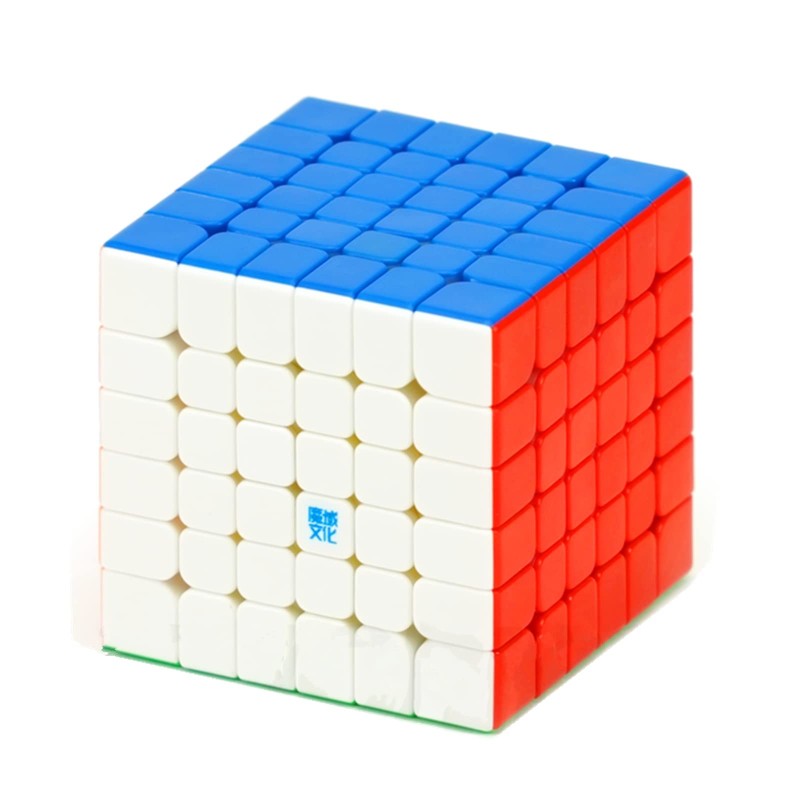


We sell the cubes these guides were made with: GAN, MoYu and QiYi, from a first cube to competition models, plus lubricants.
6x6 speed cubes in stock →7x7 speed cubes in stock →Buy speed cubes →