Scala 40 rules: opening, jokers and scoring
How to play scala 40, Italian rummy with 108 cards: 13 cards each, the 40-point opening, joker and ace values, going out, scoring to 101 and variants.
In short
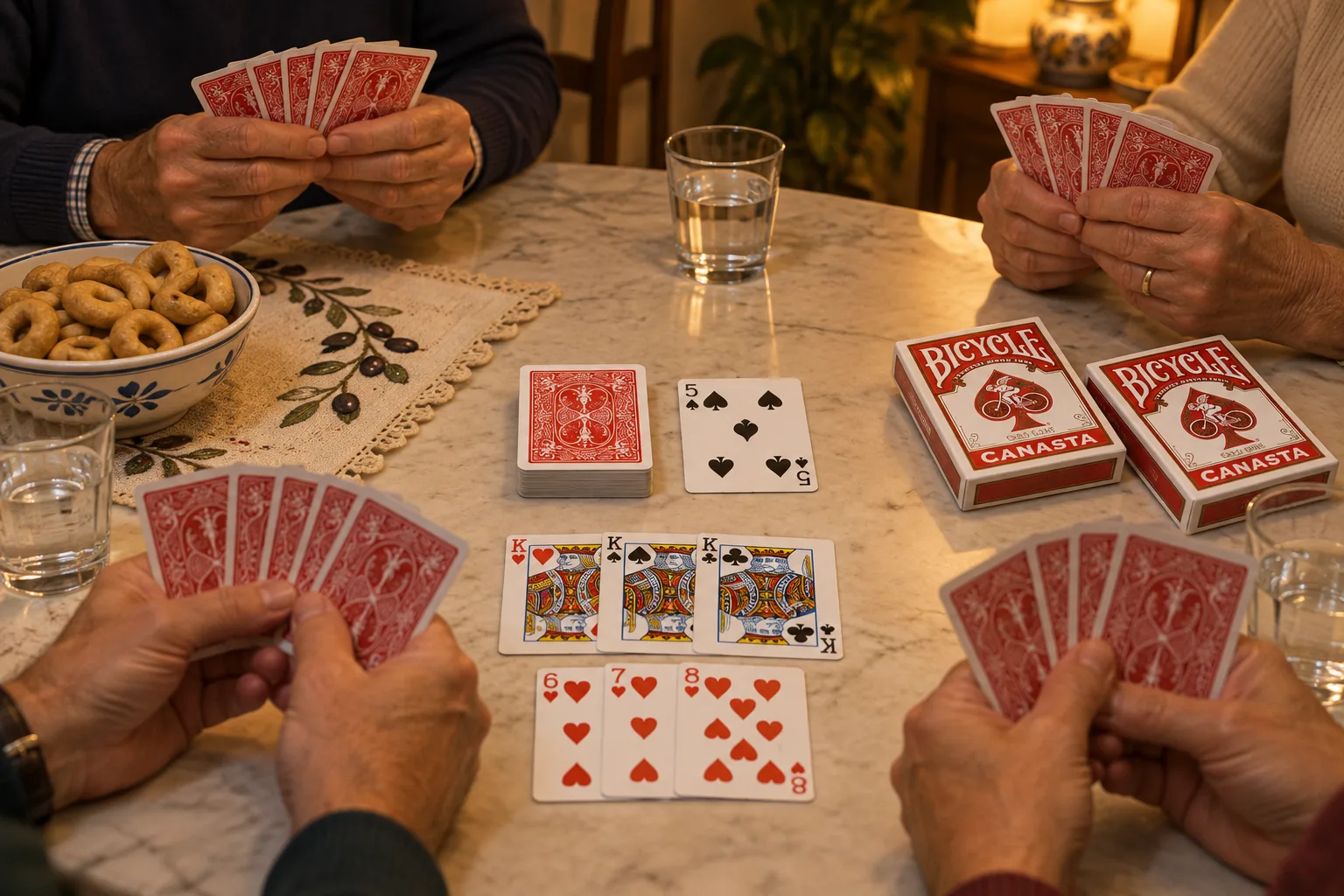
Scala 40 (or scala quaranta) is the most widely played rummy game in Italy. It takes 2 to 6 players, each playing for themselves, with 108 cards: two standard 52-card decks plus 4 jokers. Everyone is dealt 13 cards, whatever the number of players. To lay down your first melds (runs in one suit and sets of three or four cards of different suits) they must total at least 40 points in a single turn. A hand is won by the player who gets rid of all their cards by discarding the last one; the others score penalty points for what is left in their hand, and anyone who reaches 101 points is out.
- Card values: 2 to 10 at face value, picture cards 10, ace 1 (in ace, 2, 3) or 11 (in queen, king, ace, in a set or left in hand), joker 25 in hand.
- Jokers: on the table a joker is worth the card it replaces. The official rulebook allows one per meld; some tables allow two.
- End of the game: elimination at 101 points, or at 201 if agreed beforehand. The last player still under the limit wins.
Scala 40 takes an afternoon to learn and a lifetime to play. The engine is the same as in any rummy (draw, lay down melds, discard), but with an entry fee that changes everything: until you can put together 40 points in melds you cannot lay anything down, take from the discard pile or add cards to other players' melds. Meanwhile, every high card you keep in your hand becomes a debt if someone else goes out first. Most of the game's appeal comes from that tension between holding out for a good opening and not getting caught with a heavy hand.
These scala 40 rules follow the rulebook of the Italian Scala 40 Federation (FISCA), and wherever home games in Italy tend to play differently we explain the difference, so you can agree on it before the deal. We keep the Italian names (tallone, the stock; pozzo, the discard pile; matta, the joker; attaccare, to lay off; chiusura, going out), because they are what you will hear at any Italian table and in any app. If you are looking for burraco, which uses the same cards but is played in partnerships with a different logic, it is covered in our guide to burraco rules.
What scala 40 is and where it comes from
Scala 40 belongs to the rummy family, which in Italy is called ramino. From traditional ramino it inherited almost everything: the double deck with jokers, runs and sets, drawing and discarding. What it added was the 40-point minimum opening, the rule that gives the game its name. Over time it moved so far from its roots that it is now regarded as a game in its own right, and in many Italian homes it has replaced the ramino it came from.
Its exact origin is not documented. Italian reference works describe it spreading across the country between the two world wars, after the First World War, and repeat that it came from Hungary. That attribution is passed from book to book without anyone producing actual evidence, so it is best treated as a hypothesis. What is well established is how popular it is: together with burraco it is the most widely played melding game in Italy, and since 15 September 2010 it has had its own federation, FISCA, founded in Rome, which publishes the official rulebook and makes it available to the associations that run tournaments.
The rules have also changed over the years. Older books limited runs to five cards and required longer ones to be split in two; modern practice, and the federation rulebook, allow runs of up to 14 cards without splitting them. If you play with older people who learned in the 1950s or 1960s, you may still come across that habit.
The cards: 108 in total
Scala 40 is played with two complete standard decks, each with 52 cards and 2 jokers. That makes 108 cards: 104 natural cards, each appearing twice, and 4 jokers. In Italy this double deck is sold as a mazzo da ramino (rummy deck) or as burraco cards, but two ordinary poker decks work just as well, as long as they are the same size and have the same back, so nobody can tell which deck a card comes from when it is drawn.
Are burraco cards the same as scala 40 cards? Yes. Both games use exactly the same 108 cards. The only difference is that many Italian decks sold for burraco have the twos marked with a special symbol, because in burraco the 2 (the pinella) is a wild card. In scala 40 that mark means nothing: the 2 is an ordinary card worth 2 points. If you want to see how a standard deck is made up and how many cards of each kind it has, we explain it in how many cards are in a deck.
Having every card twice affects the whole game. It is normal to hold two identical 7s of hearts, which cannot go together in the same set, and two identical runs can sit on the table at the same time. It also helps with counting: if both 8s of clubs have already been played, no run in clubs can go from 7 to 9 without a joker.
Table vocabulary
These are the Italian terms you will meet in any game and in the rulebook:
| Italian | Meaning |
|---|---|
| Cartaro or mazziere | The dealer |
| Tallone | The stock, face down in the middle |
| Pozzo or scarti | The discard pile, face up |
| Scala or sequenza | Run: three or more consecutive cards of the same suit |
| Tris and poker (or combinazione) | Three or four cards of the same rank in different suits |
| Matta or jolly | The joker |
| Aprire (apertura) | To lay down for the first time, with at least 40 points |
| Calare | To lay melds on the table |
| Attaccare (attacco) | To lay off single cards on melds already on the table |
| Chiudere (chiusura) | To go out by discarding your last card |
| Chiusura in mano | To lay down your whole hand at once, without having opened before, and go out |
| Punteggio di uscita | The score at which a player is eliminated: 101 or 201 |
Players and the deal
Scala 40 is for 2 to 6 players, each playing for themselves. It is an individual game; a partnership version exists and is covered under variants, but it is not the usual form. Some Italian guides recommend at least four players: with two it becomes a very different duel, and with six the stock runs out quickly.
The first dealer is chosen at random, for example by having each player draw a card. After that the deal passes to the next player each hand. The deal goes like this:
- The dealer shuffles all 108 cards in full view and the player on their right cuts.
- The dealer gives 13 cards to each player, face down, one at a time and clockwise, starting with the player on their left.
- The next card is turned face up: it starts the pozzo, the discard pile. Several Italian guides add that this first card cannot be a joker.
- The rest of the deck stays face down in the middle: this is the tallone, the stock.
- The player to the dealer's left starts, and play continues clockwise.
How many cards are dealt for each number of players
A very common question is whether two players get more cards. They do not: it is always 13 cards each, whether there are two players or six. What changes is how many cards are left in the stock, which affects how long a hand lasts before the discards have to be reshuffled:
| Players | Cards each | Cards dealt | Left in the stock |
|---|---|---|---|
| 2 | 13 | 26 | 81 |
| 3 | 13 | 39 | 68 |
| 4 | 13 | 52 | 55 |
| 5 | 13 | 65 | 42 |
| 6 | 13 | 78 | 29 |
In every case the card turned up to start the pozzo is also taken out. Why 13? It fits the rule for going out: since you must finish by discarding, 13 cards allow, for instance, four sets plus one card to lay off or discard.
Card values and order
In scala 40 cards have two jobs: they count towards the 40 needed to open, and they count against you if they are still in your hand when someone goes out. The values are almost the same in both cases, with two important exceptions: the ace and the joker.
| Card | On the table (opening) | Left in hand (penalty) |
|---|---|---|
| 2 to 10 | Face value | Face value |
| Jack, queen and king (J, Q, K) | 10 | 10 |
| Ace | 1 in ace, 2, 3 · 11 in queen, king, ace or in a set of aces | 11 |
| Joker (jolly) | The value of the card it replaces | 25 |
How much the ace is worth
The ace causes the most confusion, because its value depends on where it is:
- 11 points at the top of a run (queen, king, ace), in a set of three or four aces, and when it is left in your hand at the end.
- 1 point at the bottom of a run, below the 2 (ace, 2, 3).
This matters a lot for opening. Three aces are worth 33, which is not enough; four aces are worth 44, which is. The run queen, king, ace of hearts is worth 31; the run ace, 2, 3 of clubs only 6.
Card order in runs
Runs follow the natural order: ace, 2, 3, 4, 5, 6, 7, 8, 9, 10, jack, queen, king, ace. The ace can go at either end, but not at both ends at once, and runs cannot wrap around: king, ace, 2 is not a valid run. Scala 40 has no ranking of suits and no trumps; the order only tells you which cards are consecutive.
The 14 positions in the picture also explain the maximum length of a run: 13 natural cards of one suit plus a joker. Because the ace can only be used at one end, the longest possible run goes from ace to king with the joker standing in as the high ace, or from 2 to ace with the joker as the low ace. A single run cannot contain both aces of the same suit. If you are curious why the ace is both the highest and the lowest card in so many games, we cover it in poker card values.
Melds: runs, sets of three and sets of four
There are only two kinds of valid meld in scala 40.
The run (scala or sequenza)
Three or more consecutive cards of the same suit, up to a maximum of 14 including the joker. You can lay down runs identical to ones already on the table, because every card exists twice: if 5, 6, 7 of spades is on the table, you can lay down another 5, 6, 7 of spades.
Sets of three or four (tris, poker or combinazione)
Three or four cards of the same rank in different suits. This is the condition that most sets scala 40 apart from other two-deck games: since each suit can appear only once, a set never has more than four cards, joker included. Three 9s with two spades among them do not make a set, even though the cards are physically different. In burraco, by contrast, this is allowed.
There can be several sets of the same rank on the table, for instance two sets of 7s made from the two decks.
Melds that do not count
| Cards | Valid? | Why |
|---|---|---|
| Queen, king and ace of hearts | Yes | Run with the ace high |
| Ace, 2 and 3 of clubs | Yes | Run with the ace low |
| King, ace and 2 of spades | No | Runs cannot wrap around |
| 9 of spades, 9 of spades and 9 of hearts | No | A set needs different suits |
| 7 of spades, 7 of hearts, 7 of diamonds, 7 of clubs and a joker | No | A set has four cards at most |
| 5 and 6 of diamonds with 7 of hearts | No | A run must be in one suit |
| Joker, joker and joker | No | Melds made only of jokers are not allowed |
A card cannot belong to two melds at once, and once a meld is down you cannot take cards out of it to build another. Melds on the table belong to nobody: after opening, any player can add cards to their own melds or to anyone else's.
Scala 40 joker rules: the matta or jolly
In scala 40 the joker is the only wild card. Unlike burraco, the 2 is not wild. There are four in the deck, and their rules vary more from table to table than almost anything else, so it is worth knowing the official version first and then the alternatives.
How much the joker is worth
- On the table, it is worth the card it replaces. A joker standing in for a king is worth 10; standing in for the ace in ace, 2, 3 it is worth 1.
- In your hand, when someone else goes out, it is the most expensive card: 25 points.
Which card it represents
When you lay down a joker you have to make clear which card it represents. In a run its position says it all: in 8, joker, 10 of diamonds, the joker is the 9 of diamonds. In a set it is not obvious (in 7 of spades, 7 of hearts and joker, is it the 7 of diamonds or of clubs?), so the player has to name the suit out loud. Some tables use a colour convention to avoid saying it, but announcing it is the safest option.
Can you put two jokers in the same run?
Under the FISCA rulebook, no: each meld may contain at most one joker, whether it is a run or a set. This is also the rule given by the main rule collections in English and Italian. It is not universal, though. Some tables allow two jokers in a long run, and a few set no limit, and the reference guides themselves mention this as a house variant. If your table plays with more than one, it is worth also agreeing a minimum number of natural cards per meld, because a three-card run with two jokers turns the opening into a formality.
What nobody allows is a meld made only of jokers.
Swapping a joker on the table
A player who has already opened may, on their turn, take a joker from any meld on the table (their own or someone else's) if they hold the natural card it represents: they put that card in its place and keep the joker. For example, if 8, joker, 10 of diamonds is on the table and you hold the 9 of diamonds, you put it down and take back the joker.
What you may then do with that joker is one of the big differences between tables:
- FISCA rulebook: the recovered joker must be used again, in a new meld or laid off on another meld on the table.
- Many home games: the player can keep it in hand and use it whenever they like. This is the version given in several rule collections outside Italy.
No joker can be swapped before you open. And in the most common version, a player who has not opened cannot discard a joker either: they have to keep it, at the risk of paying 25 points if someone else goes out.
Did you know decks like these exist?
At heart, every deck has the same cards. What changes is everything else: the design, the finish, metallic inks or gilded edges. Take a look at our catalogue and bring your own style to the card table.
Browse our playing cards →




Opening: the 40-point rule
This is the rule that gives the game its name: to lay down for the first time you must put down, in that same turn, new melds totalling 40 points or more. In Italy the question is asked as «a quanto si esce?» or «a quanto si apre?» (what do you need to open?), and the answer is 40.
The conditions are:
- The 40 points must come from new melds laid down from your hand. Cards you could lay off on other players' melds do not count.
- You can combine several melds in the same opening: a run and a set, two runs, two sets…
- A joker counts as the card it replaces.
- Until you open, you cannot lay off cards on the melds on the table or take from the pozzo.
- Once you have opened, later melds can be worth any amount, even a 2, 3, 4.
| Cards laid down | Count | Can you open? |
|---|---|---|
| Three kings + 3, 4 and 5 of spades | 30 + 12 = 42 | Yes |
| Three kings on their own | 30 | No |
| Four 10s (or four jacks) | 40 | Yes |
| Three aces | 33 | No |
| Four aces | 44 | Yes |
| Queen, king and ace of hearts + 2, 3 and 4 of clubs | 31 + 9 = 40 | Yes, exactly |
| Queen, king and ace of hearts + ace, 2 and 3 of clubs | 31 + 6 = 37 | No |
| 9, 10, jack and queen of clubs | 9 + 10 + 10 + 10 = 39 | No, by one point |
| 9, 10, jack, queen and king of clubs | 49 | Yes |
| Jack and queen of spades + joker as king + 5, 6 and 7 of hearts | 30 + 18 = 48 | Yes |
| Three 4s + run from 3 to 7 of diamonds | 12 + 25 = 37 | No |
The table shows something useful: picture cards and aces are what get you open. With low cards you need a lot of them to reach 40 (a run from 2 to 8 adds up to 35 and is still short), and that means emptying half your hand in one go. That is why some players hang on to picture cards early in a hand even though they are heavy: they are the ticket in.
A turn, step by step
Every turn has three parts, always in this order:
- Draw a card. If you have not opened, only from the stock. If you have, from the stock or the top card of the pozzo (only that one: you never take the whole pile, as you would in canasta).
- Meld and lay off, if you can and want to: open with 40, lay down new melds, add cards to melds on the table (the attacco) and swap jokers. Everything except opening requires you to have opened already.
- Discard one card face up on the pozzo. Discarding is compulsory and ends your turn.
Taking from the pozzo
Taking the top card of the discard pile comes with conditions:
- Only a player who has already opened may do it (or one who opens that turn, if you play the opening-from-the-discard variant).
- The card taken must be used in that same turn, in a new meld or laid off on one on the table. It cannot stay in your hand.
- You cannot discard the card you just took. The only exception in the rulebook is holding an identical card (remember every card exists twice): you may discard that one, announcing it and showing it if asked.
A card drawn from the stock, on the other hand, can be discarded in the same turn.
The attacco: laying off cards
Once you have opened you can add cards to any meld on the table, yours or another player's: extend a run at either end (up to 14 cards) or complete a set of three with the missing suit to make it a set of four. You cannot move cards from one meld to another or split melds already on the table.
Cards that fit: what you cannot discard
A distinctive scala 40 rule: you cannot discard a card that fits a meld on the table (in Italian, a card that «attacca»). If 5, 6, 7 of spades is on the table, you cannot throw the 8 of spades, because any player could lay it off. The idea is to stop players handing useful cards to the next player or conveniently dumping cards they ought to play.
The details depend on which rules you follow:
| Situation | FISCA rulebook | Common variants |
|---|---|---|
| Game with 3 or more players | Always banned | Some tables ban it only for players who have not opened |
| Head to head (2 players) | Banned only for a player who has not opened | Same as with more players |
| Discard used to go out | Allowed | Allowed almost everywhere |
The exception for going out is practical: without it, a player could be left with a last card that fits and have no legal way to go out.
When the stock runs out
If the last card of the stock is drawn and nobody has gone out, the dealer takes the pozzo, sets aside the last card discarded (which stays as the pozzo), shuffles the rest, has it cut and places it face down as the new stock. With six players, who leave only 29 cards in the stock, this happens often.
Going out: how to win a hand
Going out (chiudere) means getting rid of all your cards, and in scala 40 there is a condition that surprises players who know other rummy games: your last card must always be discarded. You cannot lay all your cards on the table and end with an empty hand. If that happens, you must take back what you laid down that turn and play it again.
This has consequences. A player with two cards who draws a third cannot go out by making a set with all three, because there would be nothing left to discard. They need to lay one off and discard the other, or lay off two and discard the third. Italians say a player in this spot «si è incartato»: they have got tangled up in their own cards.
Two more rules for going out:
- Nobody can go out in the first round: every player must have had at least one turn.
- Going out ends the hand at once. Nobody can lay down or lay off cards afterwards to lighten their hand.
Chiusura in mano: going out in one go
The most spectacular way to win is chiusura in mano: without having laid anything down before, the player puts down their whole hand at once in melds and discards the last card. In this case you do not need to reach the 40 points for opening, because you open and go out in the same turn. It is risky, since while you wait you hold 13 cards that weigh heavily if someone else goes out first, but it pays well at tables that reward it, as you will see in the variants.
In the example the player holds 14 cards after drawing: four melds using 13 of them (2, 3, 4 of spades; 6, 7, 8 of hearts; 9, 10, jack and queen of clubs; and three 5s) and the king of diamonds, which is discarded to go out. The melds add up to 9 + 21 + 39 + 15 = 84, but with chiusura in mano it would not matter if they came to less than 40.
Scala 40 scoring
In scala 40 you play to avoid points. When someone goes out:
- The player who goes out scores 0 points for that hand.
- Every other player scores against themselves the value of all the cards left in their hand, even if they form melds that were never laid down.
| Card | Penalty points |
|---|---|
| Joker | 25 |
| Ace | 11 (always, in hand) |
| Jack, queen and king | 10 |
| 2 to 10 | Face value |
A scoring example
Four players. Anna goes out by discarding her last card. At that moment:
| Player | Cards in hand | Points |
|---|---|---|
| Anna | None (she went out) | 0 |
| Bruno | King of spades, 7 of hearts and a joker | 10 + 7 + 25 = 42 |
| Carla | Ace of diamonds and 3 of clubs | 11 + 3 = 14 |
| Dario | 13 cards, never opened | The total of all 13, for example 78 (or a flat 100 if that rule is played) |
Dario's case is the most painful: a player who has not opened still holds all 13 cards, and the count shoots up. That is why so many tables apply a flat penalty to anyone who has not opened, which we cover in the variants.
Elimination at 101
Points carry over from hand to hand. A player who reaches or passes the elimination score (the punteggio di uscita) is out of the game. Hands continue among the remaining players until only one is left under the limit: that player wins.
- 101 points is the usual limit and the one in the rulebook.
- 201 points is the official alternative, agreed before starting, and makes for longer games.
- Some tables play to 150 or 151, and some play without elimination, as explained below.
At 101, a single bad hand can cost you half the game: a player who has not opened can take 80 or 90 points in one go. That is exactly why the 201 limit exists.
Re-entry
This is one of the most widespread house rules, although it is not in the federation rulebook. When a player reaches the limit, instead of being knocked out they re-enter with a score equal to that of the worst-placed player still in the game. The most common version adds a condition: you can only re-enter while more than one other player is still in. It is also worth agreeing whether re-entry is allowed once or several times, because without a limit the game may never end.
Scala 40 needs two matching decks
Two poker decks with their jokers, the same size and with the same back, make up the full 108-card pack.
See playing cardsScala 40 variants
The FISCA rulebook includes three official variants (opening from the discard, chiusura in mano and opening without jokers), and many more circulate in home games. None is better than another, but changing rules halfway through is the most common cause of arguments at a scala 40 table. The sensible thing is to decide which ones apply before the deal.
Scala 40 in partnerships
4playersFour players in two pairs, or six in two teams of three. It is a recognised form of the game, but there is no common rulebook for it: each table sets its own rules.
- House rule
- Agree on scoring
What needs agreeing
Reference works note that scala 40 can be played in pairs with four players, or in teams with six, but none of them says how. Before starting it is worth agreeing on at least four things: whether partners sit alternately with opponents (the natural choice, so they do not play one after the other); whether the hand ends when either partner goes out; whether a pair's penalty points are the sum of both hands or only the worse one; and the elimination score, because adding two hands together reaches 101 very quickly and many tables raise it to 201. Normally partners may not show each other their cards or talk about them, and can only help each other by laying off cards on each other's melds.
Scala 40 for two players
13cardsThe two-player game uses the same rules and the same 13 cards each. With 81 cards left in the stock, you hardly ever need to reshuffle.
- FISCA rulebook
- Discarding a card that fits: banned only before opening
More detail
The only rulebook difference is in discarding: with two players, a player who has opened may discard a card that fits, and only a player who has not opened is barred from doing so. Since every hand is a duel, elimination at 101 is settled in a few hands, and many couples play each hand as a separate game (whoever goes out wins) or up to a fixed total. If you like this format, our guide to two-player card games has more classic duels.
Double for chiusura in mano
×2If someone goes out by laying down all their cards at once without having opened before, the other players score double what they hold.
- FISCA variant
- A full hand pays 100
More detail
In the FISCA version, on top of the doubling, a player who still holds all their cards when chiusura in mano happens scores a flat 100 points, whatever their cards add up to. Other tables only double, with no flat score. With this variant, chiusura in mano stops being a curiosity and becomes a strategy worth chasing.
Opening from the discard
Lets you take the top card of the pozzo before you have opened, provided you open that same turn and use that card in your opening.
- FISCA variant
- Very common at home
- Easier to open
Opening without jokers
A joker cannot be part of the opening, unless the joker-free melds laid down that same turn already reach 40 on their own.
- FISCA variant
- Harder to open
100 for not opening
100pointsA player who has not opened when someone goes out pays a flat 100 points, whatever is in their hand. With elimination at 101, that leaves them on the brink.
- Very common house rule
- Punishes waiting too long
Re-entry
An eliminated player rejoins with the score of the worst-placed player still in, as long as more than one remains.
- House rule
- Agree how many times
Limit of 201, 151 or no elimination
201pointsRaising the limit makes the game longer and leaves room to recover from a bad hand. The rulebook allows 201 if agreed at the start.
- 201: allowed by FISCA
- 151: house rule
No elimination
Another option is to eliminate nobody and play until someone reaches a fixed total (1,000, 1,500 or 2,000 points); whoever has the fewest at that point wins. Simpler still: each hand is a separate game and whoever goes out wins, with no scoring.
More than one joker per meld
Some tables allow two jokers in the same run, or set no limit. The federation rulebook allows only one.
- House rule
- Easier to open and go out
Different values for picture cards
An uncommon variant makes the jack 11, the queen 12, the king 13 and the high ace 14. With these values three aces (42) are enough to open.
- House rule
- Joker in hand: 14
Other table habits
Some tables allow going out without discarding, let the first player keep the face-up pozzo card without using it, or allow players who have opened to discard cards that fit.
- House rules
- Announce before the deal
Official rules and house rules
Scala 40 is in an odd position: it has a clear federation rulebook and, at the same time, is played in countless homes with rules passed on by word of mouth, often different from one family to the next. The table sums up where they usually clash:
| Point | FISCA rulebook | What many tables do |
|---|---|---|
| Jokers per meld | One at most | Sometimes two, or no limit |
| Joker recovered from the table | Must be used again | Can be kept in hand |
| Taking from the pozzo before opening | No (except in the official opening-from-the-discard variant) | Yes, if you open that turn |
| Discarding cards that fit | Always banned with more than two players | Banned only for players who have not opened |
| Going out | Always by discarding the last card | Some tables allow going out without discarding |
| Player who has not opened | Adds up their cards (100 on a chiusura in mano) | Always pays a flat 100 |
| Elimination score | 101, or 201 if agreed | 101, 150, 151 or 201 |
| Re-entry | Not provided for | Very common, on agreed terms |
In a tournament the rulebook applies, with whatever variants are announced in the entry conditions. At home, the useful rule is a different one: whoever deals the first hand runs through the four or five rules that vary most (jokers, the pozzo, cards that fit, 100 for not opening and re-entry) out loud, and everyone plays by what was agreed.
Scala 40, burraco and other games in the family
Because they use the same cards, scala 40 and burraco are often confused, much as canasta and continental rummy are in other countries. These are the core differences:
| Scala 40 | Burraco | Canasta | Continental | |
|---|---|---|---|---|
| Players | 2 to 6, each for themselves | 4 in pairs (also 2, 3 and 6) | 4 in pairs | 3 to 6, each for themselves |
| Cards per player | 13 | 11 (plus the pozzetto) | 11 | 6 to 12, depending on the round |
| Sets | Different suits, 4 cards at most | Repeated suits allowed | Sets only, no runs | Sets and runs, by contract |
| Wild cards | Joker only | Joker and 2 (pinella) | Joker and 2 | Joker |
| First meld | 40 points minimum | No minimum | Minimum depends on the running score | The round's contract |
| Discard pile | Top card only, and it must be used | Taken whole | Taken whole, with conditions | Top card; buying is allowed |
| Aim | Stay under 101 | Score the most points | Score the most points | Score the fewest points after 7 rounds |
Burraco has its own guide on our site, with the pozzetto, the pinella and full scoring: burraco rules. Canasta and continental rummy also have their own guides, and if you want a shorter rummy played with Spanish cards, there is chinchón.
Basic strategy
The deal brings a lot of luck into scala 40, but among players who know the rules the winner is nearly always the one who handles two things better: when to open and how heavy their hand is.
Before you open
- Work out your opening from the start. When you pick up your 13 cards, look for the melds that get you closest to 40. Picture cards and aces are what open: a run of four picture cards gets there on its own.
- Do not wait too long. Holding out for a big opening or a chiusura in mano is tempting, but a player who has not opened can end up paying 70, 80 or 100 points in one go. If the stock is shrinking and other players already have few cards, open with what you have.
- Watch the discards. Since you cannot take from the pozzo until you open, what goes through the pile is information: it tells you which suits and ranks the others are not collecting.
After you open
- Get rid of heavy cards early if they do not fit anywhere. A loose ace costs 11, a picture card 10. Once you have opened, start shedding the heavy cards and keep loose 7s and 8s, which cost less.
- Jokers belong on the table. In your hand they cost 25. If you recover one by swapping in its natural card, lay it down as soon as you can.
- Count the cards that have gone. Every card exists twice. If you have already seen both 8s of clubs, your 7 and 9 of clubs will never make a run without a joker.
- Keep an eye on your card count. Since you always go out by discarding, being left with two loose cards that do not fit is a trap: you need to lay one off and discard the other in the same turn.
Reading your opponents
- Count the other players' cards. A player with three or four cards can go out at any moment. That is when having lightened your hand matters most.
- Do not gift your discard. If the next player has opened, think about whether your discard helps them. The rules already stop you throwing cards that fit, but a card that completes a set in their hand is a gift too.
- Beware the quiet player. Someone who never opens all hand while holding 13 cards may be building a chiusura in mano. If you play the doubling variant, lightening your hand is no longer optional.
How much does a deck of cards cost?
From €5 to over €100. The 52 cards and the rules stay the same; this is what changes.
 To play€5.95 |  Designer€12.95 |  Premium€17.99 |  Collectible€34.94 | |
|---|---|---|---|---|
| Typical price | €5-9 | €9-15 | €15-30 | €30 or more |
| What sets it apart | Classic casino design | Artist illustration on back and faces | Special inks, embossing and foil on the box | Limited print runs and gilded edges |
| Who it is for | Games at home | Playing with something beautiful | Gifts or cardistry | Collecting and display |
| Example | Tally-Ho Fan Azul | theory11 Medallion | The Sandwich Series (Luncheon Meat) | Kings Wild LOTR Two Towers Gilded |
| See decks | See decks | See decks | See decks |
Frequently asked questions
How do you play scala 40?
Each player is dealt 13 cards from a 108-card pack (two standard decks with 4 jokers). On each turn you draw a card, may lay down runs in one suit and sets of three or four in different suits, and discard. Your first meld must total at least 40 points. A hand is won by the player who runs out of cards by discarding the last one; the others score what is left in their hands against themselves, and anyone who reaches 101 is out.
How much is the joker worth in scala 40?
On the table it is worth the card it replaces. In your hand, when someone else goes out, it costs 25 penalty points, more than any other card.
How much is the ace worth?
1 point at the bottom of a run (ace, 2, 3) and 11 at the top (queen, king, ace), in a set of aces and when it is left in your hand at the end.
How many cards are in a scala 40 deck?
108: two standard 52-card decks plus 4 jokers. They are the same cards used for burraco.
How many cards are dealt with two players?
13 each, the same as with more players. With two, 81 cards are left in the stock.
How many people can play?
2 to 6, each playing for themselves. It can also be played in pairs with four players, but there is no common rulebook for that form, so you need to agree how points are added up.
Can you put two jokers in the same run?
Under the FISCA rulebook, no: one joker at most per meld. Some home games allow two; if you play that way, make it clear before the deal.
How many points do you need to open in scala 40?
Your first meld must total 40 points or more, using new melds laid down in a single turn. The only exception is chiusura in mano: if you lay down your whole hand at once and go out, you do not need to reach 40.
What score do you play to in scala 40?
A player who reaches 101 penalty points is out, or 201 if agreed at the start. The last player still under the limit wins.
Can you use burraco cards for scala 40?
Yes. They are the same 108 cards. If your burraco deck has the twos marked as pinella, in scala 40 they play as ordinary twos.
You do not need a special deck to play scala 40: two matching poker decks with their four jokers make up the full pack. Our playing cards section has well-finished decks that shuffle smoothly in a 108-card pack and stand up to plenty of games. And if you want to discover other games from the same family, our full list of card games sorts them by type.
Want more guides like this one? Sign up for the newsletter.
Keep exploring
- Burraco rules: dealing, going out and scoring
- Continental rummy rules: contracts, buying and scoring
- Gin rummy rules
- Card games for four or more players
- History of the joker card
Poker
Bicycle Ghost in the Shell – Spielkarten
Bicycle Bridge Black – Playing Cards

Tally-Ho Circle Expert Touch Blue – Playing Cards

Tally-Ho Circle Expert Touch Red – Playing Cards

Bicycle Brown Back – Playing Cards

Tally-Ho Fan Blue – Playing Cards

Tally-Ho Circle Blue – Playing Cards

Tally-Ho Circle Red – Playing Cards
Contact our team for any clarification about this document. Contact us