
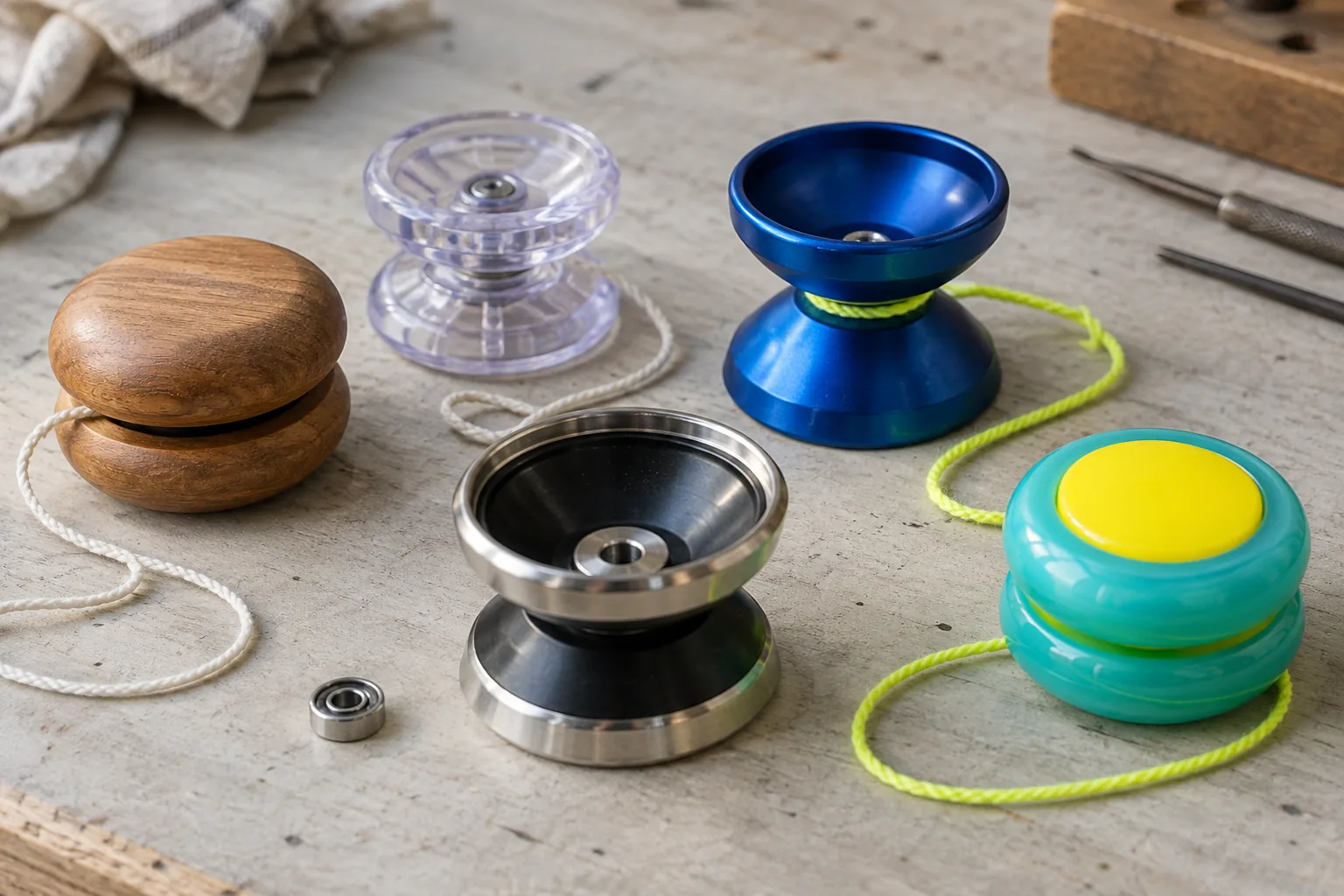
Yo-yo guide: how it works, history, bearings and tricks
What a yo-yo is and how it works, its history from Greece to Pedro Flores, bearings, responsive vs unresponsive yo-yos, 1A to 5A and easy first tricks.
In short
A yo-yo is a toy made of two discs joined by an axle, with a string wound around that axle. How does a yo-yo work? When you throw it, the string unwinds and turns the fall into spin; at the bottom, the yo-yo keeps spinning under its own momentum and, with a small tug, the string grips the axle again and the spin carries it back up. The key to the modern yo-yo is that the string is not tied to the axle: it goes round it in a loose loop, and that lets the yo-yo keep spinning at the end of the string, which is called ‘sleeping’.
- Origin: it already appears on a Greek cup from around 440 BC; the name comes from the languages of the Philippines.
- The modern yo-yo: Pedro Flores began mass-producing it in Santa Barbara (California) in 1928; Donald F. Duncan turned it into a mass phenomenon.
- Two families: responsive yo-yos come back with a tug and are the ones to learn on; unresponsive yo-yos only come back with a move called a bind and are used for long tricks.
- Competition: five official styles, from 1A to 5A, and a world championship held every year.
Almost everyone has held a yo-yo at some point, and almost everyone put it down again once they had managed to make it go up and down a few times. What tends to go unnoticed is how much the toy has changed over the last thirty years. Today’s yo-yos have ball bearings, silicone pads and machined aluminium bodies; they can spin for several minutes at the end of the string, and they are used in a world championship with judges, music and technical scores. At the same time, the physical principle is still the one shown on the Greek cup: a spinning disc and a string that controls it.
In this guide we look at how it works, where it comes from (separating what is known from what has been repeated without evidence), what parts a modern yo-yo has, how to choose one for your level, the first tricks in the order they are usually learnt, and basic maintenance. Anyone coming from the kendama or the fingerboard will recognise the path: a simple tool and tricks that are learnt step by step.
How does a yo-yo work? The physics of spin
When you hold a yo-yo in your hand, it has potential energy, the energy that comes from its height. When you let go, that energy turns into motion, but in two forms at once: the yo-yo moves down (translational motion) and at the same time it spins, because the unwinding string forces the axle to rotate. That is why a yo-yo falls much more slowly than a stone of the same weight: a good part of the energy goes into the spin rather than into falling speed. If you also throw it hard instead of just letting it drop, your arm adds energy and the spin is much faster.
When it reaches the end of the string, the downward movement stops abruptly, but the spin does not. A spinning body has angular momentum, a quantity that is conserved as long as nothing slows it down. That angular momentum is what keeps the yo-yo spinning at the end of the string, and it is also what makes it stable: like a spinning top or a gyroscope, a yo-yo that spins fast resists tilting. The faster it spins, the more stable it is and the easier it is to do tricks with it.
The slip loop: why a yo-yo can ‘sleep’
On old yo-yos the string was tied to the axle. When it reached the bottom, the yo-yo had no choice but to start winding up the other way and climb back: it went down and came up, and not much else. The big change came when the string stopped being tied. On a modern yo-yo the end of the string forms a loop that goes round the axle without gripping it. Once the string is fully unwound, the axle turns inside that loop with almost no friction and the yo-yo stays spinning at the bottom. This is called sleeping (and the trick itself a sleeper), and it is the basis of almost every trick.
To bring it back, a short tug is enough. The tug makes the yo-yo hop slightly and leaves the string slack for an instant; at that moment the loop rubs harder against the axle, catches, and the spin starts winding the string up. From then on the process is the reverse of the descent: the energy of the spin is turned into upward movement. The direction of spin never changes at any point; what changes is the direction in which the string winds, which on the way up wraps from the opposite side.
The yo-yo eventually stops because of friction: at the axle or bearing, between the string and the inner walls, and from the air. Without friction it would keep spinning indefinitely. The whole technical evolution of the yo-yo, from the wooden axle to the ball bearing, is about managing that friction: removing it where it gets in the way (so the yo-yo sleeps longer) and adding it where it is needed (so it comes back when the player wants).
History of the yo-yo
It helps to separate what is known from objects and documents, what a court put in writing (which is quite a lot) and what has been repeated for a century without any evidence.
Ancient Greece
The oldest image usually cited is on an Attic red-figure cup, a kylix from around 440 BC held in the collection of classical antiquities of the Berlin State Museums. The medallion inside shows a boy in a cloak holding a string from which a double disc hangs. Identifying it as a yo-yo is the usual reading and appears in catalogues of Greek pottery, although nobody knows what the Greeks called this toy or how it was played.
Double discs made of terracotta from the same period have also survived, some of them painted. Here more caution is needed: the museums that hold them debate whether they were yo-yos or spools for thread, and their fragility suggests that many were votive offerings that were never used for play. The reasonable assumption is that yo-yos for playing were mostly made of wood, which has not survived. Many texts say the cup with the boy is in Athens; the records for the piece place it in Berlin, and the confusion probably comes from mixing it up with the terracotta discs in the National Archaeological Museum in Athens.
Europe: the bandalore
Between antiquity and the twentieth century the toy comes and goes. At the end of the eighteenth century it went through a strong craze in France and in England, where it was called the bandalore. There are engravings from 1791 showing ladies and gentlemen playing with it. In the United States, the first patent for a toy of this kind was granted in 1866 to James L. Haven and Charles Hettrick of Cincinnati, for an improved ‘bandelore’ with metal discs. All of these yo-yos had the string tied to the axle: they went up and down, but they did not sleep.
The Philippines: the name and what is known about the toy
The word ‘yo-yo’ comes from the Philippines. Standard dictionaries derive it, with a ‘probably’, from the Ilocano yóyo, with similar forms in other languages of the archipelago; many texts explain it as ‘come, come back’. The yo-yo was an ordinary children’s toy in the islands in the early twentieth century: an American science magazine published an article on Filipino toys in 1916 that described it by that name, more than ten years before anyone mass-produced it in California.
What is not documented is how old it is in the Philippines. There are no objects or texts that allow us to say it was played there centuries ago, and some toy historians believe it may have arrived or become popular during the colonial period. What is certain is that the modern form of the yo-yo, the one with the loop that lets the disc sleep, reached the United States thanks to a Filipino.
Pedro Flores and the Yo-yo Manufacturing Company (1928)
Pedro Flores was born in 1896 in Vintar, in the province of Ilocos Norte, and emigrated to the United States in 1915. He worked in several jobs (among them as a hotel bellboy, according to several biographies) and in 1928 he opened the Yo-yo Manufacturing Company in Santa Barbara, California, starting with a handful of handmade wooden yo-yos. The business grew very quickly: by around 1929 he already had factories in Los Angeles and Hollywood. In 1930 he registered the trademark ‘Flores Yo-Yo’.
Flores made two contributions. The first was the string with a slip loop instead of a tied one, which is what lets the yo-yo sleep and makes tricks possible. The second was the idea of selling the yo-yo through demonstrations and neighbourhood contests, a business model that his buyer would later copy on a large scale.
Donald F. Duncan and the Yo-Yo trademark
Donald F. Duncan was a Chicago businessman with a flair for advertising (he is associated with Good Humor ice cream and with parking meters). He saw the yo-yo in California in 1928 and bought Flores’s business over the following years. Sources disagree on the exact date, which ranges from 1929 to 1932, probably because the purchase was made in stages: first the manufacturing rights and then the trademark. What is on record in official documents is the sequence of registrations: ‘Flores Yo-Yo’ in July 1930, ‘Genuine Duncan Yo-Yo’ in November 1932 and plain ‘Yo-Yo’ in January 1933, in the name of Duncan’s company, which had first had to acquire the Flores trademark because the patent office had rejected its original application.
Duncan took what Flores had done in California to a national scale: teams of demonstrators (many of them Filipino) who toured towns and schools, contests sponsored with newspapers and prizes for the children who mastered the tricks. In 1946 the company opened a factory in Luck, Wisconsin, chosen for the local maple wood, which came to produce around 3,600 wooden yo-yos an hour and earned the village the nickname ‘Yo-Yo Capital of the World’. From 1955 the plastic models were made for Duncan by another company, Flambeau.
The 1965 lawsuit: when ‘yo-yo’ became an ordinary word
For years Duncan defended its trademark vigorously, to the point of getting some American dictionaries to mark ‘Yo-Yo’ as a registered trademark. When other manufacturers began selling yo-yos under that name, the company took them to court. The decisive case was Duncan against Royal Tops, which reached the federal Court of Appeals for the Seventh Circuit. In March 1965 the court ruled against Duncan: it held that ‘yo-yo’ was the name of the toy and not of a manufacturer, and that it had been so from the start.
The evidence presented at trial is the most curious part of the story. The president of Royal, who was born in the Philippines, testified that the toy had never been called anything else there. A linguist confirmed that the word was of Filipino origin. The 1916 article on Filipino toys was submitted. And, above all, a letter from Duncan himself to the patent office, dated 1931, came to light in which he acknowledged that ‘yo-yo’ was used in the Philippines to mean ‘to return’, precisely in order to argue that it could not be someone else’s trademark. To cap it all, the company had spent years trying, without success, to get the public to call the toy a ‘return top’. The court concluded that the word was generic, like ‘aspirin’ or ‘escalator’ in American English, and the trademark was struck down.
The booms: the 1930s, the 1960s, the 1990s and 1998-99
The yo-yo has lived through waves, and the manufacturers themselves speak of a cycle of about ten years between one craze and the next.
| Period | What happened | What drove it |
|---|---|---|
| Late 1920s and the 1930s | First boom in the United States with the wooden yo-yos of Flores and Duncan | Demonstrators, contests run with newspapers, the loop that made tricks possible |
| 1962 and the years after | Duncan sells 45 million yo-yos in a single year, in a country with about 40 million children | Television adverts, cheap plastic, the slogan ‘If it isn’t a Duncan, it isn’t a yo-yo’ |
| Early 1990s | High-end aluminium yo-yos with bearings appear | Hobbyist designers such as the dentist Tom Kuhn and his SB-2 |
| 1997-1999 | Worldwide boom: analysts estimated the American market at between 50 and 100 million dollars a year | Ball bearings, automatic clutches, cable television, schools confiscating yo-yos |
| From 2000 | The yo-yo becomes a sport with regulated styles and an annual world championship | Unresponsive yo-yos, online videos, communities in Japan, the United States and Europe |
The 1990s wave deserves a closer look. In 1990 Tom Kuhn, a San Francisco dentist who had already designed take-apart yo-yos, introduced the SB-2, an aluminium yo-yo with a ball-bearing transaxle. It was not the first attempt to put a bearing in a yo-yo, but it was the first one that worked well and sold steadily. By around 1997 an SB-2 cost about 100 dollars, while the ordinary plastic yo-yo was still 3. At the same time, the company Yomega popularised the Brain, a yo-yo with a centrifugal clutch that returned to the hand by itself. It was the combination of these two worlds, the automatic toy for children and the technical object for enthusiasts, that explains the size of the boom in 1998 and 1999.
The myth of the Filipino weapon
It is probably the most repeated story about the yo-yo: that in the Philippines it was for centuries a hunting or fighting weapon, a stone disc tied to a six-metre cord that hunters threw from the trees. There is no archaeological or documentary evidence for it at all. Toy historians attribute the legend to Duncan’s demonstrators in the 1930s, who told it to give the product an exotic air, and even then versions with stones, glass or vines were going around. Several fact-checks in the Filipino press now treat it as a myth.
There is another, smaller myth: that Duncan invented the yo-yo. He never presented himself as the inventor; what he did was market it on a scale nobody had attempted before.
Parts of a modern yo-yo
A good-quality yo-yo comes apart: the two halves screw onto an axle, and the bearing sits between them. Each part affects how it plays.
| Part | What it does | What is worth knowing |
|---|---|---|
| Halves (body) | Provide the spinning mass | Their shape and weight distribution determine stability and spin time |
| Axle | Joins the two halves | Usually a headless screw or a bolt; it should not be overtightened |
| Bearing | Lets the body spin without dragging the string | Each model takes a standard size; it can be flat or concave |
| Response system | Provides the grip that brings the yo-yo back | Silicone pads, rubber or grooves; it wears with use |
| Gap | The space between the halves where the string runs | The wider it is, the less response and the easier it is to land the yo-yo on the string |
| String | Transmits the throw and controls the yo-yo | A wear part; it is changed often |
The axle and fixed-axle yo-yos
The simplest yo-yos, such as traditional wooden ones or many plastic ones, have a fixed axle: the string rubs directly on the axle. They sleep only briefly, for a few seconds, and come back very easily. For some styles, such as 2A looping or classic tricks with a wooden yo-yo, that response is exactly what you want. Between the fixed axle and the bearing there was an intermediate step, the transaxle: a sleeve that turns freely around the axle and reduces the friction of the string.
The bearing: sizes A, C and D
Today almost all trick yo-yos have a ball bearing at the centre. The string rests on the outer race of the bearing, which stays practically still while the body spins around the inner race. This way the yo-yo can sleep for much longer, from one minute to several on a good throw with a high-end model.
Yo-yo bearings come in standard sizes designated by letters. They are not interchangeable, so before buying a spare you need to know which size each model takes.
| Size | Dimensions (inner × outer × width) | Where it is used |
|---|---|---|
| A (small) | 5 × 10 × 4 mm | Beginner yo-yos, some looping yo-yos and older models; gives more response |
| C (large) | 6.35 × 12.7 × 4.76 mm (1/4 × 1/2 × 3/16 in) | The standard for unresponsive yo-yos and 1A competition The most common |
| D | 5 × 11 × 5 mm | Some specific models; easily confused with size A, so it is worth checking |
The large bearing, being wider and having a bigger diameter, keeps the string further away from the inner walls. That is why many beginner yo-yos come with a narrow bearing, which gives response, and a wide spare one to turn them into unresponsive yo-yos when the player is ready.
Besides the size, the shape of the outer race matters. Flat bearings are the classic type. Concave bearings, with the outer race curved inwards, tend to centre the string in the middle of the bearing: that way it rubs less against the walls, the yo-yo loses less spin during tricks and it tilts less.
The response system: friction, pads and flow grooves
The response system is what lets the yo-yo come back. It is always based on the same idea: creating a point of friction between the string and the inner walls of the yo-yo so that, when the player wants, the string grips and starts winding up.
- Direct friction: on fixed-axle yo-yos, the string itself against the axle and the walls.
- Rubber or cork rings: older systems, fitted around the axle on the first bearing yo-yos.
- Silicone pads: the current system. They are thin silicone rings set into a groove in each inner wall. They can be replaced and come in different thicknesses: thinner or recessed pads give less response, taller ones give more.
- Flowable silicone: instead of an adhesive pad, the groove is filled with liquid silicone that sets inside it. It fits better, but replacing it takes more work.
- Flow grooves: small grooves or steps machined into the walls around the bearing, which help the string slide in and out smoothly and help the yo-yo ‘bite’ when you bind.
The string: material, thickness and tension
A yo-yo string has one end with a fixed loop, which goes over your finger, and an open end that is twisted to form the loop that wraps around the axle or the bearing.
- Cotton: the traditional material. It grips a lot and wears out quickly; today it is used mainly with fixed-axle yo-yos.
- Polyester: the most widely used material among players. It lasts longer than cotton, is smooth and gives little response, which makes it suitable for unresponsive yo-yos.
- Nylon: somewhat stiffer and more durable than polyester, and fast through the air. Some players find it rough on the finger, and it is not recommended for looping, because the friction can actually melt it.
- Blends: mixes of cotton and polyester that aim for a middle ground.
Thickness is given as a ‘type’ number, linked to the number of strands that make up the string: type 6 is thin, type 8 is the standard, and type 9 or 10 is considered thick. A thicker string fills more of the gap and gives more response and easier binds; a thinner one gives more spin and less grip. The usual length runs from your navel to the floor with your hand relaxed, and it is adjusted by cutting the string and tying a new knot for the finger loop.
Tension is how much the string is twisted on itself. Each throw twists or untwists it slightly, depending on which side the tricks are done. If it gets too tight, the string coils up on itself, knots form and the yo-yo responds oddly. If it gets too loose, the loop opens up and the string tangles around the bearing. Further down, in the maintenance section, we explain how to correct it.
Shape and profile: imperial, butterfly, modified, H, O and V
The yo-yo’s silhouette, seen from the side, determines what it is best for. These are the shapes you will find in any specialist shop:
Imperial
The classic shape, with two rounded discs and a narrow gap. The weight sits close to the centre, which makes looping easier.
- Narrow gap
- Central weight
- Looping (2A)
More detail
This is the shape of the traditional wooden yo-yo. Landing it on the string is hard because the gap is small and the edges are rounded, so it is not the best choice for modern string tricks.
Butterfly
The two halves are fitted ‘the other way round’ compared with the imperial, with the flat faces pointing outwards and the open sides facing the gap, which ends up shaped like a funnel.
- Wide gap
- Easy to land
- String tricks
More detail
Duncan registered ‘Butterfly’ as a trademark in 1959 for its model with this shape, and the name ended up describing the type. It is the recommended shape for anyone who wants to learn string tricks, and almost all modern yo-yos derive from it.
Modified
A middle ground: slightly flared edges on an imperial base. It works for looping and for simple string tricks.
- All-rounder
- For beginners
H-shape
A butterfly with almost straight walls and a lot of weight on the outer rim, like a letter H lying on its side.
- Lots of rim weight
- Long spin
- Stable
More detail
Concentrating the weight far from the centre gives plenty of spin time and stability. In return, it can feel less nimble in fast tricks.
V-shape
Angled walls that form a very open V. The area where the string is caught is wide.
- Easy landing
- Fast tricks
More detail
It is usually more nimble than the H and slightly less powerful in spin. It is a very common shape for competition yo-yos in both plastic and metal.
O-shape
A rounded profile, with the weight more evenly spread. There are light, fast O-shapes and heavy, stable ones.
- Evenly spread weight
- Smooth feel
Two measurements complete the specification of any yo-yo. The diameter is usually between 50 and 60 mm on trick models, and the weight between 60 and 70 grams. Just as important is where that weight sits: the further from the centre, the greater the moment of inertia and the longer the spin. That is why many metal yo-yos have weight rings on the rim, made of stainless steel or brass, fitted to a lighter body.
Responsive vs unresponsive yo-yos
This is the most important distinction when choosing a yo-yo, and the one that most confuses people who come back to the yo-yo after many years.
A responsive yo-yo comes back to the hand with a tug. It has a narrow gap, a small bearing or a fixed axle, and the string rubs enough to catch as soon as the player tugs. It is the classic yo-yo and the right one to learn with: the sleeper, walk the dog and around the world are all done with it.
An unresponsive yo-yo does not come back with a tug: even if you tug, it keeps spinning at the bottom. It has a wide gap, a large bearing and recessed silicone pads that barely touch the string. What looks like a flaw is in fact what makes modern tricks possible: the player can wrap the string, make the yo-yo jump from one strand to another and link long sequences without worrying that the yo-yo will shoot back to the hand halfway through a trick.
The bind: how to bring back an unresponsive yo-yo
To bring an unresponsive yo-yo back you need to do a bind. With the yo-yo sleeping, the player gives the string some slack and feeds it into the gap so that it crosses over itself. That double layer of string fills the gap, touches the pads, grips and starts winding up. The most common way is to loop the string around the underside of the yo-yo, and it can be learnt in a few days of practice.
If an unresponsive yo-yo will not bind, it is almost always for one of these reasons: technique (not enough slack in the string), worn pads, a dirty bearing or a string that is too thin for that gap.
Yo-yo competition styles: 1A to 5A
Competitive yo-yoing is organised into five main divisions, numbered from 1A to 5A according to the number of yo-yos and how they are used. There is also an artistic performance division (AP), in which any yo-yo or prop is allowed and the choreography is judged.
1A: string tricks
1yo-yoOne unresponsive yo-yo tied to a finger. The player lands it on different sections of the string and creates shapes, jumps and wraps.
- The most popular style
- Unresponsive
- Large bearing
More detail
This is where almost everyone starts and where there are the most tricks and the most competitors. The positions in which the yo-yo rests on the string are called mounts, and moving from one to another are the transitions. 1A yo-yos are almost always butterfly shapes in metal or high-end plastic.
2A: looping with two yo-yos
2yo-yosA responsive yo-yo in each hand, in constant motion: they go out, come back and go out again, circling around the hands.
- Responsive
- Imperial or modified shape
- Rhythm
More detail
Looping yo-yos concentrate their weight in the centre so that they turn on themselves easily and offer little resistance to changing orientation. The style requires coordinating both hands at once, with tricks such as loop the loop or around the corner linked together.
3A: two string-trick yo-yos
2yo-yosString tricks as in 1A, but with an unresponsive yo-yo in each hand and the two strings crossing each other.
- Unresponsive
- Highly technical
More detail
It is one of the hardest styles, because you have to keep track of two yo-yos and stop the strings tangling with each other. The tricks that combine both yo-yos have their own names within the community.
4A: no attached string (offstring)
1yo-yoThe string is not attached to the axle. The player launches the yo-yo into the air and catches it on the string.
- Offstring
- Wide plastic
- Throws into the air
More detail
Large plastic yo-yos are used, with a very open butterfly profile to make catching easier and often with rims that can take knocks against the floor. Losing the yo-yo counts as a penalty in competition.
5A: counterweight (freehand)
1yo-yoThe string is not tied to the finger but to a counterweight, such as a die or a ball, which is also thrown and moved between the hands.
- Counterweight
- Unresponsive
More detail
It is the most recent of the five styles. It combines string tricks with juggling the counterweight, which can swing around the hand or around the string.
The World Yo-Yo Contest
The World Yo-Yo Contest is the most important competition. Its roots lie in the contests held in Montreal between 1992 and 1998, as part of a juggling convention; in 2001 it settled in a hotel in Orlando (Florida), where it was held every year until 2013. Since 2014 it has been organised by the International Yo-Yo Federation (IYYF) together with the host country’s association, and the venue rotates between the Americas, Europe and Asia: Prague, Tokyo, Cleveland, Reykjavík, Shanghai, Osaka and other cities. In 2021 and 2022 it was held online.
Each competitor performs a freestyle routine to music. The final lasts three minutes and the scoring has two parts: technical execution, in which the judges use clickers to count successes and mistakes, taking difficulty and risk into account, and an overall evaluation, with criteria such as control, variety of tricks, use of the space and the music, and stage presence. Points are deducted when the yo-yo stops, when it has to be changed and when the string breaks; if the yo-yo flies off towards the audience, the player is disqualified. Japan is, by a wide margin, the country with the most titles.
Materials: plastic, aluminium, bimetal and titanium
Material on its own does not make a yo-yo better or worse, but it changes what the designer can do with it: where the weight can go, how well it stands up to knocks and how much it costs to make.
| Material | Advantages | Drawbacks | Who it suits |
|---|---|---|---|
| Wood | Traditional feel, clear response | Almost always a fixed axle, little spin, warps with humidity | Classic tricks, collectors |
| Plastic (polycarbonate, POM or Delrin) | Cheap, takes knocks, does not scratch easily | Less freedom to put weight on the rim | Beginners, 2A, 4A, players who want a tough yo-yo |
| 6061 aluminium | Light, easy to machine, good value | Softer: it dents when knocked | First metal yo-yo, intermediate level |
| 7075 aluminium | Harder and stronger, allows thinner walls | Slightly more expensive; small difference in weight | Intermediate and advanced |
| Bimetal | Aluminium body with steel or brass rings on the rim: plenty of spin and stability | More expensive, and a hard knock can affect how the rings fit | Advanced and competition |
| Titanium | Very strong, allows very thin walls | Very expensive and hard to machine | Advanced enthusiasts and collectors |
The difference between 6061 and 7075 aluminium is the subject of plenty of debate among enthusiasts. 7075 is slightly denser and considerably harder. With the same design, a 7075 yo-yo weighs only two or three grams more; where it really shows is that the designer can make the walls thinner and move more weight to the rim, and that the yo-yo survives drops better. Many players describe 7075 as feeling more solid, although much of that impression depends on the design.
Bimetal yo-yos take the idea of weight distribution to the extreme: a light aluminium body and a heavy ring of stainless steel or brass on the outer rim. Since mass far from the centre contributes much more moment of inertia than mass close to it, the yo-yo spins longer from the same throw and is more stable in long tricks. Titanium is chosen more for durability and personal taste than for performance: compared with a good bimetal, the difference in play is small.
How to choose a yo-yo: the best yo-yo for beginners and beyond
There is no perfect yo-yo for everyone: some players prefer small, heavy models and others wide, light ones. What there is, though, is a sensible sequence of stages.
| Stage | Type of yo-yo | What you will learn | Common mistakes |
|---|---|---|---|
| Beginner | Responsive, plastic butterfly or modified, small bearing or fixed axle | The throw, the sleeper, classic tricks | Starting with an unresponsive yo-yo before you can throw a long sleeper |
| Transition | Wide plastic yo-yo that takes two bearings (small and large) or pads of different thicknesses | The bind, first mounts, trapeze | Switching to unresponsive before the bind works reliably |
| Intermediate | Unresponsive, 6061 or 7075 metal, or high-end plastic; large concave bearing | Long combos, slacks, jumps | Buying an expensive bimetal before your technique is consistent |
| Advanced | Bimetal or competition metal, according to taste | Your own style, competition | Thinking the yo-yo will make up for practice |
Beginner
To start with, a responsive yo-yo with a butterfly or modified shape is the way to go: the wide gap makes string tricks easier and the response guarantees that the yo-yo comes back. For children under about eight, the manufacturers themselves recommend a more rounded, very responsive shape, where simply going up and down is enough. What matters at this stage is that the yo-yo sleeps long enough (a few seconds) to learn the sleeper and the classic tricks.
Transition and intermediate
For the intermediate step, several brands sell plastic models with two bearings: a narrow one, which gives response, and a wide size C one for playing unresponsive once the bind works reliably. It is the cheapest way to learn both with the same yo-yo. After that comes the first unresponsive yo-yo in metal or high-end plastic, and at that point what matters most is the diameter and weight you feel comfortable with, the shape and the quality of the bearing. A well-designed aluminium monometal will see you through years of progress.
Well-known brands
The trick yo-yo market is fairly concentrated in specialist brands. These are some with a long track record:
- Duncan: the historic brand, heir to Donald F. Duncan’s company, with classic beginner models such as the Butterfly and the Imperial as well as metal yo-yos.
- YoYoFactory: founded in 2003 in Arizona. It has very widespread plastic beginner models, such as the ONE and the Arrow, and competition yo-yos.
- YoyoRecreation: a Japanese brand with a wide range and a strong presence in competition.
- C3yoyodesign: an Asian manufacturer known for its bearings and metal yo-yos.
- One Drop: an American manufacturer of aluminium yo-yos machined in the United States.
- Magic YoYo: a budget brand, including low-priced unresponsive metal models that are very popular as a first metal yo-yo.
Easy yo-yo tricks for beginners, in learning order
Before the first trick there is one move worth learning properly: the throw. Put the string’s loop on your middle finger, between the first and second knuckle, with the yo-yo in your palm and the string coming over the top of the yo-yo towards you. Throw with your palm facing up, bending your elbow and wrist as if showing off your biceps, and turn your hand over only once the yo-yo is already on its way to the floor. If you turn it too early, the yo-yo comes straight back. Most tricks are done with the thumb, index and middle fingers, with the ring finger and little finger tucked in.
| Order | Trick | What it is | What it teaches |
|---|---|---|---|
| 1 | Sleeper (sleeping the yo-yo) | Throwing the yo-yo and leaving it spinning at the bottom for a few seconds before bringing it back with a tug | The basis of almost everything: a straight, strong throw |
| 2 | Forward pass | Throwing the yo-yo forwards with your arm by your side and catching it as it returns | Throws in another direction, the basis of looping |
| 3 | Walk the dog | With the yo-yo sleeping, letting it touch the floor and roll forwards before bringing it back | Controlling the force of the spin and the timing of the tug |
| 4 | Around the world | Throwing forwards and letting the yo-yo make a full circle over your head before it returns | A strong spin and arm coordination |
| 5 | Rock the baby | Making a triangle with the string, the ‘cradle’, and swinging the sleeping yo-yo inside it | Shape tricks and a long sleeper |
| 6 | Breakaway | Throwing sideways, across the front of your body, with the yo-yo spinning in a plane parallel to you | The sideways throw, the basis of modern string tricks |
| 7 | Trapeze | After a breakaway, landing the yo-yo on the string stretched between your two hands | The first mount: the step into string tricks |
The order is not fixed: some people learn the forward pass first, and a trick you are stuck on can be left for later. What almost always holds true is that shape tricks (such as rock the baby or the Eiffel Tower) need a sleeper of several seconds, and that the trapeze is the gateway to the 1A style: from there come variations such as the brain twister, double or nothing and, with an unresponsive yo-yo, the bind and long tricks.
It helps to film yourself in slow motion and to watch the teacher’s hands rather than the yo-yo. The same step-by-step way of learning works for the kendama or the fingerboard.
Yo-yo maintenance
A bearing yo-yo needs little care, but that little makes a big difference. Most complaints along the lines of ‘it used to sleep longer’ or ‘it won’t come back any more’ can be fixed with one of these four jobs.
Cleaning the bearing
You can tell a bearing is dirty because it sounds gritty, feels rough when you spin it with your finger, the yo-yo sleeps for less time or it comes back when it should not. To clean it:
- Unscrew the yo-yo and remove the bearing carefully, rocking it from side to side. If you use pliers, put a cloth in between so as not to scratch it.
- If it has shields, you can remove them by lifting the small clip that holds them with a needle.
- Soak it in a solvent (enthusiasts use lighter fluid, mineral spirits or acetone) in a small jar with a lid, shake it and leave it for about fifteen minutes.
- Take it out with tweezers and let it dry completely. Spin it: if it still sounds gritty, repeat.
- Press it back into place with your thumb and close the yo-yo firmly, without forcing the thread.
Two precautions: solvents are flammable, so they must be used away from flames and in a well-ventilated place; and they can crack or melt plastic, so the bearing must be dry before it goes back into a plastic yo-yo. Rubbing alcohol is not a good idea because it contains water and can rust the balls.
Thin lube
A freshly cleaned bearing spins very freely, but without lubricant its parts rub against each other and wear out sooner. The usual practice is to add a very small drop of thin lube made specifically for bearings and spin it to spread it around. The enthusiasts’ rule is to use less than seems necessary. Oil makes the bearing smoother and quieter, but if you add too much the yo-yo sleeps for less time and responds more than it should until the excess spreads out or is cleaned off. A thick lube, on the other hand, adds response, and is sometimes used on fixed-axle or looping yo-yos.
Changing the string
The string is the part that wears out most. Manufacturers recommend changing it often, as soon as it looks frayed, dirty, dark near the bearing or has lost its springiness; some players change it after one or two hours of intense play. There is no need to open the yo-yo: untwist the old string near the yo-yo until the loop opens and slip it off. To fit the new one, twist the unknotted end until a loop opens, pass it over one of the halves and let the string twist back up. If a knot does not come out straight away without forcing it, it is better to change the string.
Changing the pads
When the silicone pads wear out, the yo-yo becomes harder to throw or stops responding to the bind. They are removed with something thin, taking care not to scratch the groove, any remains of adhesive, dust and string are cleaned off, and the new pad is pressed in with a finger. Always change both at the same time. New pads usually give a bit more response for the first few days, until they bed in with use.
Fixing string tension
If the string coils up on itself or the loop around the bearing is very open, the tension needs adjusting. The simplest way is to take your finger out of the loop, let the yo-yo hang and allow the string to spin freely until the twists come out. Another way is to throw a sleeper, hold the string gently so that it can slip, and let the spin of the yo-yo tighten or loosen it; if it gets worse, try the other direction. To check it, just bring the yo-yo and the end of the loop together: if the hanging string no longer spins on itself, the tension is right. Experienced players use sideways tricks that correct the tension without stopping.
Frequently asked questions
Who invented the yo-yo?
Nobody in particular. It already appears on a Greek cup from around 440 BC and was a common toy in the Philippines in the early twentieth century. The Filipino Pedro Flores was the first to mass-produce it, in California in 1928, with the looped string that lets it sleep, and Donald F. Duncan made it popular all over the world.
What does the word ‘yo-yo’ mean?
It comes from the languages of the Philippines, probably from the Ilocano yóyo. It is usually translated as ‘come’ or ‘come back’, a reference to the toy’s movement. In eighteenth-century Europe the same object was called a bandalore.
Was the yo-yo really a weapon in the Philippines?
There is no evidence for it at all. The story is attributed to Duncan’s demonstrators in the 1930s, who told it to give the toy an air of mystery, and today it is considered a legend.
What is the best yo-yo for beginners?
A responsive one, made of plastic with a butterfly or modified shape, that comes back with a tug. If you later want to move on to modern tricks, look for a model that comes with a second, large bearing so you can play it unresponsive.
Why won’t my yo-yo come back?
If it is an unresponsive yo-yo, that is normal: you need to bind. If it is responsive and used to come back, check the string (it may be very loose or worn), the pads and the bearing, which may be dirty or have too much thin lube.
How long can a yo-yo spin?
A cheap fixed-axle yo-yo sleeps for a few seconds. A good-quality bearing yo-yo, thrown well, easily goes past a minute, and throws by expert players reach several minutes.
How often should you change a yo-yo string?
It depends on how much you play. It should be changed as soon as it looks frayed, dirty or has lost its springiness; with intense play, that can happen within one or two hours. A pack of spare strings saves a lot of trouble.
We do not sell yo-yos in our shop, but if you like the idea of a skill toy that you learn through practice, in our skill games section you will find kendamas and other toys that follow the same path of tricks by level.
Would you like more guides like this one? Sign up for our newsletter.
Keep exploring
- Kendama: the complete guide
- What is a kendama
- Fingerboard: the complete guide
- Rubik’s Cube: the complete guide
- Brain teaser gifts
Playing Cards
- New
Buskers Exclusive Edition by Erik Mana
Gemini Casino Phthalo Green – Playing Cards
Premier Edition Restricted Red – Playing Cards

Premier Edition Jet Black Private Reserve – Playing Cards
Card Mafia One Piece Robin – Playing Cards
Lounge Edition Terminal Turquoise – Playing Cards
Lounge Edition Taxiway Yellow – Playing Cards
Tally-Ho Gaff – Playing Cards
Contact our team for any clarification about this document. Contact us