
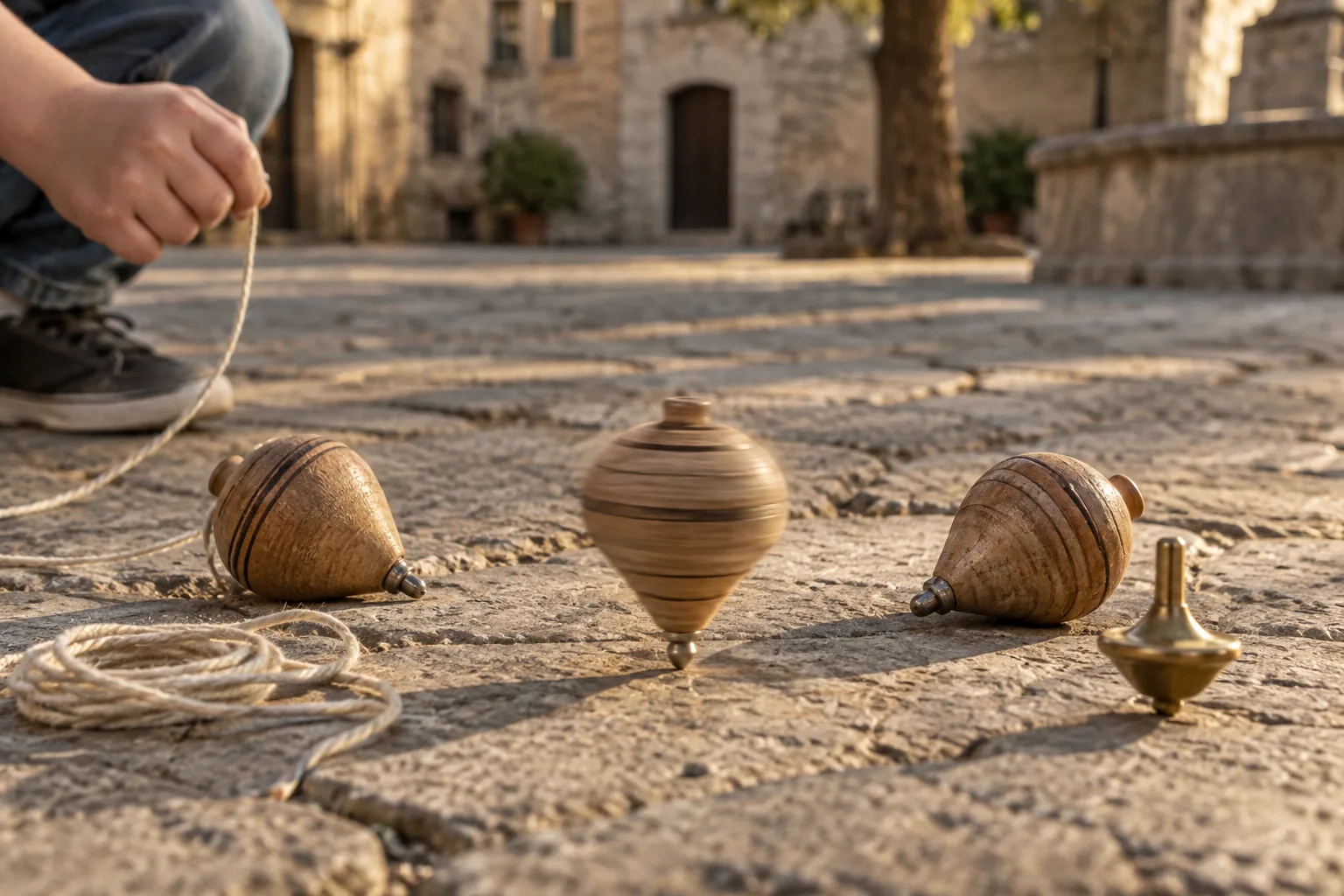
Spinning top guide: physics, history, types and tricks
Why a spinning top does not fall over, its 5,000-year history, peg, whip and tippe tops, how to wind and throw one with string, games and world records.
In short
A spinning top (also called a top, a peg top or, in Spanish, a peonza or trompo) is a toy that spins on a point and stays balanced for as long as it keeps turning. Why does a spinning top not fall over? A body that rotates quickly has angular momentum, a kind of ‘inertia of spin’ that resists any change in the direction of its axis. Gravity tries to topple it, but instead of falling, the axis slowly drifts round in a circle: this is precession. As the spin slows down, that wobble grows wider and the top ends up on the floor.
- Age: there are clay tops around 5,000 years old from Iraq and wooden tops from Egypt that are almost 4,000 years old.
- Main types: string tops, whip tops, finger tops, gambling tops with lettered sides (such as the dreidel and the teetotum), precision tops and the tippe top, which turns itself upside down.
- To spin it: wind the string from the point upwards, nice and tight, and throw the top, pulling the string back at the very last moment.
- Guinness World Record: 7 hours, 1 minute and 14 seconds keeping a top in motion (New York, 2006).
The spinning top is probably the toy with the longest history of any that is still sold today. It has turned up in Egyptian tombs, in the verses of Virgil, in eighteenth-century paintings and in school playgrounds across half the world, and every region has given it its own name and its own rules. In this guide we explain what keeps it upright (with real physics, but without formulas), what it is called in different places, where it comes from, which types exist, what it is made of, how to throw it and catch it, which games are played with it and which records can be documented.
What is a spinning top and why doesn't it fall over?
A spinning top is a body with rotational symmetry (round when seen from above) that rests on a single point. When it is still, it falls over straight away: its centre of gravity sits above the point and the slightest tilt tips it over. When it spins fast, on the other hand, it stays upright for half a minute, several minutes or even longer, depending on its shape and on how hard it was thrown. The difference lies in the spin, and understanding it is easier than it looks.
The gyroscopic effect, explained in plain words
Every object that turns around an axis has what physicists call angular momentum. It is a quantity with a size (how fast it turns and how much mass is turning) and a direction (that of the axis). A basic law of mechanics says that angular momentum does not change unless something pushes on it, and that when something does push on it, it changes in the direction of the push, not in the direction you would expect at first sight.
It is the same principle that keeps a gyroscope steady. The faster the top turns and the more mass it carries far from the axis, the greater its angular momentum and the harder it is for any force to change the orientation of the axis. That is why makers of long-spinning tops put the weight at the rim, as in a flywheel.
Precession: why the axis traces circles
No top ever spins perfectly upright. As soon as its axis leans a little, gravity, which pulls the centre of gravity downwards, creates a torque around the point: it tries to knock the top over. If the top were not spinning, it would fall to that side. Because it is spinning, that torque does not topple it; what it does instead is push the axis sideways, and the axis begins to turn slowly around the vertical, tracing out a cone. This movement is called precession.
One detail explains everything you see on the floor: the speed of precession is inversely proportional to the speed of spin. A freshly thrown top precesses so slowly that it seems not to move at all. As it loses speed, the axis circles faster and faster and the circle widens, until the cone is so open that the rim touches the ground.
On top of precession there is sometimes a small, quick nodding of the axis, an up-and-down movement called nutation. You notice it after a crooked throw or a knock.
When the top ‘sleeps’
A well-thrown top usually lands slightly tilted, wobbles for a few seconds and then straightens itself up until it stands vertical and almost motionless. In English the top is then said to be sleeping, and in much of Spain and Latin America people say the same thing: the top ‘duerme’, it sleeps. The straightening comes from the friction between the point and the floor: if the point is slightly rounded, it slides and pushes the axis towards the vertical. This is the steadiest and longest phase of the spin.
The phenomenon already caught people's attention in antiquity. In the Republic, Plato uses the spinning top as an example of something that is at rest (its axis does not move) and in motion (everything else turns) at the same time. It is one of the oldest written references to the toy.
Why it falls over in the end
Friction at the point and air resistance steal speed from the top, and with less spin the precession speeds up and the cone opens out. There comes a moment when the rim touches the ground, the top rolls on it for a few turns and then stops. Curiously, less friction does not always mean a longer spin: a point that barely grips takes longer to straighten up, and the top may spend more of its time wobbling. Every combination of weight, shape and point has its own ideal amount of friction.
What the spinning top is called around the world
Few words change as much from one region to the next. English has top, spinning top, peg top and whip top. Within Spain alone you will hear peonza, trompo, peón and, in the co-official languages, baldufa, buxaina or ziba, while in Latin America the most widespread name is trompo. There are also two Spanish words that look very much alike and are easily confused: perinola and pirinola.
| Language or area | Name | Notes |
|---|---|---|
| English | Spinning top, top | Peg top (with a metal point), whip top (driven with a whip) |
| Spanish (central and northern Spain) | Peonza | The most common name in Spain; peón in many areas |
| Spanish (Andalusia, Canary Islands, Latin America) | Trompo, peón | Trompo is the general name in almost all of Spanish-speaking America |
| Catalan | Baldufa | Also in Valencia and the Balearic Islands |
| Aragonese | Galdrufa | Related to baldufa |
| Galician | Buxaina, pión | Buxaina recalls buxo, box, a classic wood for tops |
| Basque | Ziba, zibota | The forms given in the standard dictionaries |
| Mexico | Trompo; pirinola | The pirinola is the six-sided gambling top (‘toma todo’, take all) |
| Venezuela | Trompo; perinola | There the perinola is a different toy: a stick with a piece attached by a cord, a relative of the cup-and-ball |
| French | Toupie | Sabot is the whip top |
| German | Kreisel | Peitschenkreisel is the whip top |
| Italian | Trottola | In Latin it was called turbo |
| Portuguese | Pião | Piorra or pitorra, and carrapeta in Brazil, for small types |
| Japanese | Koma (独楽) | Beigoma is the small metal top used for battles |
| Hebrew / Yiddish | Sevivon / dreidel | The four-sided top of Hanukkah |
History of spinning tops
Nobody invented the spinning top in one particular place. It appears in places that had no contact with each other (Mesopotamia, Egypt, China, Polynesia, pre-Columbian America), which suggests it is one of those ideas that occur to anyone playing with a seed, a stone or a piece of wood.
The oldest tops: Mesopotamia, Egypt and China
The oldest examples museums usually mention are clay tops around 5,000 years old found in present-day Iraq, ancient Mesopotamia. In Egypt, the archaeologist Flinders Petrie excavated several wooden tops at the end of the nineteenth century; one of them, now in the Pitt Rivers Museum in Oxford, is a whip top almost 4,000 years old, and the University of Pennsylvania Museum holds another from Kahun. In China, whip tops around 3,000 years old are known, and people there have gone on whipping tops across ice and smooth ground to this day.
Clay tops have also been found in the excavations at Troy, and from Roman Egypt (between the first century BC and the fourth century AD) there are wooden tops with iron points, barely 5 centimetres tall, from sites such as Karanis, Oxyrhynchus and Tebtunis.
Greece and Rome
The Greeks had at least two words for the top: bembix, which seems to refer to the whip top, and strobilos, a top that hummed and was thrown with a string. Aristophanes mentions it in The Birds, and Plato in the Republic.
The Romans called it turbo. The best-known example is in Book VII of the Aeneid: Virgil compares the maddened Queen Amata to a top that some boys keep spinning with their whips in an empty courtyard. That the poet chose this image shows that any Roman reader would have seen it for themselves.
Whip tops and peg tops in Europe
In medieval Europe the spinning top was a common toy by around the twelfth century. For centuries the whip top dominated: it was set on the ground, given a first push by hand or with the lash of the whip wound round it, and then kept going with blows. The peg top thrown with a string, the one most people now picture when they hear the word top, became widespread later, and in early twentieth-century England children threw it against the pavement with a sharp tug on the string.
Painting and engraving left plenty of traces. Claudine Bouzonnet-Stella included it in her 1657 engravings of children's games, and around 1735 Jean Siméon Chardin painted a boy absorbed in watching a small finger top spin on a table.
Japan: koma, beigoma and kenka-goma
In Japan the spinning top is called koma, and its tradition is so rich that it deserves a chapter of its own. It arrived from China some twelve hundred years ago, and at the Heian court in Kyoto people were already playing with tops thrown with a string. Over time it became a children's game and a New Year custom, and even today many Japanese nurseries and schools hand out wooden tops before the holidays and hold tournaments.
There are tops that hum, tops that release smaller tops as they spin, and display tops that performers send running along the edge of a sword or a taut wire.
The best known outside Japan is the beigoma. Its name comes from baigoma, ‘shell top’: the first ones were made from the shells of a sea snail called bai, filled with sand and sealed with wax, and they were already known in the Edo period (seventeenth century). Later they were made of lead and then of cast iron. A beigoma is about 3 centimetres across, has no handle, is usually octagonal and carries designs in relief. It is thrown with a thin string about 60 centimetres long onto a canvas stretched over a bucket, the toko, and all the players throw at the same time. The winner is the top that keeps spinning longest or the one that knocks the others off the canvas. It was a hugely popular street game in twentieth-century Japan until post-war toys pushed it aside.
Wooden tops designed for fighting are known generically as kenka-goma, ‘fighting tops’. They usually have a sharp iron point and some have a metal ring around the rim, which adds weight where it helps most to keep the spin going and is used to strike the opponent. The ones from Sasebo, in Nagasaki, are among the most widely used in traditional tournaments.
The Americas
Before the Europeans arrived, various peoples of the Americas were already playing with tops. The string-and-peg top seen today in Mexico, Chile, Colombia and the Caribbean spread in colonial times from the Spanish model, and in some countries it is still tied to particular dates: in Chile it is one of the typical games of the Fiestas Patrias, the national holidays in September. There the classic trompo was made of hard wood, often orange wood, with a small knob on top and an iron point underneath.
From the laboratory to anime
In 1891 a German woman, Helene Sperl, registered a patent for a top that turned itself over, the forerunner of the tippe top we describe further down. During the twentieth century tin plunger tops, which you wind up by pumping a spiral rod, filled the toy shops, and in the late 1990s Japan produced the Beyblade, a battle top with interchangeable parts whose name pays tribute to the beigoma. In 2022 the spinning top entered the National Toy Hall of Fame in the United States as number 77 on its list.
| Period | What we know |
|---|---|
| About 5,000 years ago | Clay tops in Mesopotamia (present-day Iraq) |
| About 4,000 years ago | Wooden whip tops in Egypt (excavated by Petrie) |
| About 3,000 years ago | Whip tops in China |
| 5th-4th centuries BC | Aristophanes and Plato mention the spinning top |
| 1st century BC | Virgil uses it as an image in the Aeneid |
| 12th century | A common toy in Europe |
| 17th century | The beigoma is already known in Edo-period Japan |
| Around 1735 | Chardin paints a boy with a spinning top |
| 1891 | Helene Sperl patents the self-inverting top in Germany |
| 2000 | First world championship for spinning tops (World Spintop Contest) |
| 2022 | Enters the National Toy Hall of Fame |
Types of spinning top
What sets one type apart from another is mainly how it is set going: with a string, with a whip, with the fingers or with a mechanism. On top of these come the lettered tops, used for drawing lots, and precision tops, which aim to spin for as long as possible.
String top
The classic top of Spain and Latin America: a pear-shaped body, a head on top and a metal point underneath. A string is wound round the body and the top is thrown at the ground with a sharp pull.
- Hard wood
- Iron or steel point
- String of 30 to 60 cm
More detail
It is the most versatile: you can throw it overarm or underarm, catch it in your hand, do string tricks with it and play the games where you strike your opponent's top. A typical one is around 6 centimetres tall. Tops for traditional games have a sharp iron point; modern trick tops usually have rounded points or a bearing.
Whip top
It has no string of its own: you set it spinning and keep it going by whipping it. It is usually wider and lower, sometimes shaped like a truncated cone.
- The oldest on record
- Sabot in French
- Played on ice in China
More detail
To start it, you wind the lash of the whip round the upper part, hold the top with your other hand and pull the whip back sharply to release it spinning. After that you strike it from the side, always in the direction of spin. In Europe whips were made of leather or even eel skin, and in Germany the Peitschenkreisel was made of oak or box.
Finger top
Small, with a stem on top. You spin it by twisting the stem between your thumb and forefinger, or between your palms if the stem is long.
- No string
- Perinola in Spain
- Piasca in Portugal
More detail
Short-stemmed tops spin for less time but can be flicked some distance; long-stemmed ones, driven with both palms, last longer. The metal precision tops described further down also belong to this family.
Metal-pointed top
In English, the peg top: the name comes from the metal point, a small peg on which it spins. It is the classic playground top.
- Rejón or point
- For striking and splitting
- Traditional in Spain
Perinola, teetotum and dreidel
4-8sidesTops with flat sides marked with letters or phrases. They are not meant to spin for long, but to land on a random side, like a die. They are used to gamble for counters.
- European teetotum
- Hanukkah dreidel
- ‘Take all’ pirinola
More detail
The old European model, the teetotum, had four sides with Latin letters: A (aufer, take one), D (depone, put in), N (nihil, nothing) and T (totum, all). That is where its name comes from. In Germany it was called a trendel, and the Jewish dreidel descends from it; the six-sided Latin American pirinola belongs to the same family. Further down we explain how to play with each of them.
Precision spinning top
Small finger tops machined from metal (brass, copper, steel, titanium, tungsten), with a ceramic, ruby or tungsten carbide tip. They are collectors' pieces.
- Over 10 minutes of spin
- Weight at the rim
- Concave base
More detail
They apply the physics of long spins to the letter: plenty of mass far from the axis (sometimes a ring of tungsten, which is very dense), a low centre of gravity and an extremely hard, fine tip that barely rubs. At around 2.5 centimetres across, the best ones spin for more than ten minutes from a single flick of the fingers on a smooth concave dish. The figures depend a great deal on the surface, and carbide tips can scratch glass.
Tippe top
A truncated ball with a short stem. You spin it with the stem pointing up and, after a few seconds, it turns itself over and carries on spinning on the stem.
- Patented in 1891
- Inverting top
- A physicist's toy
Battle tops and Beyblade
Tops designed to crash into each other in an enclosed arena. The winner is the one that keeps spinning or the one that knocks the other out of the ring.
- Heirs of the beigoma
- Mechanical launcher
- Interchangeable parts
More detail
Beyblade, born in Japan in the late 1990s with its own animated series, turned top battles into a worldwide phenomenon. They are launched with a rack-and-pinion mechanism instead of a string, and assembled from parts that change how they behave (attack, defence, stamina or a balance between them). Their success brought attention back to traditional tops in Japan.
Tippe top physics: why does a tippe top flip?
The tippe top seems to defy common sense. It is spun resting on its rounded part, which is the low, stable position, and within a few seconds it leans over, rises up and ends up spinning on its stem, with its centre of gravity higher than at the start. For it to rise, something has to give it energy, and that something is its own spin.
- The centre of gravity is not at the centre of the ball. It sits slightly lower, towards the rounded part. When the top leans a little, the point of contact is no longer directly below the axis of spin.
- The point of contact slides. Because it is off the axis, that point drags round in circles on the table as the top spins.
- Friction does the work. That sliding friction creates a torque that tilts the axis further and further. Friction takes energy from the spin and turns part of it into height: the centre of gravity rises. The total energy does not increase; some of the spin is lost along the way.
- The flip. If the initial spin is strong enough, the tilt continues until the stem touches the table and lifts the body. Seen from above, it keeps turning in the same direction. Since the body has turned upside down, the spin has reversed relative to the top itself.
Without friction there is no flip: on a very slippery surface the tippe top takes much longer to turn over, or never does. Niels Bohr and Wolfgang Pauli knew this well; there is a famous photograph of the two Nobel physics laureates bent over a tippe top at the opening of the physics institute in Lund, Sweden, in the early 1950s (sources disagree on the exact year). The full explanation filled research papers for decades.
Parts and materials of a spinning top
A traditional string top has four parts: the body, the head, the point and the string. Each one affects how it spins and how it is thrown.
| Part | Other names | What it does |
|---|---|---|
| Body | Belly, crown | Holds the mass and the spin; the string is wound round it, often over a set of grooves |
| Head | Button, knob, stem | The finish at the top; it holds the loop of the string at the start and is used to spin the top with the fingers |
| Point | Peg, spike, rejón or pulla (Dominican Republic) | The only point of contact; its shape decides whether the top spins on the spot or travels |
| String | Cord, lace, lienza or soguilla (Chile) | Transfers the push from the arm to the body |
The body: hard woods and some plastic
A traditional top is made from hard, dense woods, which are heavy, withstand knocks and can be turned precisely on a lathe. In Spain and Portugal holm oak and box have been widely used, and also beech, which is easier to obtain and to turn; in England, girls' small tops were often made of box and painted red and blue. In Chile orange wood was the classic choice, and in the Dominican Republic sources mention lignum vitae (guayacán), mahogany and oak. In Germany, whip tops were made of oak or box.
Plastic tops, which are cheaper and lighter, spin well but usually stay up for less time and stand up to knocks less well.
The point or peg
This is the part that changes the top's behaviour the most. Traditionally it is an iron or steel nail driven into the wood; on home-made tops, quite literally a nail. Sources from several countries agree on two families:
- Sharp point: it digs slightly into earth or rough tarmac and the top spins on the spot. It is the right one for striking games and for throwing hard.
- Rounded point: it slides more, straightens up sooner, glides smoothly across the floor and is far more comfortable on the palm of the hand. It is the favourite for tricks.
The string: material, thickness and length
Traditional strings are made of cotton or plant fibres such as hemp: they grip the wood well and do not slip when you wind them. The thickness should let the turns sit close and tight; a string that is too thin cuts into your fingers when you pull, and one that is too thick fills the whole body in just a few turns.
The length varies a lot: for Spanish, Italian or Portuguese string tops the figure given is 30 to 50 centimetres; beigoma strings are around 60, and those for the large English peg tops of the early twentieth century reached 90 (about three feet). The practical rule is that it should cover the body from the point to the widest part and leave a good length free. At the hand end you usually tie a thick knot or attach a washer or a button so it does not slip away.
Shape and centre of gravity
Three principles explain why some tops spin longer than others:
- Mass far from the axis. The more weight there is at the rim, the greater the angular momentum at the same speed. That is why long-spinning tops are wide and fighting tops carry metal rings.
- Low centre of gravity. The closer the centre of gravity is to the point, the smaller the torque trying to topple the top and the more slowly it precesses. The limit is that the rim must not touch the ground when it leans.
- Small contact. A fine, hard point on a smooth surface loses little energy to friction.
Above all comes balance: if the centre of gravity does not fall exactly on the axis, the top vibrates, wobbles and stops sooner. It is what separates a carefully turned top from a badly made one, and you cannot see it with the naked eye.
How to spin a top with string, step by step
Throwing a string top takes a little practice at first and then becomes second nature. What goes wrong most often in the first attempts is the winding.
How to wind a spinning top
- Make the loop. At the end of the string that goes on the top, tie a small knot or a slip loop. Put it round the head and pull it tight, or simply hold it against the head with your thumb for the first few turns.
- Go down to the point. Take the string down the side of the body to the point and wrap one turn round the base of the peg, just above the metal. This first turn is the one that ‘hooks’ the top.
- Spiral upwards. From the point, wind upwards with the turns packed close together, leaving no gaps and pulling the string so it stays taut. If the top has grooves, follow them.
- Stop at the widest part. Stop winding when you reach the widest part of the body, or a little before. Whatever is left over is free string.
- Secure the end. Wrap the end round your little finger or ring finger, or pinch the knot between two fingers, so you do not let go of the string when you throw.
The overarm throw
This is the most classic throw and the one that gives the most power. Hold the wound top with the point upwards, between your thumb and your index and middle fingers, with the string coming out towards you. Bring your arm up and back, to head height, and throw the top forwards and downwards, as if you were throwing a ball at the ground a metre in front of your feet. Just before letting go, pull the string back with a sharp flick of the wrist. The top turns over in the air, lands on its point and spins away.
The underarm throw
Gentler and more controlled, this is the throw many players use for tricks and for starting out. Hold the top with the point downwards and the string coming out over the top of your hand. Crouch a little, swing your arm forwards at hip height, as if bowling a boule in pétanque, and release it close to the ground, pulling the string back. It lands softly, hardly bounces and straightens up straight away. It is the best one to learn first.
There is also a sidearm throw, with the arm out to the side and a backhand movement, which is the usual one with the beigoma: the top flies out almost horizontally and skims onto the canvas.
Catching it in your hand
This is the first trick almost everyone learns, and the one that impresses most the first time. It works best with a rounded point and with the top already ‘sleeping’.
- Wait until the top is steady and upright.
- Hold your hand palm up and flat, with your index and middle fingers slightly apart, and bring it down to the floor just in front of the top.
- Slide your hand underneath decisively, so that the point rides up onto your palm, or between the two parted fingers.
- Lift your hand slowly and keep it level. The top will carry on spinning on your palm and tickle it.
| What happens | Likely cause | Fix |
|---|---|---|
| It won't spin: it falls on its side without turning | String too loose or badly hooked at the point; no final pull | Wind more tightly, starting with a turn round the base of the peg, and pull the string back as you let go |
| It spins briefly and falls straight away | Too few turns of string, or a throw without enough wrist | Wind up to the widest part and put the effort into the flick of the wrist |
| It wobbles a lot and doesn't straighten up | Crooked throw, bent point or poorly balanced top | Throw with the axis more upright; check that the peg is straight and centred |
| It flies off or bounces | Hitting the ground too hard or at too steep an angle | Release the top closer to the ground or try the underarm throw |
| It keeps travelling across the floor | Rounded or worn point on a smooth surface | This is normal with a rounded point; to make it spin on the spot, use firm earth or a sharper peg |
| The string slips out of your hand | No knot or nothing to hold the end | Tie a thick knot or attach a washer or button and wrap it round a finger |
Traditional spinning top games
The spinning top lends itself to games of skill, of aim and of chance. The names change almost from village to village, so we describe the games by what you do in them and add the names used in some places. The exact rules were agreed before starting.
The ring: knocking objects out
A circle is drawn on the ground and coins, bottle caps, buttons or other stakes are placed inside it. Each player throws their top into the circle and tries to knock objects out with it. Whatever you knock out, you keep.
- Troya in Chile
- Aim
- From 2 to many players
More detail
In some versions the top must spin its own way out of the circle; in others it is picked up in the hand and dropped onto the coin.
Splitting or spiking the opponent's top
The player who loses a round leaves their top in the circle, and the others try to hit it with the point of their own as they throw. The aim is to knock it out of the circle, split it or leave marks on it.
- Quiño or picotón in Chile
- Parte-piões in Portugal
- Sharp-pointed tops
More detail
This game is the reason playground tops had such sharp points. In some versions, whoever knocks the top out of the circle keeps it; in others, whoever misses puts their own top in the middle. In the Dominican Republic people remember a version in which the top that failed to roll out stayed inside as a target for the others.
Last top spinning
Everyone throws at the same time and the winner is the top that is still spinning at the end. It is the basis of Japanese beigoma and of Beyblade battles.
- The simplest game
- Useful for deciding turns
More detail
In Japan, beigoma players throw together while saying a set phrase, ‘chitchi no chi’, so that nobody goes early.
Dreidel and perinola
Gambling games with lettered tops, played sitting down with counters, nuts or sweets. Everyone spins in turn and does what the top face says.
- Hanukkah
- Take all
- Pure chance
How to play dreidel
The dreidel or sevivon is the four-sided top that Jewish families play with during Hanukkah. Each side carries a Hebrew letter, and each letter stands for a Yiddish word that tells you what to do:
| Letter | Yiddish word | What the player does |
|---|---|---|
| נ Nun | nisht, nothing | Neither wins nor loses |
| ג Gimel | gants, everything | Takes the whole pot |
| ה Hei | halb, half | Takes half the pot (rounding up if the number is odd) |
| ש Shin | shtel, put in | Puts one counter into the pot |
Each player starts with the same number of counters, usually between 10 and 15, and everyone puts one into the pot at the beginning and each time the pot is emptied or down to a single counter. Whoever runs out of counters is out. The four letters are also read as the initials of the Hebrew phrase ‘a great miracle happened there’, referring to the Hanukkah story; in Israel the last letter is replaced by a pe to say ‘here’.
How to play pirinola or ‘toma todo’
The Latin American pirinola has six sides. The most common inscriptions are ‘take one’, ‘take two’, ‘take all’, ‘put in one’, ‘put in two’ and ‘everyone puts in’. Each player puts a counter into the pot; then, in turn, each one spins the pirinola and does what the top face says. When someone takes everything, the pot is built up again as at the start. The exact inscriptions vary by country and by maker, so the usual thing is to follow those on the pirinola you have in your hand.
Classic spinning top tricks
These tricks turn up, under different names, in Spain, Portugal, Italy, Mexico and Japan. They are listed in the order in which they are usually learnt:
- Spinning on the hand. Picking the top up off the floor onto your palm and keeping it spinning. It is the basic proof that you have mastered the throw.
- Throwing to the hand. Throwing and, without the top touching the floor, pulling the string so that it jumps straight onto your palm.
- Moving it to a nail or a finger. From the palm, getting the top to climb onto your thumbnail or a fingertip and keep spinning there.
- The bridge or cable car. Stretching the string between your two hands, lifting the top onto it and making it run from one end to the other.
- Catching it in the air. Throwing and, before the string has fully unwound, catching the top back in your hand.
Competition tricks build on these and link them together without the top ever stopping, much as with kendama tricks.
Competitions and world records
The World Spintop Contest
There is a world championship for string tops, the World Spintop Contest, held every year since 2000. It is run by the International Top Spinners Association (ITSA), a players' association that started informally in the United States in 1990 and in 2015 became a non-profit organisation and took over the running of the championship from the International Yo-Yo Federation. More than a dozen countries are represented on its international board, among them Spain, Japan, France, Colombia and the United States.
The main event is freestyle: each player goes on stage and links tricks together to music for a set time, and a panel of judges scores the routine. The championship has been held in Orlando, Prague, Tokyo, Reykjavik, Shanghai and Cleveland, among other places, took place online during the pandemic and in 2024 was held in Majorca. Several Spanish-speaking players have been world champions, and in the 2020 edition the open category was won by a Spaniard.
Spinning top world records
Guinness keeps several records related to spinning tops. The ones below are those listed on its official record pages; the figures may change if someone beats them.
| Record | Mark | Who, where and when |
|---|---|---|
| Longest time keeping a top in motion | 7 h 1 min 14 s | Ashrita Furman, Brooklyn (New York), 18 November 2006, with a Korean wooden top |
| Longest time spinning a top unassisted | 1 h 37 min 42 s | Inosuke Mori, Kagawa (Japan), 24 October 1999 |
| Most tops spinning at once (one person) | 27 | Mark Hayward, New York, 17 March 2012 |
| Most people spinning tops at the same time | 891 | City of Kitanagoya (Japan), 5 November 2016 |
| Most people playing with whip tops at the same time | 1,946 | Jingyu County, Jilin (China), 20 January 2024 |
| Longest-spinning mechanical (motorised) top | 27 h 9 min 24 s | Battery-powered prototype, Tel Aviv (Israel), June 2018 |
Guinness keeps the general record separate from the ‘unassisted’ category, which suggests that the first allows the top to be pushed again (its record page does not say how). The 1999 mark is that of a top spinning on its own from a single push. Outside Guinness, in traditional competitions in the Torres Strait Islands, in Australia, tops have been recorded spinning for almost 30 minutes.
How to choose a spinning top
| What for | What to look for | What to avoid |
|---|---|---|
| Young children | Finger top or plunger top, with no metal point | Sharp points and long strings without supervision |
| Learning to throw with string | Medium-sized hard wooden top, well balanced, with a slightly rounded point | Very light plastic tops, which get blown off course by the throw itself |
| Traditional playground games | Hard wood and a sharp iron point that can take knocks | Tops with sentimental or collector's value |
| Tricks and freestyle | Rounded point or bearing, body with good grip for the string | Sharp points, which hurt your palm |
| Long spins and desk use | Metal precision top on a concave dish | Glass surfaces with carbide tips |
| Family table game | Dreidel or pirinola with clear inscriptions | Nothing in particular |
When buying a wooden spinning top for string play, check that the peg is straight, centred and firmly set, that there are no cracks or knots in the wood near it and that the string is made of natural fibre. The one that comes with many cheap tops is too thin and is worth replacing.
A spinning top can be learnt in an afternoon and takes years to master, like other skill toys. In our gift guide we go through other ideas from the same family.
How to look after a spinning top
- Keep the top dry. Damp wood swells, the peg works loose and can rust. If it gets wet, dry it with a cloth and leave it at room temperature, away from radiators.
- Check the peg. If it is loose, you can secure it with a little wood glue. If it is bent, the top will always wobble; straightening it at home is difficult and it is often better to replace it.
- Look after the string. A frayed string snaps at the worst possible moment. When it wears out, replace it with a cotton one of the same thickness. Store it wound loosely round the top.
- Protect the wood. A light coat of wood oil or wax from time to time stops it drying out and cracking. Avoid thick varnish where the string is wound, because it makes the string slip.
- Choose the floor. Tiles and parquet suffer under sharp points; use a rubber mat or a board, or play outdoors on firm ground. Precision tops are best kept on their dish.
Frequently asked questions
Why does a spinning top not fall over while it spins?
Because it has angular momentum, which resists any change of direction. Gravity tries to topple it, but what it manages to do is make the axis move round in circles (precession). As the top loses speed, that circle widens and it eventually falls.
What is the difference between a top, a peonza and a trompo?
There is none in the object itself: they are names for the same toy. Peonza is the usual Spanish word in central and northern Spain, and trompo in Andalusia, the Canary Islands and most of Latin America. Peón, baldufa, buxaina and ziba are other regional names.
What is a perinola?
It depends on the country. In Spain it is a small top spun with the fingers; in Mexico, the pirinola is a six-sided gambling top (‘toma todo’, take all), and in Venezuela, perinola is a toy made of a stick and a piece joined by a cord, a relative of the cup-and-ball.
How do you wind a spinning top?
Fix the end of the string at the head, take it down to the point, wrap one turn round the base of the peg and wind upwards in a spiral, with the turns close and tight, up to the widest part. The other end is secured round a finger.
Why won't my spinning top spin?
Almost always because the string was wound too loosely or the final pull on the string is missing. Wind more tightly, starting from the point, and as you let go pull the string back with a sharp flick of the wrist. If it wobbles a lot, check that the peg is straight.
What is the spinning top world record?
The overall Guinness World Record is 7 hours, 1 minute and 14 seconds (New York, 2006). In the category of a top spinning unassisted, without being pushed again, the mark is 1 hour, 37 minutes and 42 seconds (Japan, 1999).
Why does a tippe top flip over?
Because its centre of gravity is below the centre of the ball and the point of contact slides as it spins. The friction at that point gradually tilts the axis until the top rests on its stem and lifts its body, using up part of its spin to raise the centre of gravity.
At The Joker House we do not sell spinning tops, but we do have other skill toys that are learnt with the same patience, such as the kendama, Rubik's cubes and brain teasers. You can find them in our skill games section.
Would you like more guides like this one? Sign up to our newsletter.
Keep exploring
- Kendama: the complete guide
- Rubik's Cube: the complete guide
- Fingerboard: the complete guide
- Brain teaser gifts by age and difficulty
- Card games for kids
Playing Cards
- New
Buskers Exclusive Edition by Erik Mana
Gemini Casino Phthalo Green – Playing Cards
Premier Edition Restricted Red – Playing Cards
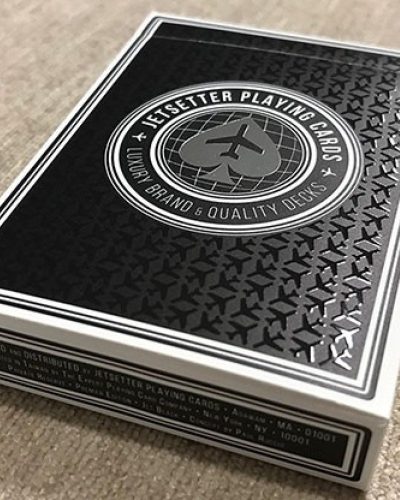
Premier Edition Jet Black Private Reserve – Playing Cards
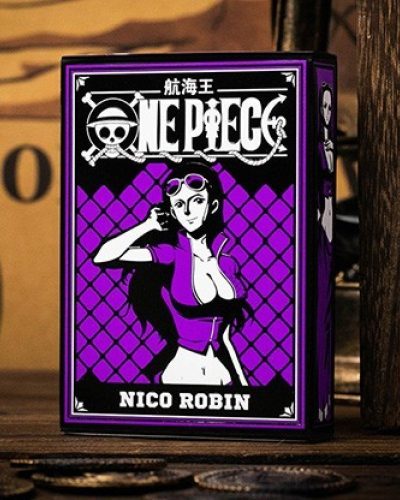
Card Mafia One Piece Robin – Playing Cards
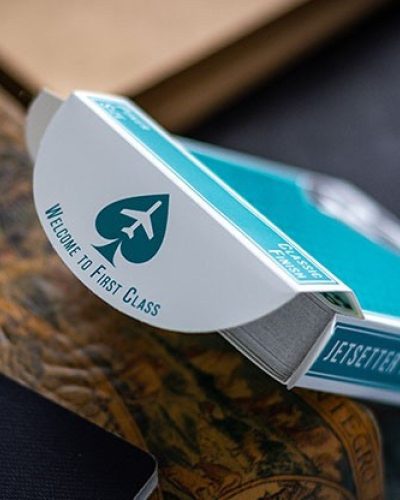
Lounge Edition Terminal Turquoise – Playing Cards
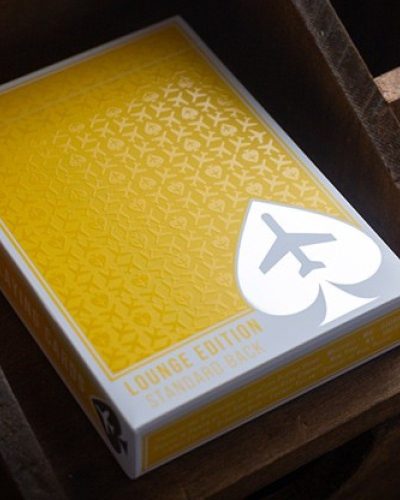
Lounge Edition Taxiway Yellow – Playing Cards
Tally-Ho Gaff – Playing Cards
Contact our team for any clarification about this document. Contact us